
Not all corporate intranet platforms are built the same, and choosing the wrong one costs more than just money. Here is everything you need to know before making the decision.
There is a version of a corporate intranet that everyone recognises. Outdated policies nobody reads. A homepage frozen in time. A search bar that surfaces nothing useful. Employees who quietly stopped checking it months ago.
That version still exists inside a lot of organisations. But it does not have to.
The best corporate intranet platforms in 2026 look and function nothing like that. They are personalised, mobile-ready, and built to serve real workforce needs across desk, remote, and frontline environments. And when they work well, they become the connective tissue of your entire organisation.
This guide breaks down the leading platforms, what makes each one worth considering, and how to figure out which one actually fits your situation.
The Intranet Has Changed. Has Yours?
Ten years ago, the intranet was an IT project. A place to host documents, post announcements, and publish the company phone book. Most employees tolerated it. Few actually used it.
That model broke down for a simple reason: the workforce changed faster than the technology did.
Organisations now manage hybrid teams, large frontline populations, multiple office locations, and employees who may never sit at a desk. The tools that hold those workforces together need to do more than store files. They need to communicate, connect, guide, and engage.
Modern corporate intranet platforms have risen to meet that challenge. The question is whether yours has.
What a Modern Corporate Intranet Actually Does
A modern corporate intranet is not just a website with a login page. At its best, it functions as the operational layer connecting your people to information, tools, and each other.
Good corporate communications depend on having the right infrastructure in place. Here is what the leading intranet platforms cover in 2026:
- Communication and news — targeted company updates, leadership messages, and team announcements delivered to the right people, not everyone at once
- Knowledge and documentation — policies, guides, onboarding materials, and process documents in one searchable, governed location
- People and culture — employee directories, org charts, recognition tools, and community spaces that make the organisation feel connected
- Search and discovery — intelligent search that surfaces relevant content without employees needing to know exactly where to look
- Integrations — connections to Microsoft 365, Google Workspace, HR platforms, and IT systems so the intranet sits at the centre of the digital workplace
- Mobile access — native apps that give frontline and deskless workers access without requiring a desktop or corporate email address
The platforms that do all of this well are the ones worth your time.
What to Decide Before You Speak to a Single Vendor
Most intranet buying mistakes happen before the demo. Organisations enter vendor conversations without a clear picture of their own requirements and end up buying on brand recognition or feature count rather than actual fit.
Just as a strong brand communication strategy requires clarity before execution, so does choosing an intranet. Answer these four questions first and your evaluation will be significantly sharper.
Who is your workforce? A desk-based professional team has very different intranet needs than a retail operation with thousands of frontline staff. The platform that serves one well may be completely wrong for the other.
Who will run it? Some platforms need a technical team behind them. Others are built for internal comms professionals with no coding experience. Knowing which category your team falls into matters enormously.
What already exists in your tech stack? If your organisation runs on Microsoft 365, you are working with a very different starting point than a Google Workspace environment. Integration fit is fundamental, not optional.
What does success look like in twelve months? Adoption rate, content freshness, employee satisfaction, reduction in email volume. Getting specific about outcomes makes it far easier to evaluate whether a platform can get you there.
The Best Corporate Intranet Platforms in 2026
Not all corporate intranet platforms are built the same, and choosing the wrong one costs more than just money. Here is everything you need to know before making the decision.
Unily
Best for: Global enterprises managing multiple regions or brands
Website: unily.com
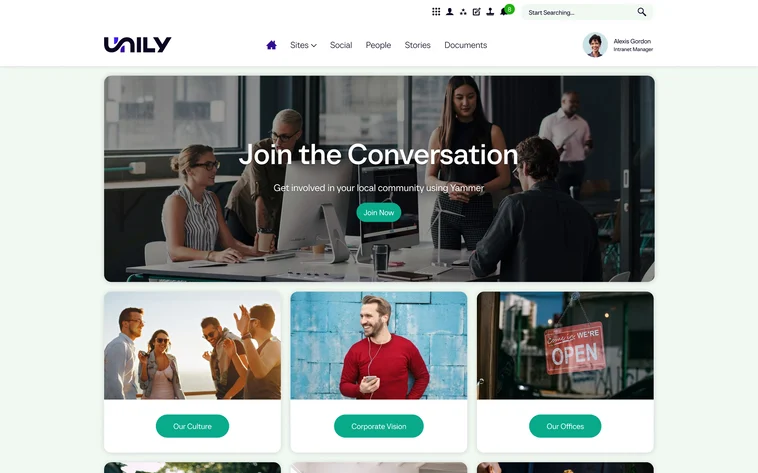
Unily is enterprise intranet software built at genuine scale. Multilingual content, complex information architecture, multi-brand configurations, and advanced governance controls. For large multinational organisations with sophisticated internal communications requirements, Unily is one of the most capable platforms available.
The trade-off is time and resource. Implementation is not fast, and total cost of ownership is on the higher end of the market. Unily performs best when the organisation has a clear intranet strategy in place and dedicated people to execute it.
For enterprises managing multiple brands under one roof, having a platform like Brandy alongside Unily can ensure brand consistency is maintained across every internal and external touchpoint.
Strengths to note: Global scalability, deep customisation, enterprise governance
Oak Engage
Best for: Hybrid and frontline organisations
Website: oakengage.com
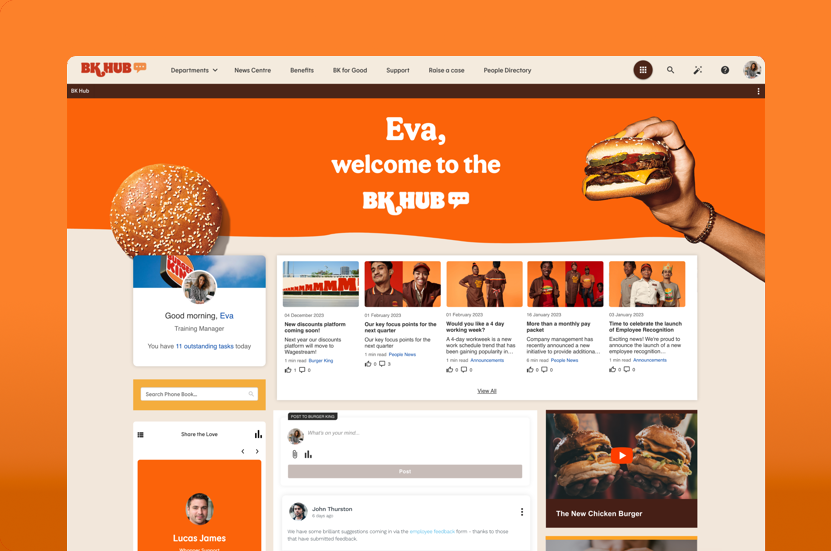
Oak Engage is built around one idea that most intranet platforms still struggle with: the right content should reach the right person without anyone having to search for it.
Its targeting and personalisation engine means employees see information relevant to their role, location, and department rather than a wall of content intended for everyone. For large or distributed organisations, this alone changes the quality of the intranet experience significantly.
What makes Oak stand out further is that governance and administration sit with the communications team, not the IT department. Content approvals, ownership rules, and lifecycle management are all handled within the platform without requiring technical resources for every update or change.
For frontline workers, Oak’s native mobile app removes friction entirely. Employees in retail, logistics, healthcare, or manufacturing can access the intranet from personal devices without a corporate email address or company laptop.
Strengths to note: Personalisation and targeting, frontline mobile access, comms-led governance, Microsoft 365 integration
Microsoft SharePoint
Best for: Microsoft-standardised organisations with strong IT support
Website: microsoft.com/sharepoint
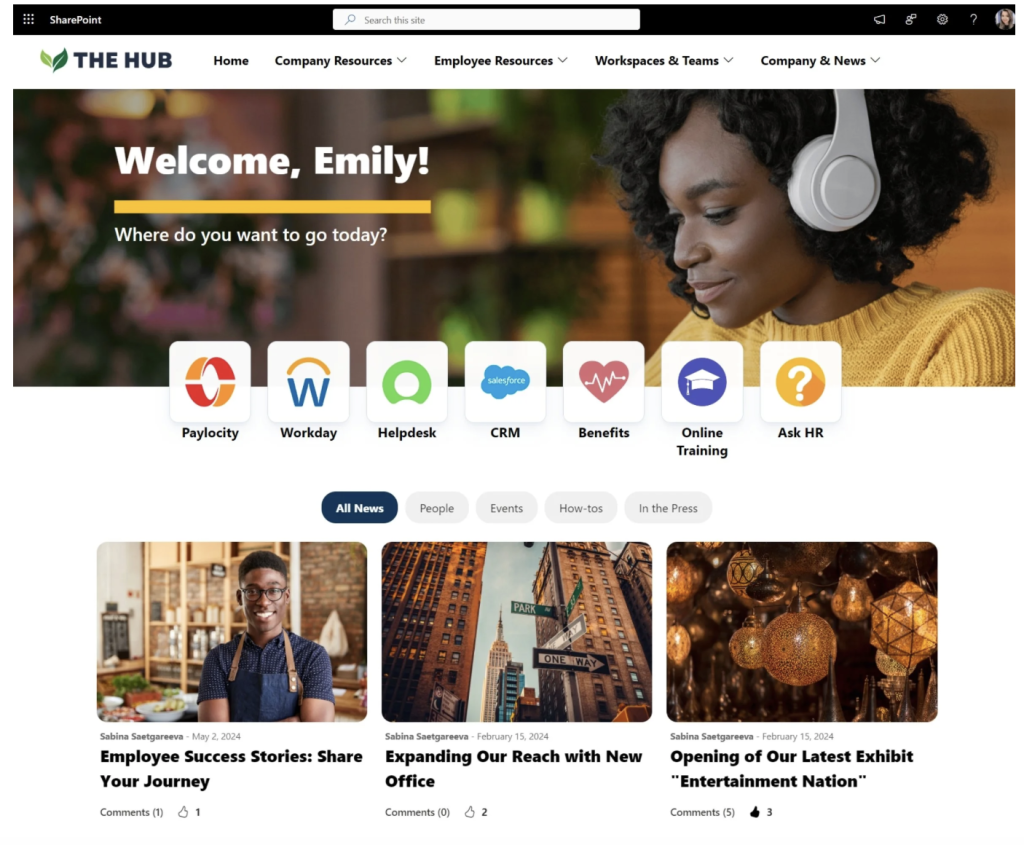
SharePoint is the default starting point for most Microsoft 365 organisations, and for good reason. Its document management, permissions structure, and security controls are enterprise-grade. It connects deeply with Teams, OneDrive, and Outlook. And for many organisations, the licence is already paid for.
The challenge with SharePoint is the gap between what it can do and what most organisations manage to build with it. Creating an engaging, easy-to-navigate intranet typically requires either significant custom development or a third-party product layered on top.
It works best as the content backbone of a broader intranet strategy rather than the whole solution. Pair it with a digital asset management workflow that keeps your brand assets organised and accessible across teams.
Strengths to note: Document control, security architecture, Microsoft ecosystem integration
Jostle
Best for: Smaller organisations that need something working quickly
Website: jostle.me
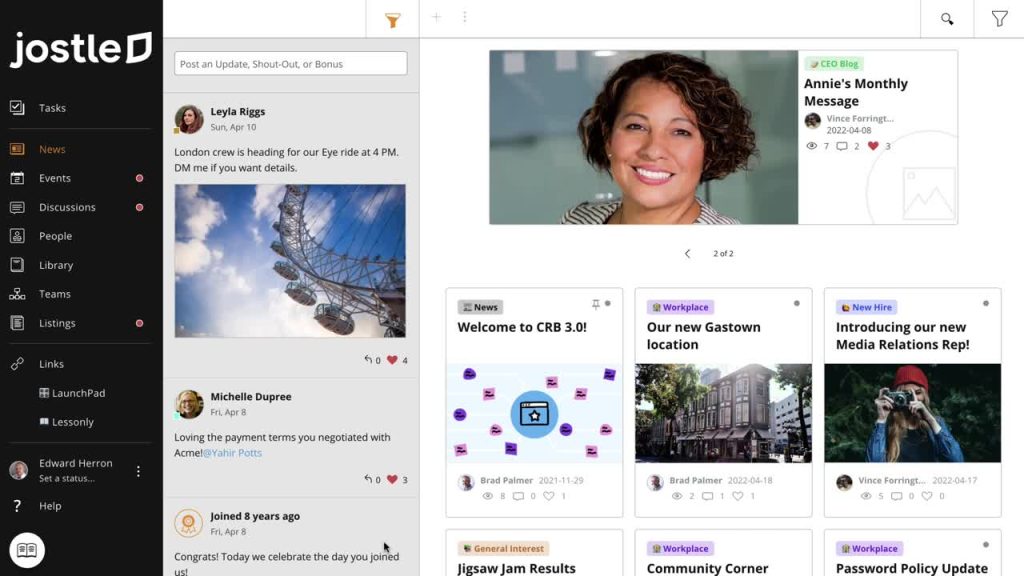
Jostle is deliberately lightweight, people-focused, and fast to deploy. For smaller organisations that need a functional intranet without a six-month implementation and a dedicated project team, it delivers the essentials cleanly.
For enterprises with complex requirements, it will feel limited. But for the right audience, its simplicity is a genuine advantage rather than a compromise.
Strengths to note: Fast deployment, ease of use, people-focused design
Simpplr
Best for: Mid-sized organisations that want simplicity without compromise
Website: simpplr.com
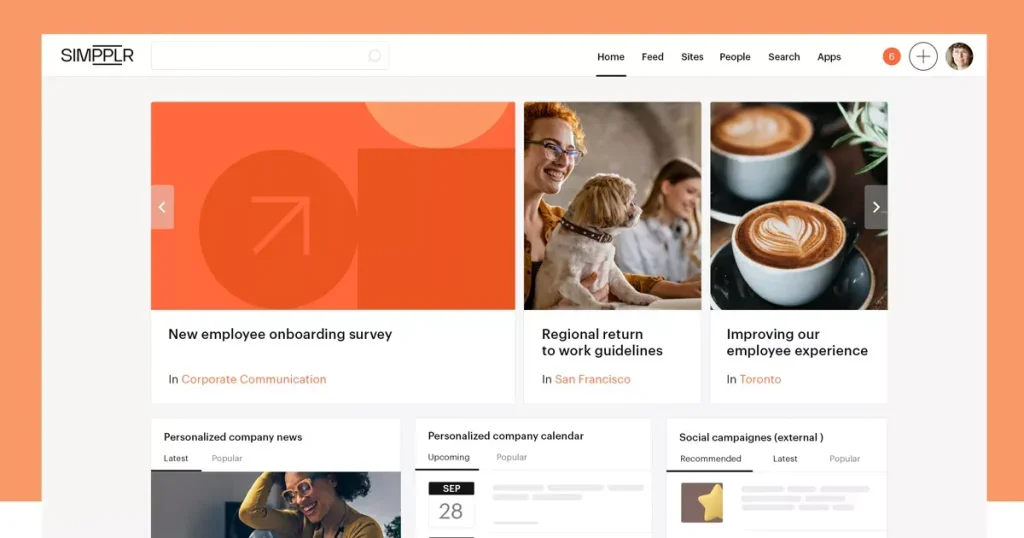
Simpplr has made a deliberate choice to prioritise ease of use over feature depth, and for a large segment of the market, that is exactly the right call. Its interface is clean, its content governance is largely automated, and the administrative burden on comms teams is genuinely low.
Where Simpplr is lighter is in frontline access, advanced personalisation, and the kind of complex governance that larger or more distributed organisations typically need. For mid-sized teams that want a polished intranet without months of setup, it is a strong contender.
Strengths to note: Simple administration, automated content lifecycle, clean user experience
Workvivo
Best for: Organisations where culture and engagement are the primary goal
Website: workvivo.com
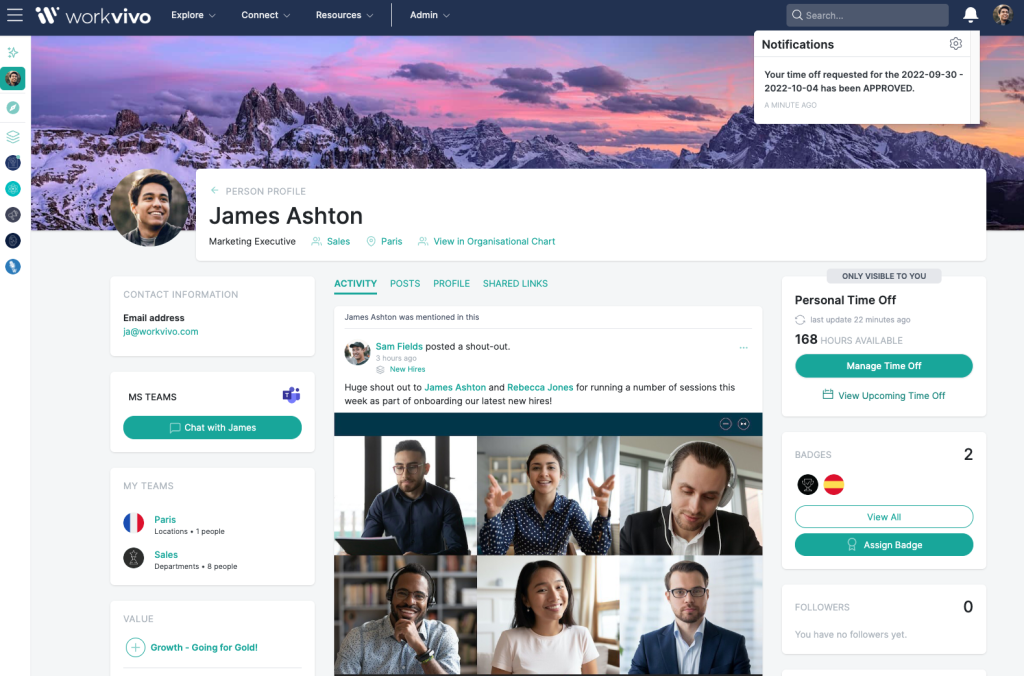
Workvivo takes a social-first approach to the intranet. Its feed-based interface is closer to a consumer social network than a traditional internal platform, which is entirely intentional. Peer recognition, comments, reactions, and community spaces are built into the experience at every level.
For organisations running engagement initiatives or trying to build a stronger sense of culture across distributed teams, Workvivo delivers. As a knowledge management or structured content platform, it is lighter. Many organisations pair it with a more architecture-focused intranet tool to cover both needs.
Strengths to note: Employee engagement, recognition tools, community features, social interaction
Interact

Best for: Regulated industries where compliance is central
Website: interactsoftware.com
Interact has been in the corporate intranet market long enough to earn a strong reputation in sectors where governance is not optional. Healthcare, financial services, local government, and education are all well-represented in its customer base.
Its policy management tools, taxonomy controls, and structured content capabilities are among the strongest available. The user experience is more traditional than newer design-led platforms, but in environments where content accuracy and auditability matter more than visual polish, that is an acceptable trade-off.
Think of it the same way you would approach brand governance: the rules and structures you put in place today are what protect quality and consistency at scale.
Strengths to note: Policy management, compliance controls, powerful search, structured content
Staffbase
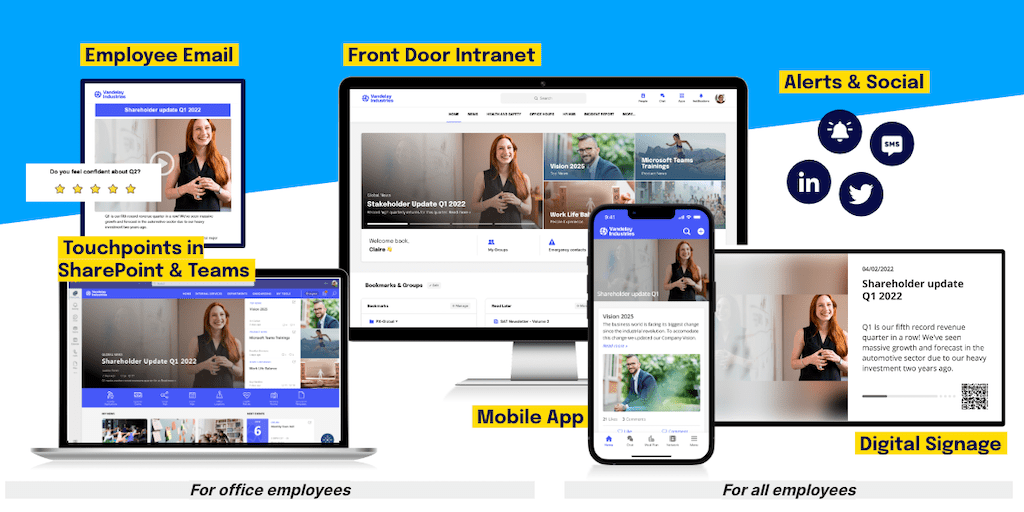
Best for: Large frontline and deskless workforces needing multi-channel reach
Website: staffbase.com
Staffbase approaches the intranet challenge from a distribution angle. Rather than building the most feature-rich platform, it focuses on making sure communication reaches every employee regardless of where they work or what device they use. Intranet, mobile app, internal email, and digital signage all sit within one platform.
For organisations with large frontline populations spread across multiple sites, this breadth of channel coverage is genuinely valuable. It is less focused on deep knowledge architecture, but as a communication reach platform, it is one of the best.
Strengths to note: Multi-channel distribution, mobile reach, frontline communication
Happeo
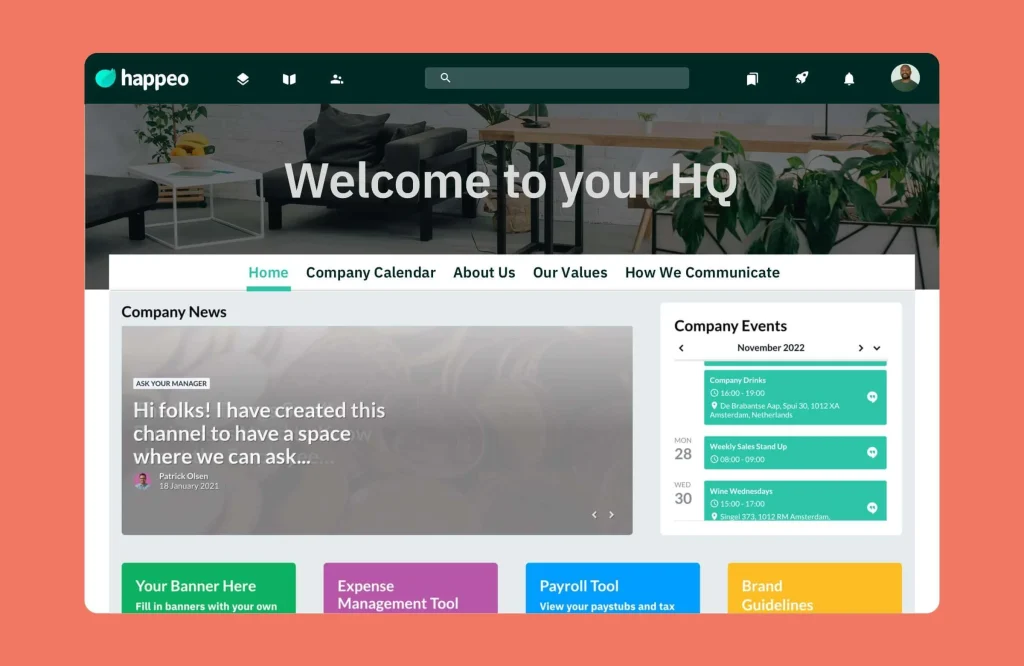
Best for: Knowledge-led organisations running on Google Workspace
Website: happeo.com
Happeo combines intranet functionality with strong knowledge management and search capabilities. It integrates closely with Google Workspace and supports Microsoft environments too, but its natural home is within Google-first organisations looking for a more structured internal hub.
Its governance depth and frontline capabilities are more limited than platforms built specifically for large distributed workforces. But for teams where knowledge discovery and cross-functional collaboration are the priority, Happeo handles both well.
Strengths to note: Intelligent search, knowledge organisation, Google Workspace integration
Matching the Platform to Your Situation
Rather than ranking these platforms against each other, it is more useful to match them to real organisational scenarios.
You have a large frontline workforce and need mobile-first access with strong targeting: Start with Oak Engage. Its combination of personalisation, native mobile access, and comms-led governance is purpose-built for this situation.
You are already deep in the Microsoft ecosystem and have strong IT capability: SharePoint is a reasonable foundation. Consider whether a purpose-built layer on top would meaningfully improve employee experience and adoption.
You are running a global operation across multiple regions and brands: Unily has the architecture for it. Budget the time and resource to do the implementation properly. And make sure your brand assets and guidelines are centralised so every regional team stays on-brand.
You want a clean, manageable intranet without a complex rollout: Simpplr is worth a serious look. It does less than some competitors but does it consistently well.
Employee engagement and culture are the driving force behind your intranet project: Workvivo is the natural starting point, potentially paired with a more structured platform for knowledge management.
You operate in a regulated sector and content accuracy is business-critical: Interact has the governance depth that most newer platforms have not yet matched.
The Internal Comms and Brand Connection Most Organisations Miss
Here is something worth thinking about. Most organisations treat their intranet and their brand management as two completely separate concerns. One sits with IT or comms. The other sits with marketing.
But they serve the same underlying need: making sure the right information reaches the right people in a consistent, trustworthy way.
When your intranet surfaces outdated logos, old messaging, or off-brand templates, it creates the same problem as inconsistent external communications. It erodes confidence. Digital tools that simplify brand management work best when they sit alongside a well-governed intranet, not independently of it.
The organisations that get this right treat their intranet and their brand management platform as complementary infrastructure. One governs internal communication. The other governs the brand assets that flow through it.
Final Thought
The intranet that works is not the one with the most features on a comparison chart. It is the one that employees actually open, trust, and return to. Getting there means choosing a platform built for your workforce rather than the average workforce, and giving your internal team the tools and governance to keep it performing over time.
The platforms in this guide represent the strongest options in 2026. The right one for your organisation is the one that fits where you are today and where you are heading.
Brandy helps organisations centralise their brand assets, style guides, and visual identity in one clean, shareable space. If your intranet surfaces internal content, Brandy makes sure the brand behind that content stays consistent. Get started free.