
Brand milestones are not just moments on a timeline. They reflect how a brand grows, adapts, and earns its place in the market over time. For a CMO, every brand milestone carries strategic weight. It signals progress to leadership, builds trust with customers, and shapes how a company is remembered in the long run. From the day a brand identity is first defined to the moment it expands into new markets, each milestone tells a story of intent, consistency, and evolution.
Yet managing these moments is no longer simple. Today’s brands operate across multiple channels, regions, and partner networks, making every milestone more complex than before. A single misalignment can dilute years of brand equity. This is why CMOs need a clear approach to planning, managing, and measuring brand milestones with precision and confidence. This guide explores what brand milestones truly mean for modern marketing leaders and how to turn them into engines of sustainable growth.
What Are Brand Milestones and Why They Matter to CMOs
Brand milestones are specific moments that signal meaningful progress in a brand’s lifecycle. These moments go beyond routine marketing activities. A brand milestone marks a shift in perception, structure, reach, or maturity. It could be the first public launch of a brand identity, a major rebrand, expansion into a new market, the introduction of a new product line, or the roll out of a unified brand system across teams and regions.
For CMOs, brand milestones serve as strategic checkpoints rather than celebratory highlights alone. They provide clear signals of whether brand investments are translating into market trust, customer recognition, and sustainable growth. Each milestone reflects how well a brand is aligning its promise with real world execution.
Unlike short term campaigns that drive temporary spikes in engagement, brand milestones shape long term brand equity. They influence how customers remember a brand, how partners evaluate its credibility, and how leadership measures marketing impact. A missed milestone can lead to brand confusion, while a well managed milestone can unlock stronger loyalty and market authority.
In today’s fast moving digital ecosystem, the importance of brand milestones has only increased. CMOs are expected to use these moments to prove value, strengthen competitive positioning, and ensure that brand consistency is maintained even as the organization scales.
How Brand Milestones Shape Long Term Brand Value
Brand value is built over time through thousands of consistent interactions, but brand milestones act as defining chapters in that journey. Each milestone reinforces how a brand is perceived, remembered, and trusted in the market. When handled with clarity and consistency, these moments strengthen emotional bonds with customers and create lasting brand recall.
A well executed milestone such as a successful rebrand or a market expansion signals maturity and reliability. It tells customers that the brand is evolving without losing its core promise. Over time, these signals accumulate into brand equity. This equity directly influences buying decisions, brand preference, and long term customer loyalty.
Brand milestones also shape internal brand value. Teams gain confidence when they see their work translate into visible progress. This creates stronger brand ownership across departments, which is critical for maintaining consistency as operations scale.
From a financial perspective, sustained brand milestones influence investor confidence, partnership opportunities, and overall company valuation. Strong brands command higher trust, shorter sales cycles, and greater market resilience during economic uncertainty.
For CMOs, this means brand milestones must be treated as long term brand assets rather than isolated marketing moments. Each milestone either adds to or slowly erodes the cumulative value of the brand depending on how well it is planned, executed, and governed.
Key Brand Milestones Every Growth Stage Company Encounters
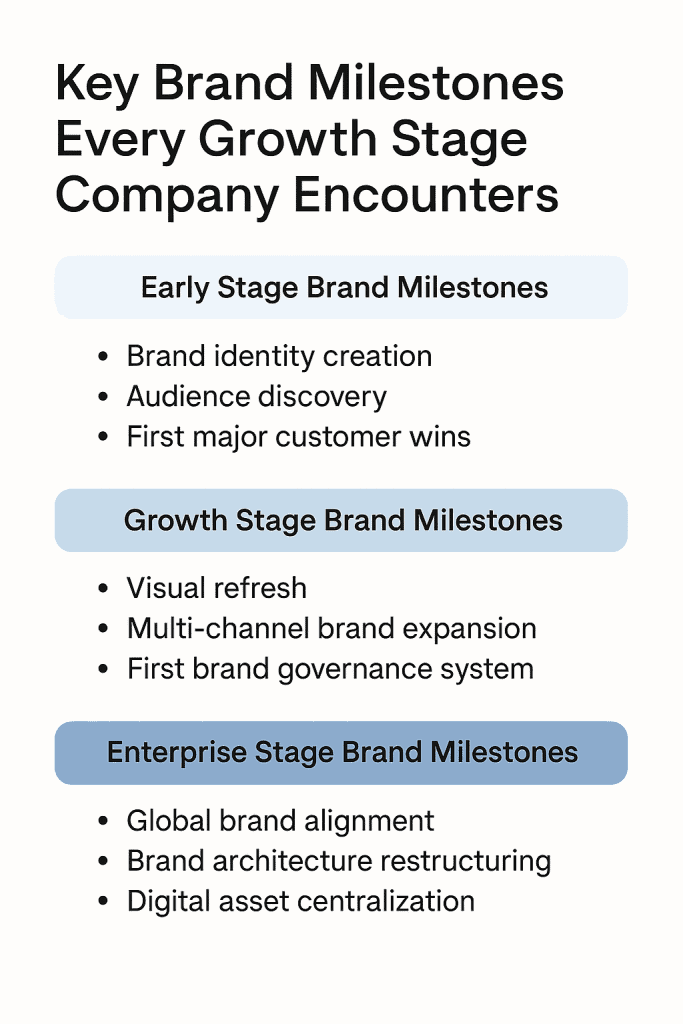
Every brand moves through distinct stages of growth. At each stage, different brand milestones signal progress, maturity, and readiness for the next level. Understanding these phases helps CMOs anticipate challenges and plan brand investments with clarity.
Early Stage Brand Milestones
In the early phase, brand milestones focus on establishing identity and credibility. This is when a brand defines its core purpose, values, visual identity, and voice. Key milestones include the first brand launch, the creation of foundational brand assets, and the acquisition of the first loyal customers. These moments shape how the market interprets the brand from the very beginning. For CMOs, the priority is clarity and consistency, as early impressions are difficult to reverse.
Growth Stage Brand Milestones
As the brand gains traction, milestones become more complex and visible. This stage often includes a visual refresh, expansion into new digital channels, growing content operations, and the introduction of formal brand guidelines. CMOs begin managing multiple campaigns, regions, or product lines. Brand consistency becomes harder to control, and operational systems start replacing informal processes. The brand now shifts from survival to structured growth.
Enterprise Stage Brand Milestones
At the enterprise level, brand milestones are tied to scale, governance, and global alignment. These include market expansions across regions, brand architecture restructuring after mergers or acquisitions, centralized digital asset management, and formal brand compliance programs. The brand is now a business asset that requires protection and strict governance. For CMOs, success at this stage depends on operational discipline as much as creative excellence.
Across all stages, each milestone builds upon previous foundations. When earlier milestones are weak, later growth becomes fragmented and risky. Strong brand leadership ensures that every stage supports the next with confidence.
How CMOs Decide Which Brand Milestones Truly Matter
Not every brand activity qualifies as a true milestone. One of the most important responsibilities of a CMO is deciding which moments deserve long term attention, resources, and organizational focus. This decision is rarely based on creativity alone. It is shaped by business objectives, market dynamics, and leadership expectations.
Internally, CMOs must balance what matters most to the executive team with what matters most to customers. Leadership often prioritizes milestones tied to revenue growth, market expansion, and competitive positioning. Customers, on the other hand, respond most to changes that affect their experience, trust, and emotional connection with the brand.
CMOs also evaluate milestones through the lens of risk and opportunity. A global rebrand, a major product launch, or a shift in brand architecture carries both high upside and high exposure. These moments demand stronger governance, clearer messaging, and tighter execution controls.
Ultimately, the milestones that truly matter are the ones that move the business forward while strengthening brand integrity. Smart CMOs focus on milestones that align strategic growth with long term brand trust rather than short term visibility.
Emotional Impact of Brand Milestones on Marketing Teams
Brand milestones do not only shape how the market sees a company. They deeply affect the people behind the brand as well. For marketing teams, these moments bring a mix of excitement, pressure, pride, and responsibility.
A successful brand milestone often becomes a defining career moment. Teams feel a strong sense of ownership when they see their work influence perception at scale. This boosts morale, reinforces creative confidence, and strengthens long term commitment to the brand. Recognition from leadership and customers further amplifies this positive effect.
At the same time, major milestones create intense pressure. Tight timelines, high expectations, and public scrutiny can lead to burnout if not managed carefully. CMOs must balance ambition with realistic workloads and psychological safety.
When handled well, brand milestones become powerful cultural anchors. They unite teams around shared goals, reinforce the purpose behind the work, and transform individual contributions into collective achievement. This emotional alignment often becomes the hidden driver behind sustained brand excellence.
The Hidden Operational Challenges Behind Brand Milestones
Behind every successful brand milestone sits a complex layer of operations that is often invisible to the outside world. While the public only sees the final outcome, the real risks live in the systems, processes, and coordination required to execute at scale.
One of the most common challenges is brand inconsistency across teams and regions. As organizations grow, different departments and markets often interpret brand rules differently. This leads to fragmented messaging, outdated visuals, and diluted brand perception during important milestones.
Asset sprawl is another major issue. Logos, templates, campaigns, and product visuals often live across shared drives, emails, and personal folders. When milestone moments arrive, teams struggle to locate approved assets quickly, increasing the risk of brand misuse.
Approval bottlenecks also slow brand milestones down. Without clear workflows, creative reviews become chaotic, delaying launches and frustrating teams. Add agencies, partners, and external vendors into the mix, and misalignment multiplies.
Compliance and governance become even more critical at scale. Regulatory missteps, unapproved messaging, or outdated disclaimers can turn a milestone into a liability rather than a win. For CMOs, the real challenge is not creativity. It is building the operational backbone that allows creativity to scale safely.
How CMOs Can Build a Repeatable Brand Milestone Framework
Brand milestones cannot be managed through instinct alone. As organizations grow, CMOs need a structured framework that allows milestones to be planned, executed, and measured consistently across teams and markets. A repeatable framework reduces risk while improving speed and alignment.
The first step is to clearly define the purpose of each milestone. Every milestone should be tied to a specific business objective such as market expansion, product adoption, customer trust, or brand repositioning. When the purpose is clear, teams understand what success looks like before the work begins.
Next comes governance. CMOs must establish who owns the milestone, who approves creative decisions, and who ensures brand compliance. Without defined ownership, even the strongest ideas lose momentum. Governance brings accountability and removes ambiguity from the process.
Measurement is equally critical. CMOs should define success indicators early, including brand perception shifts, engagement quality, internal adoption, and operational efficiency. Clear metrics transform brand milestones from creative moments into business performance signals.
Finally, alignment across creative, legal, product, and leadership teams is what makes a framework scalable. When every stakeholder understands their role in a milestone, execution becomes faster and more confident. Over time, this creates a proven system that turns brand growth into a predictable and repeatable outcome rather than a high risk event.
Role of Technology in Managing Brand Milestones at Scale
As brands grow across teams, regions, and channels, manual systems begin to fail. Spreadsheets, shared folders, and email based approvals may work in early stages, but they quickly collapse under the weight of large scale brand milestones. This is where technology becomes a strategic enabler rather than a support tool.
Centralized brand systems allow CMOs to maintain a single source of truth for brand assets, messaging, and guidelines. When every team works from the same controlled platform, the risk of outdated logos, off brand visuals, and inconsistent messaging drops dramatically during key milestones.
Real time access control is another critical function. Not every stakeholder should have the same level of editing power. Technology ensures that agencies, partners, and regional teams access only what they need while core brand ownership remains protected. This becomes especially important during rebrands, launches, and regional expansions.
Version management and audit trails also protect brand integrity. When assets change frequently during milestone execution, teams must know which version is approved and who made each update. Technology removes guesswork and prevents costly errors.
For CMOs, scalable technology turns brand milestones from operational stress points into controlled, repeatable executions. It provides visibility, speed, and governance at the exact moments when brand risk is at its highest.
How Brandy Supports CMOs Through Every Brand Milestone

Modern brand milestones demand more than creative execution. They require structure, visibility, and control across every touchpoint. This is where a centralized brand management platform becomes a critical ally for CMOs.
Brandy provides a unified digital space where brand assets, guidelines, and brand knowledge live together in one controlled environment. During key milestones such as rebrands, market expansions, and global launches, this centralization ensures that every team works from the latest approved materials without confusion or delay.
CMOs gain real time visibility into how brand assets are being accessed and used across regions and partners. Controlled permissions protect sensitive brand elements while still enabling fast collaboration with agencies, vendors, and distributors.
With Brandy, brand updates can be rolled out instantly across teams, eliminating the risk of outdated visuals or messaging during high impact launches. This allows CMOs to focus on strategic direction while the underlying brand operations stay aligned, secure, and scalable throughout every brand milestone.
Final Thoughts
Brand milestones are not isolated marketing moments. They are leadership moments that define how a brand grows, earns trust, and sustains relevance over time. For CMOs, each milestone represents both an opportunity and a responsibility. The opportunity lies in strengthening brand equity, accelerating growth, and shaping long term perception. The responsibility lies in protecting consistency, alignment, and trust at every stage of expansion.
The brands that scale successfully are not the ones that move the fastest. They are the ones that manage their milestones with clarity, structure, and discipline. When brand milestones are guided by strategy, supported by the right systems, and measured with purpose, they become powerful engines of sustainable growth.
For modern CMOs, mastering brand milestones is no longer optional. It is a core pillar of long term brand leadership.