Managing digital assets today is no longer about storing files neatly in folders. Brands operate across multiple platforms, regions, teams, and formats at the same time. Content moves fast, expectations are high, and consistency matters more than ever. As demand for on brand content grows, the systems behind that content must grow too.
This is where DAM scalability becomes critical. A Digital Asset Management system should not only support today’s campaigns. It should be built to support where your brand is heading next year, and five years from now. Choosing the right DAM software is no longer a tactical decision. It is a long term investment in how your brand operates.
In this guide, we explore why scalability matters and the 8 essential questions every brand should ask before committing to a DAM that claims to be future ready.
Why DAM Scalability Is No Longer Optional

The way brands create and distribute content has fundamentally changed. Marketing teams now produce assets for websites, social platforms, ads, marketplaces, partners, and internal use all at once. Each channel brings new formats, new versions, and new compliance needs.
At the same time, teams are becoming more distributed. Global brands work across regions and time zones. Even smaller organizations collaborate with external agencies, freelancers, and partners. Every new contributor adds complexity to how assets are stored, shared, and controlled.
A scalable DAM helps manage this complexity without slowing teams down. It allows asset libraries to grow without hurting performance. It enables new users to onboard quickly. Most importantly, it keeps brand assets consistent even as volume and velocity increase.
Without scalability, DAM systems become bottlenecks instead of enablers. That is why scalability should never be treated as a future upgrade. It needs to be built into the foundation from the start.
The Hidden Cost of DAM Systems That Cannot Grow
Many DAM platforms work well in the early stages. Asset libraries are small. Teams are limited. Workflows are simple. Over time, cracks start to appear.
Performance is often the first issue. As libraries grow, search slows down. Uploads take longer. Simple tasks begin to feel frustrating. These delays compound across teams and reduce productivity.
Next comes restricted growth. Adding new regions, brands, or campaigns becomes difficult. Teams start creating workarounds outside the DAM. Assets get duplicated. Version control breaks down. What was meant to be a single source of truth becomes fragmented.
User adoption suffers as well. If a system feels slow or confusing, people avoid it. When adoption drops, brand governance disappears quietly. Off brand assets get used not because teams want to break rules, but because the system makes it hard to do the right thing.
Eventually, the DAM becomes outdated. Instead of supporting growth, it limits it. Brands then face costly migrations, retraining, and lost historical data. These are preventable problems when scalability is evaluated early.
8 Questions That Define a Future Ready DAM Ecosystem
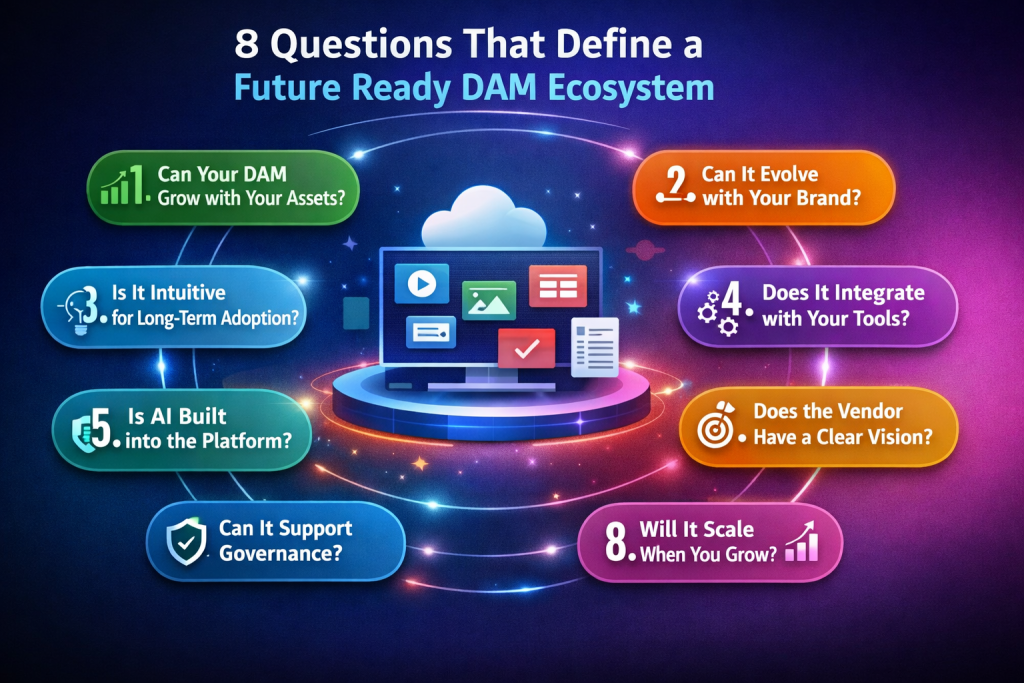
A future ready DAM adapts as your brand, teams, and content operations evolve, rather than relying on static feature lists. These questions help uncover whether a DAM will scale with your organization or quietly limit it.
Question 1: Can Your DAM Grow With Your Asset Library?
One thing is guaranteed as brands scale: the asset library will continue to grow. Campaigns expand, formats evolve, and richer content like video, motion, and interactive assets quickly become standard. A scalable DAM must be able to handle this growth without introducing friction or slowing teams down.
The right system allows storage to expand smoothly without requiring teams to rethink architecture or workflows. It should support a wide range of file types and large assets while maintaining fast performance and reliable search. Growth should feel like a natural extension of the system, not a trigger for technical reassessment.
A future ready DAM provides room to scale confidently. Instead of forcing teams to adapt to system limitations, it adapts alongside the asset library as content demands increase.
Question 2: Can It Evolve With Your Brand Structure?
Brands rarely remain static for long. New markets open, sub brands emerge, and regional teams gain more responsibility, all while global consistency must be maintained. A scalable DAM needs the flexibility to support this evolution without breaking structure or clarity.
This means accommodating multiple brand identities within a single platform while allowing regional or language specific portals where needed. It also means preserving legacy assets so brand history is not lost, even as visual systems and messaging evolve over time.
When a DAM cannot support these shifts, teams often create parallel systems to compensate. That fragmentation weakens brand alignment and creates confusion. A future ready DAM treats brand structure as something that grows and changes, not something frozen at implementation.
Question 3: Is It Intuitive Enough for Long Term Adoption?
A DAM only delivers value when people actually use it. Scalability is not just a technical concern related to storage or performance. It is equally about sustained adoption as teams grow and change.
As organizations expand, new users join constantly, many of whom are not familiar with DAM systems. They need an interface that feels intuitive from day one. Features such as drag and drop uploads, smart search, automated tagging, version control, and clear permissions help reduce friction and eliminate unnecessary learning curves.
Brand portals play a critical role here. When assets are presented with proper context, guidance, and usage rules, teams make better decisions without training or oversight. High adoption supports brand consistency naturally and ensures the DAM continues to deliver value over time.
Question 4: Does It Integrate With Your Existing Ecosystem?
Most marketing and brand teams already operate within a complex ecosystem of tools. Assets are created in design software, published through CMS platforms, localized through templating tools, and distributed across multiple channels. A DAM that operates in isolation adds friction rather than reducing it.
A scalable DAM should integrate seamlessly with the tools teams already rely on. Strong integrations allow assets to move directly from creation to activation without unnecessary downloads, uploads, or manual handoffs. This shortens production cycles, reduces errors, and keeps workflows efficient.
Integration also strengthens consistency. When approved assets are accessible inside the tools teams use every day, the risk of off brand content drops significantly. Instead of forcing teams to adapt to the DAM, a future ready DAM fits naturally into existing workflows.
Question 5: Is AI Built Into the Foundation?
AI is no longer an optional enhancement for DAM platforms. As asset volumes grow, manual tagging, organization, and retrieval simply do not scale in a sustainable way.
A DAM powered by AI helps teams work faster and more accurately. Automated metadata tagging improves search precision, while intelligent search reduces the time spent looking for the right asset. Multilingual metadata further supports global teams without adding manual overhead.
Looking ahead, AI will continue to influence how assets are selected and used. Recommendations based on campaign context and historical usage will help teams choose content with greater confidence. A future ready DAM is not just AI enabled today. It has a clear vision for how intelligence will evolve alongside growing complexity.
Question 6: Does the Vendor Have a Clear Product Vision?
Choosing a DAM is not only about software features. It is about forming a long term partnership. Your DAM vendor plays a role in how your brand operates and evolves over time.
A future ready provider is transparent about where the product is heading. They actively gather customer feedback and use it to guide development. Updates are released regularly and with purpose, rather than sporadically or reactively.
Understanding a vendor’s roadmap helps reduce long term risk. It signals whether the platform will continue to support emerging needs or gradually fall behind. A strong product vision reflects commitment, stability, and alignment with customer growth.
Question 7: Can It Support Governance Without Slowing Teams?
Governance is essential for protecting brand integrity, but it should never feel like a barrier to productivity. A scalable DAM embeds governance directly into everyday workflows so teams naturally use the right assets without constant supervision.
Clear permissions, version control, and guided brand portals help ensure compliance while keeping work moving efficiently. When governance is built into the system itself, teams stay aligned without delays, manual approvals, or approval fatigue.
Over time, this approach builds trust across the organization. Teams spend less time second guessing rules and more time executing confidently, knowing the assets they are using are approved and current.
Question 8: Will It Still Work When Your Organization Doubles?
Growth rarely follows a predictable or linear path. New teams form, partners join, and use cases expand, often faster than systems are updated. A future ready DAM remains reliable even as users, assets, and workflows multiply.
The platform should remain intuitive and performant under pressure. Search, permissions, and asset structure must scale without becoming confusing or slow as complexity increases.
When a DAM continues to feel simple and dependable even as the organization grows, it demonstrates that it was designed for real world conditions, not ideal scenarios.
How to Think About DAM Scalability as an Ecosystem
Scalability is not a single feature. It is the result of how technology, people, and processes work together. A truly scalable DAM supports growth without increasing complexity.
At an ecosystem level, a DAM should act as connective tissue across teams and tools. It should make it easier to collaborate, govern, and distribute assets at scale. When systems are intuitive and well integrated, governance becomes part of everyday work instead of an enforced rule.
Brands that treat DAM as long term infrastructure gain a competitive advantage. They move faster, stay consistent, and adapt to change without disruption. Scalability ensures that growth strengthens the brand instead of stretching it thin.
Where Brandy Fits Into a Scalable DAM Strategy

Brandy is built around the idea that brand systems should grow naturally with the organizations behind them. Instead of focusing only on asset storage, Brandy helps teams create structured, usable brand environments.
With intuitive brand portals, flexible asset organization, and intelligent metadata handling, Brandy supports both daily execution and long term evolution. Teams can scale their asset libraries, onboard new users, and manage multiple brand identities without sacrificing clarity or control.
Brandy fits into modern brand ecosystems by prioritizing usability, structure, and future readiness. It is designed to support growth without forcing teams to change how they work.
Final Thoughts Choosing a DAM That Grows With You
DAM scalability is not a technical concern reserved for IT teams. It is a strategic decision that impacts brand consistency, speed, and confidence across the organization.
By asking the right questions early, brands can avoid costly limitations later. A future ready DAM supports growth, encourages adoption, and adapts as brand needs evolve.
As content demands continue to increase, the brands that win will be the ones backed by systems built to scale. Choosing a DAM that grows with you is not just smart planning. It is essential brand infrastructure.
Frequently Asked Questions
Scalability ensures your DAM can handle increasing asset volumes, new users, and evolving brand structures without slowing teams down. A scalable system prevents performance issues and reduces the need for costly migrations as your organization grows.
A future ready DAM supports multiple brands, regional portals, AI powered search, flexible permissions, and strong integrations. Just as important, it has a clear product roadmap that shows how the platform will evolve over time.
Intuitive interfaces, smart search, automated tagging, and guided brand portals make DAM systems easier to use. When users can find and apply assets quickly without training, adoption improves naturally across regions and roles.
Integrations reduce friction and speed up content activation. When DAM connects with CMS, creative tools, and templating platforms, teams can publish and localize content directly from one system without duplication.
AI automates metadata, improves asset discovery, and reduces manual work. As asset libraries grow, AI helps maintain usability and efficiency, ensuring the DAM remains valuable as demands increase.