
Digital content is growing faster than most teams can control. Every campaign generates hundreds of files. Every brand update creates new versions. And, every market adds localization layers. By 2026, the volume and complexity of digital assets will no longer be a side challenge. It will be a core operational risk for brands that are not prepared.
A digital asset management system is no longer just a storage solution. It is the command center for brand consistency, collaboration, compliance, and speed. Yet many companies still struggle with failed adoption, messy libraries, slow approvals, and lost assets because the foundation was never set correctly.
That is exactly why a clear digital asset management checklist for 2026 is critical. The next generation of DAM success depends on governance, automation, and cross team alignment from day one.
This guide walks you through every stage of building, launching, and scaling a future ready DAM system. From strategy and audits to platform selection, training, and long term optimization, this checklist is designed to help you avoid costly mistakes and build a DAM that actually works for your business.
What Digital Asset Management Means in 2026
By 2026, digital asset management will no longer be defined by where files are stored. It will be defined by how well brands control, distribute, govern, and activate their content across every channel in real time. A modern DAM is not just a library. It is a living system that connects people, processes, and platforms inside one operational framework.
In 2026, DAM will sit at the center of brand operations. Marketing teams will rely on it for campaign execution. Creative teams will use it as their production backbone. Legal and compliance teams will depend on it for rights management and audit trails. Sales and partners will access it for approved brand content in seconds.
The shift is clear. DAM is moving from passive storage to active infrastructure. Automation will drive approvals. Metadata will power discovery. Permissions will control brand risk. Analytics will guide optimization. The brands that treat DAM as a strategic business system rather than a file cabinet will gain speed, consistency, and control at scale.
Who This DAM Checklist Is For
This digital asset management checklist for 2026 is designed for teams that manage growing volumes of content and cannot afford chaos inside their brand ecosystem. It is built for marketing teams that launch campaigns across multiple channels and regions. It supports brand managers who must protect visual identity while enabling creative freedom. Also, it helps enterprises that operate across departments, partners, and global markets. It also fits agencies that manage multiple client brands and need clean workflows to avoid costly mistakes.
This checklist is equally valuable for fast growing startups that are scaling their marketing operations for the first time. It supports remote teams that need centralized access to approved assets. It also serves product teams, sales teams, and legal teams that rely on accurate and compliant content.
If your organization creates, shares, approves, stores, or distributes digital content, this checklist applies to you. It is built to support both operational control and creative speed in 2026.
Phase 1: Strategy And Internal Readiness
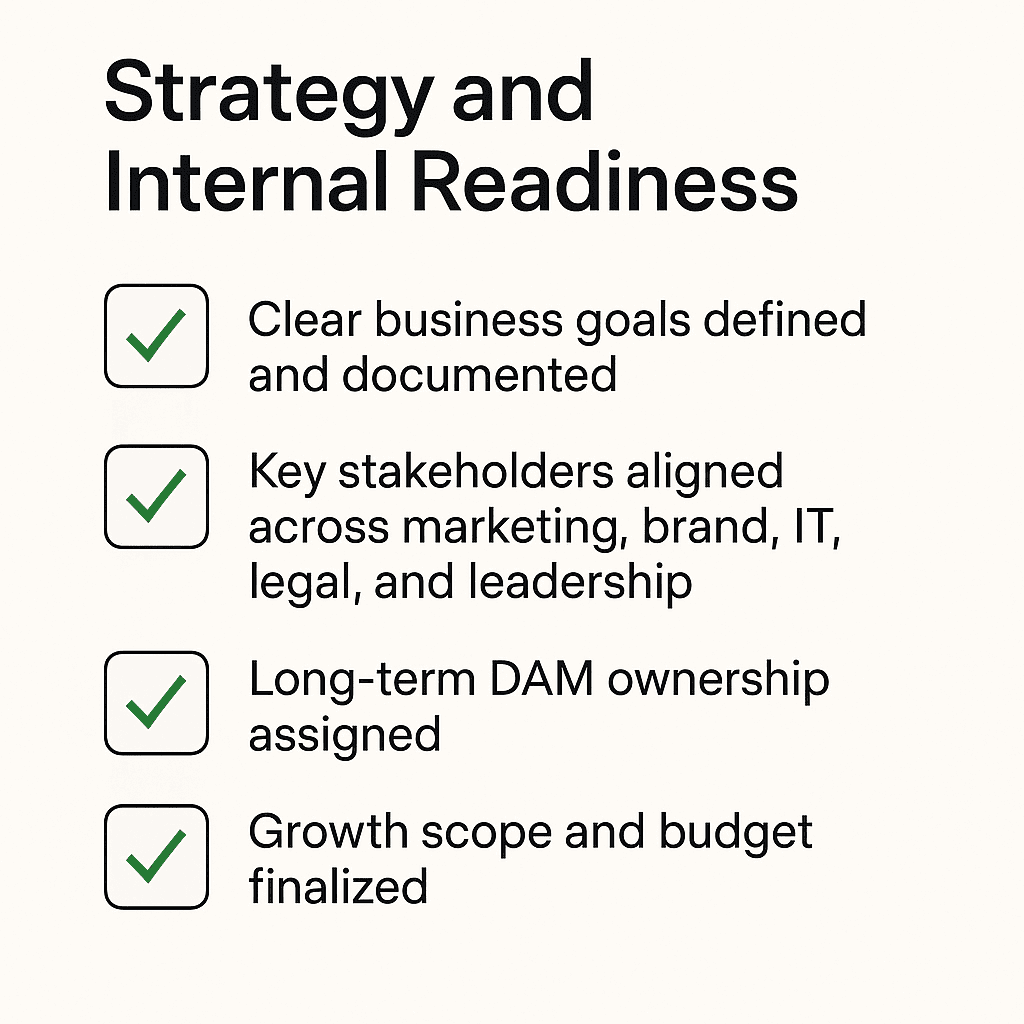
Before selecting any digital asset management platform, organizations must first build internal clarity. Most DAM failures happen not because of poor software, but because teams rush into tools without fixing strategy, ownership, and alignment. Phase one focuses entirely on preparing your business for sustainable DAM success.
In 2026, DAM implementation must start with business priorities, not product features. This phase ensures that your organization understands why it needs a DAM, what problems it must solve, and who is accountable for its long term success. It also prevents costly rework later by uncovering gaps in ownership, budget planning, and cross team alignment early.
A strong internal foundation will shape every technical decision that follows. It determines how your governance is structured, how workflows are designed, and how easily teams adopt the system after launch.
Define Clear Business Outcomes
Clear outcomes turn DAM from a software project into a business initiative. Instead of vague goals like better organization, define measurable outcomes such as faster campaign launches, reduced asset duplication, improved brand consistency, stronger compliance, and higher asset reuse across regions. These outcomes become the success benchmarks for your entire DAM program.
Identify Stakeholders And Owners
DAM touches nearly every department. Marketing, brand, IT, legal, product, and external agencies must all be represented in the planning stage. Assign system owners who make decisions, governance leads who control standards, and contributors who manage daily uploads and revisions. Clear ownership prevents delays and confusion once implementation begins.
Set Budget And Long Term Growth Scope
Your DAM budget must reflect not just current needs but future expansion. Plan for asset volume growth, user scaling, brand additions, localization, and storage expansion. A realistic long term budget protects your DAM from becoming obsolete within a few years.
Phase 2: Asset And Workflow Reality Check
Once strategy and ownership are in place, the next step is to understand the real state of your digital assets and workflows. Many organizations underestimate how scattered, outdated, and duplicated their content has become over the years. Phase two is about uncovering that reality before anything is migrated into a new DAM.
This phase protects your future system from being polluted with poor quality content on day one. It also reveals how work actually happens across teams, not just how it is documented on paper. The insights gained here directly shape your metadata design, permission structure, and governance model.
A thorough asset and workflow audit reduces migration cost, shortens implementation time, and improves search accuracy and usability after launch.
Complete Asset Inventory
Start by identifying where every digital file currently lives. This may include shared drives, cloud storage platforms, creative tools, project folders, personal devices, and agency portals. For each asset, document its owner, format, version history, usage rights, and last modification date. This process quickly exposes duplicate files, outdated content, and orphaned assets with no clear ownership. These findings help you decide what should be migrated, archived, or permanently removed.
Map End To End Asset Lifecycles
Next, document how assets flow through your organization. Track the journey from creation to review, approval, publishing, reuse, updates, and final retirement. Include exceptions such as emergency approvals or verbal sign offs. This reveals where delays occur and where compliance risks enter the process.
Identify Process Gaps And Bottlenecks
Use your asset and workflow data to pinpoint friction points. These may include slow approvals, repeated redesigns, unclear usage rights, or teams recreating assets that already exist. Identifying these gaps early allows your DAM structure to directly solve real operational problems instead of masking them.
Phase 3: Platform Evaluation Checklist for 2026
With strategy defined and your asset reality clearly documented, you are now ready to evaluate platforms. In 2026, selecting a DAM is no longer about ticking off feature lists. It is about choosing a system that can sustain governance, scale with your organization, and adapt to changing workflows without constant restructuring.
A future ready DAM must function as long term brand infrastructure. It should support multi team collaboration, protect brand integrity, automate control, and integrate seamlessly into daily work. This phase ensures you choose a platform that will not limit your growth after implementation.
Governance First Architecture
A modern DAM must enforce governance automatically. Manual policing through emails, spreadsheets, or informal approvals fails at scale. Look for platforms that offer rule based access, automated approval workflows, version control, and full audit logs. Governance should be built into every interaction so brand compliance does not depend on human memory or constant supervision.
Multi Brand And Global Scalability
Your DAM must support brand expansion, regional libraries, and market localization without fragmenting your system. The platform should allow you to manage multiple brands under one structure while maintaining separate identities, permissions, and workflows. Scalability in 2026 means growing without operational complexity.
Deep Workflow Integrations
Adoption depends heavily on integration. Your DAM should connect directly with design tools, content management systems, marketing automation platforms, project management software, and sales enablement systems. Teams should be able to search, pull, update, and publish assets without leaving their core workspace.
Enterprise Level Security And Compliance
Security cannot be optional. Look for encrypted storage, secure access control, activity tracking, and compliance certifications. As asset libraries grow, so does legal and reputational risk.
User Experience And Adoption Potential
A powerful DAM is useless if people avoid using it. The interface must be intuitive, searchable, and friendly for both technical and non technical users. Easy discovery, fast uploads, and smooth sharing directly influence long term adoption.
Phase 4: Implementation Blueprint Design

After selecting your DAM platform, the focus shifts from planning to execution. Phase four is where strategy becomes structure. A clear implementation blueprint ensures that your DAM launches with control, clarity, and confidence rather than confusion and rushed decisions.
This phase defines who will manage the system, how access will be rolled out, and how your asset structure will be built from day one. A strong blueprint protects your DAM from early chaos and sets the foundation for long term governance, adoption, and scalability.
A rushed implementation often results in poor metadata, broken workflows, and low adoption. A structured rollout ensures the system grows in an organized way as more teams and assets are added.
Build Your DAM Leadership Team
Start by assembling a cross functional leadership group that represents every major DAM stakeholder. This includes system administrators, governance leaders, brand owners, content creators, and approvers. Each role must have clearly defined responsibilities. Governance leads should have real authority to approve standards and policies so decisions do not stall in long approval loops. Clear leadership ensures accountability and faster execution.
Create A Phased Rollout Plan
Instead of launching your DAM across the entire organization at once, introduce it in controlled phases. Begin with a pilot group that reflects different use cases such as marketing, product, and regional teams. Monitor their usage, gather feedback, and refine workflows before expanding access. A phased rollout reduces risk and increases adoption quality.
Design Taxonomy Metadata And Permissions
Now define how your DAM will actually be structured. Build logical folder hierarchies based on brand, campaign, region, or time. Establish consistent naming standards and metadata fields that support fast discovery and accurate filtering. Design role based permissions so creators can upload, approvers can publish, and viewers can only download approved content. A strong structure makes your DAM usable at scale.
Phase 5: Training Adoption And Behavioral Shift
Even the most powerful DAM system will fail if people do not use it consistently. Phase five focuses on the human side of digital asset management. This is where long term success is either secured or slowly lost. Training is not a one time event. Adoption is not automatic. Both require intentional planning and continuous reinforcement.
In 2026, DAM adoption is no longer about teaching people which buttons to click. It is about changing daily behavior so the DAM becomes the default place where assets are created, approved, shared, and reused. When teams trust the system, they stop using personal drives, email attachments, and scattered folders.
Role Based Training Programs
Different users interact with a DAM in different ways. Administrators need to understand governance, permissions, and audit controls. Creators need to know how to upload, tag, version, and submit assets for approval. Viewers and partners need fast access to approved files. Training should be tailored to each role with short videos, live walkthroughs, and task based guides that reflect real workflows.
Internal Champions And DAM Advocates
Identify early adopters within each team or region and empower them as DAM champions. These champions provide peer level support, answer practical questions, and model best practices inside their teams. When people see colleagues using the system successfully, adoption spreads faster and feels more natural.
Feedback Loops And Continuous Improvement
Collect feedback through short surveys, usage data, and informal check ins. Identify where users struggle with search, uploads, approvals, or permissions. Use this feedback to refine training materials, adjust workflows, and improve system configuration. Continuous improvement keeps the DAM aligned with real team needs.
Phase 6: Long Term Governance And Optimization
Launching your DAM is only the beginning. The real value is created through consistent governance, regular audits, and continuous optimization. Without this phase, even well implemented systems slowly drift into disorder. In 2026, long term DAM success depends on how well you protect structure while allowing teams to move fast.
This phase ensures your DAM remains accurate, compliant, searchable, and trusted across the organization. It also protects your investment by keeping asset libraries clean and operational workflows efficient as volumes grow.
Ownership And Accountability Models
Every major asset library, campaign collection, and brand space must have a clearly assigned owner. These owners are responsible for content accuracy, license validation, user access control, and policy enforcement. Clear accountability removes ambiguity and ensures that quality does not degrade over time.
Regular Audits And Cleanup Cycles
Schedule routine audits to review metadata accuracy, permission settings, asset usage patterns, and license compliance. During each audit, archive outdated assets, remove duplicates, revalidate usage rights, and update access permissions. These cleanup cycles prevent search clutter and reduce legal exposure.
Performance And ROI Tracking
Track meaningful metrics such as asset reuse rates, time saved in campaign production, approval cycle reduction, and brand compliance improvement. These metrics show whether your DAM is delivering real operational value and where further optimization is required.
Optimization And Platform Evolution
As teams grow and workflows evolve, your DAM must also evolve. Continuously update automation rules, refine integrations, expand metadata models, and introduce new governance controls where needed. A DAM that evolves stays valuable. A static DAM slowly loses relevance.
Common DAM Mistakes Companies Will Still Make in 2026
Even with better technology and wider awareness, many organizations will continue to repeat the same digital asset management mistakes in 2026. These errors do not usually come from a lack of tools. They come from weak planning, unclear ownership, and poor long term discipline.
One of the most common mistakes is buying a DAM platform before defining strategy. Without clear business goals, teams end up with an expensive system that does not solve real operational problems. Another frequent issue is treating DAM as a storage tool rather than a governance system. This leads to messy libraries, weak compliance, and low trust in approved assets.
Poor metadata design remains a major failure point. When tags and naming standards are inconsistent, search becomes unreliable and users abandon the system. Many companies also underestimate the importance of internal adoption. Without proper training and champions, teams quietly return to personal drives and email attachments.
Ignoring legal, licensing, and permission control is another costly error. As asset volumes grow, so does brand and compliance risk. These mistakes are avoidable when governance and accountability are embedded from the start.
What Makes a Future Proof DAM System in 2026
A future proof DAM system in 2026 is not built around file storage alone. It is built around governance, automation, and brand control at scale. It must support how modern teams actually work across locations, channels, and partners while protecting brand integrity at every step.
Automation will be a core requirement. Approval workflows, version control, rights management, and lifecycle rules must operate automatically without depending on manual follow ups. Metadata must power fast and accurate discovery so users can find the right asset in seconds, not minutes.
A future ready DAM must also support multi brand structures and global collaboration without creating fragmented libraries. It should allow teams to localize assets while maintaining brand consistency across markets. Security and compliance must be built into the foundation with role based permissions and full activity tracking.
Most importantly, a future proof DAM must be easy to use. When users enjoy working inside the system, adoption grows naturally and the DAM becomes part of everyday operations rather than an enforced process.
How Brandy Fits Into the 2026 DAM Vision

The future of digital asset management is not just about storing files. It is about orchestrating brand operations with clarity, control, and speed. In this emerging landscape, platforms like Brandy align closely with what modern DAM is expected to deliver in 2026.
Brandy supports the idea that brands need structured spaces rather than scattered folders. With dedicated brand spaces, teams can separate internal assets, external partner resources, and campaign specific collections without losing oversight. Metadata driven organization allows assets to remain discoverable as libraries scale. Permission controls ensure that the right people access the right content at the right time.
For agencies and multi brand organizations, the portfolio view simplifies how multiple brands are managed under a single operational roof. Instead of switching between disconnected systems, teams can maintain visibility and governance across every brand they support.
Most importantly, Brandy reflects the shift toward DAM as a brand operations system rather than a file repository. It supports collaboration, governance, and brand consistency in ways that match how teams will work in 2026.
Final Thoughts
Digital asset management in 2026 will no longer be a background system running quietly behind the scenes. It will be a core business infrastructure that directly impacts brand trust, speed to market, compliance, and team efficiency. The brands that succeed will be the ones that treat DAM as a long term operational strategy rather than a short term software purchase.
A strong DAM foundation is built on clarity, ownership, governance, and continuous improvement. Tools matter, but discipline matters more. When processes are defined, people are trained, and accountability is enforced, a DAM system becomes a powerful engine for growth instead of a digital filing cabinet.
This checklist is designed to help organizations move into 2026 with confidence, control, and scalability. When digital assets are managed with intention, the entire brand ecosystem becomes faster, safer, and more consistent across every touchpoint.