
Enterprise digital ecosystems now generate content at a speed and scale that traditional storage systems cannot handle. Every campaign, product launch, regional expansion, and partner collaboration adds thousands of new files into the business environment. Over time, assets scatter across cloud drives, legacy servers, marketing tools, and personal folders. Teams lose time searching, compliance risk increases, and brand consistency starts to break.
This is where enterprise DAM migration becomes a strategic business necessity rather than a technical upgrade. Organizations no longer migrate only to replace old software. They migrate to regain control over intellectual property, protect brand integrity, strengthen compliance, and improve operational speed across global teams.
An enterprise migration also touches far more than marketing. It directly affects IT, legal, product, sales, and regional operations. When executed correctly, it becomes the foundation for faster go to market execution, stronger governance, and better return on content investment. When executed poorly, it can disrupt workflows for months.
This guide explains enterprise DAM migration in clear operational terms and walks through every critical phase needed to execute a secure, scalable, and business aligned transition.
What Enterprise DAM Migration Really Includes
Enterprise DAM migration is not a simple file movement process. It restructures how assets, data, permissions, and workflows operate across the entire enterprise digital ecosystem.
Asset Transfer Beyond Basic File Movement
An enterprise asset includes far more than a binary file. Each asset carries metadata, ownership details, rights usage rules, version history, and audit information. Migration must preserve this full data structure to maintain asset value. Moving only raw files strips away operational intelligence and turns a DAM into a basic storage tool.
Metadata, Permissions, and Workflow Migration
True DAM migration preserves approval workflows, access permissions, regional visibility rules, and lifecycle data. Without this structure, enterprise users lose confidence in system accuracy, which directly reduces adoption and governance effectiveness.
Relationship between DAM and Enterprise Tech Stack
DAM platforms operate as a central content layer connected to CMS, PIM, CRM, creative tools, marketing automation, and ecommerce systems. Migration must preserve these connections to protect downstream campaign operations, publishing workflows, and reporting systems.
Business Scenarios that Trigger Large Scale DAM Migration
Large enterprises typically migrate their DAM when operational complexity, compliance pressure, or system inefficiencies start impacting business performance and brand control.
Mergers and Acquisitions
After a merger, enterprises inherit multiple DAM systems, overlapping asset libraries, and conflicting governance models. Migration becomes the only way to centralize operations and eliminate content fragmentation.
Global Expansion and Regional Content Control
As companies expand into new markets, regional teams require fast access to approved content while maintaining local compliance. Legacy systems often fail to support this combination of speed and control.
Security, Compliance, and Audit Failures
Outdated DAM tools struggle with rights tracking, audit reporting, and license enforcement. Regulatory pressure frequently forces enterprises to migrate to avoid legal exposure and operational risk.
Poor Asset Discoverability and Duplication
When teams cannot locate approved content quickly, they recreate it. This increases creative production costs and introduces brand inconsistency. Migration restores centralized discovery and reuse.
The High Risk Areas in Enterprise DAM Migration
Enterprise DAM migration involves significant business risk if not governed properly. Understanding these risks early protects business continuity and brand integrity.
Data Loss and Corruption
High volume transfers increase the risk of missing files, broken links, and corrupted binaries. Without validation controls, these failures spread across production workflows.
Broken Permissions and Compliance Exposure
Incorrect access mapping can expose confidential materials to unauthorized users or restrict content from the teams that need it most.
Workflow and System Downtime
If DAM integrations break during migration, teams can lose access to live campaign assets and disrupt time sensitive launches.
Brand Misuse and Outdated Assets
Without version control and approval enforcement, outdated visuals and expired brand elements resurface in active distribution channels.
Enterprise DAM Migration Planning Framework
A successful enterprise DAM migration always starts with structured planning that aligns business, security, and operational objectives across departments.
Stakeholder Alignment Across Departments
Marketing, IT, legal, compliance, product, and leadership teams must align on goals, timelines, and responsibility ownership. Each function controls a different layer of asset governance.
Defining Business Outcomes and Success Metrics
Enterprises must define measurable success indicators such as reduced search time, lower compliance incidents, faster campaign cycles, and improved asset reuse.
Security and Compliance Readiness Review
Security architecture, data residency regulations, licensing requirements, and audit obligations must be reviewed before any migration work begins.
Integration and Dependency Mapping
Every connected system such as CMS, ecommerce, design tools, and analytics platforms must be mapped to avoid breaking digital workflows during transition
Step by Step Enterprise DAM Migration Execution Framework

This execution framework outlines the exact operational stages enterprises must follow to migrate digital assets securely and at scale. It connects planning, data governance, system integration, and user adoption into one structured migration process.
Step 1: Enterprise Asset Discovery & Audit
Before any migration activity begins, enterprises must gain full visibility into existing asset inventories across all systems and business units.
Identifying all active and legacy repositories
Assets often exist across cloud storage, internal servers, marketing tools, partner portals, and offline archives. Enterprises must document every source to prevent blind spots.
Categorizing retain archive and delete assets
Content classification ensures only relevant, compliant, and valuable assets migrate into the new DAM system.
Prioritizing high value business content
Customer facing marketing assets, product imagery, regulated documentation, and sales enablement materials receive priority during early migration phases.
Step 2: Metadata & Taxonomy Design for Enterprise Search
Metadata and taxonomy form the intelligence layer of an enterprise DAM. Without a clean structure, even the most advanced platform fails to deliver performance.
Creating a unified enterprise metadata schema
Standardized fields for brand, region, product, campaign, and ownership ensure consistent indexing across departments.
Rights usage and lifecycle tagging
Licensing information, expiration rules, regional restrictions, and approval states must exist at the asset level to support compliance automation.
Regional and multilingual taxonomy design
Taxonomy must support regional classification without fragmenting enterprise level search and reporting.
Search optimization for enterprise DAM performance
Proper taxonomy directly controls search speed, filtering accuracy, AI automation, and user adoption across large organizations.
Step 3: Data Cleanup Before Migration Begins
Pre migration cleanup ensures only compliant, usable, and business relevant content enters the new DAM environment.
Removing duplicates and corrupt files
Duplicate files inflate storage costs and confuse users. Corrupt assets break publishing workflows and must be eliminated.
Validating brand compliance and outdated content
Assets using old brand standards, retired logos, and legacy messaging require removal or reclassification before migration.
Resolving expired licenses and permissions
Images, videos, and audio with expired usage rights must be blocked or removed to prevent future legal violations.
Step 4: Selecting the Right Enterprise Migration Method
The migration approach must balance speed, security, and data accuracy while ensuring minimal disruption to live enterprise operations.
API based automated migration
APIs enable controlled system to system transfer while preserving metadata and permissions at scale.
Batch ingestion for large data volumes
Batch methods allow enterprises to move asset sets in phases with structured validation checkpoints.
Hybrid migration with quality assurance layers
Hybrid models combine automation with human review for sensitive asset groups such as legal, brand master files, and executive communications.
Choosing the best approach based on security and scale
Security sensitivity, compliance obligations, data volume, and integration complexity determine the final migration approach.
Step 5: Security Permissions & Compliance Mapping
Security design defines who can access what, where, and under which regulatory conditions across the global enterprise landscape.
Role based access control structure
Departments, agencies, vendors, and partners receive controlled visibility to approved asset libraries only.
Data privacy and regional compliance rules
Regional data laws influence storage locations, access policies, and retention requirements across global teams.
Audit trail and content usage tracking
Every download, edit, and distribution event must remain traceable for governance reporting and compliance audits.
Step 6: Testing Validation and Phased Rollout
Testing and phased deployment protect live business workflows while ensuring the accuracy and reliability of migrated data.
Pilot group testing
Limited user groups validate real world workflows and uncover early system issues before full rollout.
Quality assurance workflows
Automated and manual checks verify metadata accuracy, permission integrity, and asset completeness.
Rollback and fail safe protocols
Every migration phase includes recovery plans in case of performance or data integrity failures.
Controlled department wise rollout
Teams transition in waves to maintain operational continuity across enterprise functions.
Change Management & Team Adoption Strategy
Enterprise DAM success depends on how well teams adopt new workflows, not just how well the technology performs.
Internal DAM Champions and Ownership Model
Each department designates DAM owners responsible for adoption, governance enforcement, and user support. These champions act as the first line of guidance for teams and ensure that daily usage aligns with enterprise standards. They also bridge communication between business users and the DAM administration team.
Enterprise Wide Training Programs
Structured training builds confidence in search, upload, approval, and compliance workflows across global teams. Role based learning paths ensure that users only receive the training relevant to their responsibilities. Regular refresher sessions help maintain accuracy as systems and workflows evolve.
Process Documentation and Onboarding Playbooks
Clear documentation ensures long term consistency as new employees and partners join the ecosystem. Step based playbooks reduce dependency on informal knowledge and support faster onboarding across departments. This documentation also standardizes how assets move through their lifecycle.
Feedback Loops for Early Optimization
User feedback allows early system refinement and increases platform trust and engagement. Regular review sessions reveal usability gaps, permission issues, and workflow bottlenecks before they grow into operational risks. Continuous feedback ensures the DAM evolves with real business needs.
Post Migration Governance and Operating Model
A DAM without long term governance quickly loses structure. This operating model ensures continued accuracy, compliance, and business value.
Governance Ownership and Audit Cycles
Dedicated governance teams conduct scheduled audits to maintain metadata accuracy and permission integrity. These audits ensure that access controls remain aligned with organizational roles and regulatory requirements. Regular reviews also help detect inactive users, orphaned assets, and outdated classifications.
Ongoing Metadata and Taxonomy Optimization
Search behavior and operational feedback guide continuous improvements to classification systems. As business goals, markets, and content types evolve, taxonomy must adapt to maintain speed and accuracy. Ongoing optimization ensures the DAM continues to support new workflows without rebuilding the framework.
Asset Lifecycle and Archiving Policies
Assets follow defined creation, usage, expiration, and retirement rules to prevent library decay. Automated archiving reduces clutter while preserving historical content for audit and reference purposes. Clear lifecycle policies also protect teams from using outdated or non compliant materials.
Performance Reporting and Usage Analysis
Usage analytics reveal content performance, reuse value, and investment effectiveness. Reporting highlights which assets drive the most engagement and which remain underutilized. These insights guide smarter content investment and production planning across departments.
Common Enterprise DAM Migration Mistakes And Prevention
Most migration failures stem from planning gaps, not technology limitations. These prevention areas protect ROI and user adoption.
Skipping Governance During Migration
Enterprises must define ownership and accountability before any asset moves. Without clear governance, migrated content quickly loses structure and compliance control. This often leads to permission conflicts, duplicate ownership, and long term operational confusion.
Migrating without Metadata Standardization
Unified metadata must exist before content ingestion to avoid search chaos. Inconsistent tagging across departments weakens discoverability and reporting accuracy. Standardization ensures that AI search, filters, and automation perform as expected from day one.
Ignoring Integration Dependencies
Disconnected systems create downstream publishing and reporting failures. DAM rarely operates in isolation, and broken connections affect CMS, ecommerce, PIM, and marketing automation tools. Early dependency mapping prevents workflow outages and data sync errors.
Underinvesting in User Training
Low adoption occurs when teams lack confidence in system workflows. Users revert to old storage habits when training feels insufficient or unclear. Continuous enablement ensures that teams trust the DAM as their primary source of content.
Rushing Enterprise Wide Go Live
Phased deployment prevents business disruption and improves system stability. Immediate full scale activation increases the risk of system overload, permission gaps, and user confusion. Controlled rollout allows teams to stabilize workflows before expansion.
How Modern Brand Asset Platforms Support Enterprise Migration
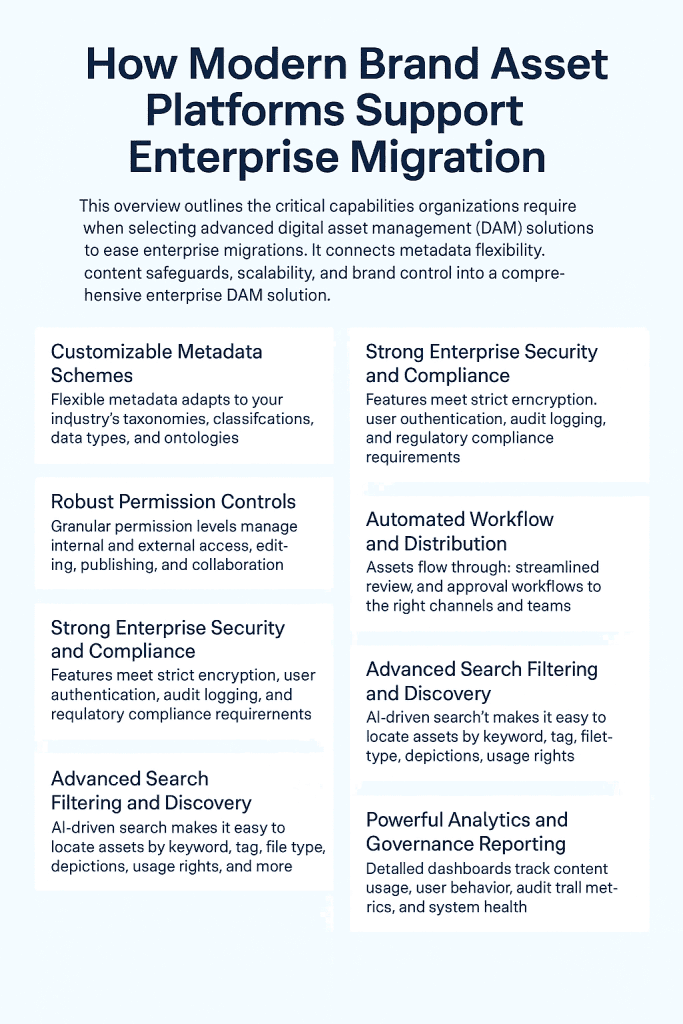
Modern brand asset platforms connect governance, discoverability, and brand integrity into one operational system for large organizations.
Centralized brand governance and control
Approvals, standards, and compliance rules become embedded into daily content workflows.
Secure global access for large teams
Distributed teams gain fast access to approved assets without sacrificing security.
Scalable asset libraries for multi brand organizations
Enterprises manage multiple brands within a unified governance framework.
Where Brandy fits into enterprise DAM ecosystems
Brandy supports structured brand governance while integrating with enterprise content systems to maintain consistency and compliance across every touchpoint.
Final Thoughts on Executing a Successful Enterprise DAM Migration
Enterprise DAM migration represents a fundamental shift in how digital content is governed, accessed, and activated. It is not a technology project but a business transformation that strengthens brand protection, reduces compliance risk, and accelerates operational performance across every department.
Organizations that invest in structured planning, data preparation, user adoption, and long term governance create a DAM foundation that supports continuous growth and market expansion. When leadership treats DAM as a strategic system of record rather than a storage tool, migration becomes a lasting competitive advantage instead of a temporary system change.