Most fashion brands do not fail because of bad product. They fail because of a weak brand identity. In a market worth $369 billion, customers are not just buying clothes. They are buying into a lifestyle, a feeling, and a community. When your brand does not communicate that clearly and consistently, you lose them to the one that does.
Fashion branding is the strategic process of creating a distinct, recognizable identity that emotionally connects with your audience across every touchpoint. From the logo on your hang tag to the tone of your Instagram caption, every element either builds or chips away at that connection.
This guide covers everything you need to build a fashion brand identity that holds up across seasons, channels, and markets.
What Is Fashion Branding and Why Does It Matter Right Now?
Fashion branding is not just about looking good. It is about being immediately recognizable, consistently trustworthy, and emotionally relevant to the right customer at the right moment.
What Makes Fashion Branding Different from Other Industries?
Unlike buying household goods, fashion purchases are deeply emotional. Customers are not buying a product. They are buying a version of themselves. That makes the stakes for brand identity higher than in almost any other category.
Fashion also operates on seasonal cycles. Brands must stay trend-relevant while protecting a consistent core identity. That balance between adaptability and consistency is the central creative challenge of fashion branding, and most brands underestimate how hard it is to maintain at scale.
The Business Case for Getting It Right
Consistent branding can drive up to 23% revenue growth. Brands with strong visual consistency see 147% higher year-over-year engagement growth. And with more than 60% of consumers in the US and UK actively trying to cut fashion spending, only brands with a clear and differentiated identity earn the purchase when budgets tighten.
The numbers are not ambiguous. Brand identity is not a creative nice-to-have. It is a growth driver with measurable outcomes.
The Core Components of a Fashion Brand Identity
A fashion brand identity is a system, not a collection of individual design choices. Every element needs to work together to create a single, coherent impression.
Visual Identity: The Elements Customers Remember First
Visual identity is the most immediately recognizable layer of your brand. It covers your logo, color palette, typography, photography style, and packaging design. These elements must work together across every format and every size.
Chanel’s black, white, and gold palette signals luxury without a single word. Supreme’s box logo communicates cultural currency through its deliberate simplicity. Bottega Veneta built an identity so distinctive that it removed its logo entirely and let the intrecciato weave speak for the brand. Each of these is a visual system, not just a logo.
A consistent color palette alone improves brand recognition by up to 80%. That is the compounding power of treating visual identity as a system rather than a set of isolated design assets.
Brand Voice and Personality: How Your Brand Communicates?
Voice is as important as visuals, and it is far easier to get wrong. Your brand voice covers your tone, your vocabulary, the personality behind every caption, email, and product description.
Ralph Lauren does not sell polo shirts. It sells American aspiration. Every piece of content the brand publishes, from campaign copy to website headers, reinforces that same lifestyle identity. The voice is as consistent as the visual identity, and that consistency is what makes the brand feel cohesive across every channel.
Every fashion brand needs to define:
- The three to five adjectives that describe the brand personality
- The tone on a spectrum from formal to conversational, aspirational to accessible
- The specific words and phrases that align with the brand and those that do not
- How the voice adapts across channels without losing its core character
Brand Experience: Every Touchpoint Counts
Brand experience covers everything a customer encounters when they interact with your company. Website navigation, packaging quality, customer service tone, unboxing experience, and retail environment all contribute to how your brand is perceived.
Hermès creates exclusivity through waitlists and carefully controlled retail environments. That scarcity is not accidental. It is a deliberate experience designed to reinforce the brand’s core value of artisanal rarity. Every touchpoint communicates the same message.
How to Build Your Fashion Brand Foundation?

Before any logo is drawn or color palette selected, you need a strategic foundation. Visual identity built on a weak strategy will look good for a season and mean nothing in the long run.
Defining Brand Values That Customers Actually Believe
Brand values must be operational commitments, not marketing statements. The most powerful fashion brands in the world have values that shape product decisions, partnership choices, and supply chain practices.
Patagonia is the clearest example. The company committed to replacing conventional materials with preferred alternatives, and 84% of its fabrics and trims now meet that standard, backed by third-party certifications. That level of follow-through is what makes a brand value credible. Consumers have become expert at detecting the gap between stated values and actual behavior. Greenwashing does not just fail to work. It actively damages trust.
Whatever values you define, they need to be ones your brand can demonstrate in practice, not just in copy.
Knowing Your Target Customer at a Lifestyle Level
Effective fashion branding requires understanding your customer beyond demographics. You need to understand how fashion fits into their identity and what they want the world to think about them when they wear your clothes.
A customer buying a Chanel jacket and one buying a Patagonia fleece may have identical incomes but completely different motivations, values, and self-concepts. Demographic data tells you who they are. Psychographic research tells you why they buy, and that is what informs every brand decision worth making.
Competitive Positioning: Where Your Brand Lives in the Market?
Competitive analysis is not a benchmarking exercise. It is a map of the territory your competitors already own, so you can identify what is unclaimed.
When analyzing competitors, examine:
- What visual territories and aesthetics are already crowded
- What values and positioning angles are overrepresented
- Where price point and brand personality combinations are missing
- What customer experiences competitors are failing to deliver
The Louis Vuitton and Supreme collaboration in 2017 generated $100 million in sales by occupying a space neither brand could own individually. That kind of positioning insight comes from rigorous competitive analysis, not aesthetic instinct alone.
Building Your Fashion Brand Visual Identity Step By Step
With the strategic foundation in place, the creative process has a clear direction to follow. Without it, even the most talented design team is guessing.
Start With Mood Boards Before You Open a Design Tool
Mood boards capture feeling before form. They collect textures, imagery, references, and competitor visuals that define what the brand should evoke and what it should never be confused with. This step forces clarity about the emotional territory the brand is claiming before anyone draws a single logo concept.
Include both aspirational references and cautionary ones. Knowing what the brand must not look like is as useful as knowing what it should.
Logo Design That Works at Every Scale
A fashion brand logo must work simultaneously on a price tag, a billboard, a social media profile, a shopping bag, and a website favicon. Nike’s swoosh works precisely because it is infinitely scalable and instantly readable at any size. Most logos fail not in the primary application but in the secondary ones.
Your logo system needs to include:
- A primary logo for main brand applications
- A secondary or stacked version for tight spaces
- A monochrome version for single-color applications
- Clear minimum size rules and clear space requirements
- Explicit rules for what the logo must never do
Color, Typography and Photography Working as a System
These three elements, applied consistently, are what create the feeling of a brand across every touchpoint. Color needs Pantone references and hex codes for both print and digital. Typography needs a clear hierarchy covering headlines, body copy, labels, and specialty applications. Photography needs defined rules for lighting, editing style, model casting, and composition.
Documenting these elements in detail is what allows a team of designers, agencies, and regional partners to all produce content that feels like it came from the same brand. Without that documentation, consistency is left to individual judgment, and individual judgment always drifts.
Brandy’s dynamic brand guidelines tool gives fashion teams a living, web-based space to document and share every one of these elements, so the guidelines update in real time and partners always work from the current version, not a PDF sent six months ago.
Maintaining Fashion Brand Consistency Across Every Channel
This is where most fashion brands quietly fall apart. A strong identity built in a brand strategy document means nothing if it is applied inconsistently across channels, markets, and partners.
Why Brand Guidelines Alone Are Not Enough?
Most brands have brand guidelines. Far fewer actually enforce them. The gap between having documentation and using it is where off-brand content leaks into the market, eroding the recognition that took significant time and budget to build.
Enforcement is not about policing creatives. It is about removing the conditions that cause inconsistency in the first place. When teams cannot find the right asset quickly, they use whatever is available. When guidelines live in a forgotten PDF, nobody references them. When partners have to email someone to get a logo, they use a screenshot instead.
The most common places brand consistency breaks down:
- External agencies working from assets sent by email months ago
- Regional teams adapting materials without access to current guidelines
- Social media managers recreating assets from memory or old posts
- Partners and resellers using outdated logos because current files are hard to request
The Role of Centralized Brand Asset Management
The operational solution to brand inconsistency is a centralized brand asset system where every approved logo, image, template, color code, and guideline lives in one place that every relevant team can access instantly.
When finding the right asset is easier than improvising, teams stay on brand by default. When guidelines are live and always current, partners reference them instead of guessing. That is the operational case for brand asset management in a fashion business.
Brandy’s centralized brand asset library gives fashion teams a single governed source of truth for every approved asset. Logos, campaign imagery, color references, typography files, and guidelines all live in one visual, organized space that anyone can access from a browser without needing to request files or dig through folders.
For teams managing multiple seasons, regional markets, and external partners simultaneously, that level of centralization is not a convenience. It is the only way to maintain consistency at scale.
Common Fashion Branding Challenges and How to Solve Them
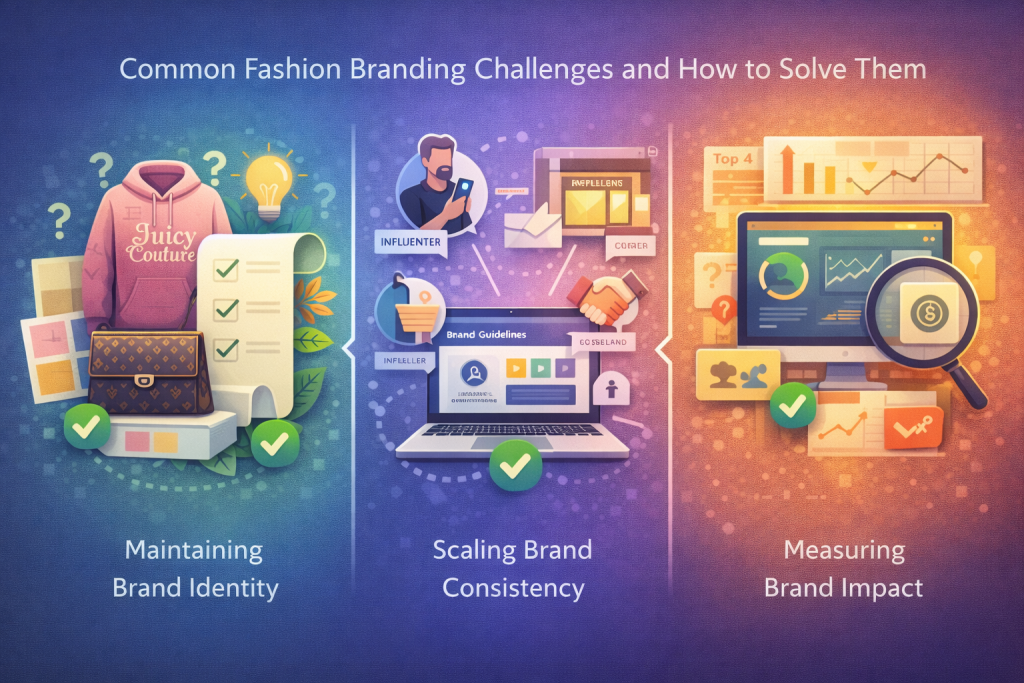
Every fashion brand hits roadblocks when building and protecting its identity. Here are the most common challenges marketing leaders face and the practical fixes that actually work.
Staying Relevant Without Losing Brand Identity
Fashion is trend-driven by nature. The risk is letting seasonal trend relevance erode the core brand identity that took years to build. Juicy Couture lost its identity by letting a single trend define the entire brand rather than being one expression of a broader identity. When the trend faded, there was nothing underneath it.
The solution is distinguishing between permanent brand elements and flexible ones. Your logo, primary palette, typography, and core values are permanent. Campaign imagery, seasonal color accents, and limited edition collaborations are flexible. Trend elements belong in the flexible layer. They should never touch the permanent one.
Scaling Brand Consistency With External Partners
Agencies, resellers, co-brand partners, and influencers all produce and distribute content on your behalf. Without governed access to current assets and clear guidelines, the brand fragments across every external touchpoint.
The practical solution is giving partners live access to a controlled brand space where they can find current assets, understand usage rules, and download what they need without contacting anyone. Brandy’s brand guidelines platform makes it possible to create exactly this: a shared, permission-controlled hub that updates automatically so partners never work from outdated files.
Measuring Whether Your Brand Is Actually Working
Most fashion brands invest in brand identity without tracking whether it is delivering results. The metrics worth monitoring include brand recognition consistency across channels, asset reuse rates, content approval cycle times, and the frequency of off-brand assets reaching market.
Brands with consistent visual identity across all touchpoints grow two to four times faster on average than those without. That is not a creative preference. It is a measurable business outcome that leadership can track and report on.
The Technology Layer: How Fashion Teams Manage Brand Assets at Scale?
A brand asset management platform gives fashion teams a single source of truth for every approved asset and guideline. The operational outcomes are direct: faster content approvals, fewer off-brand assets reaching distribution, less time spent on asset requests, and less budget wasted on recreating content that already exists but cannot be found.
For fashion brands managing seasonal collections, global markets, and external creative partners simultaneously, this level of organization is the difference between a brand that scales cleanly and one that fragments under the pressure of growth.
Explore Brandy’s features to see how fashion teams centralize brand control without the cost and complexity of enterprise-scale platforms. View transparent pricing to find the right plan for your team size and brand scope.
The Bottom Line
Fashion branding is not a design project with a start and an end date. It is an ongoing operational commitment that touches every part of how your brand goes to market, grows, and retains customers across seasons and channels.
The brands that build lasting identities share three things: a clear strategic foundation built on authentic values, a cohesive visual and verbal identity system documented in detail, and the operational infrastructure to apply that identity consistently wherever their brand appears.
Getting the strategy and the creative right is the hard part. Keeping it consistent at scale is where most brands need better tools. Start with Brandy for free and see what it looks like when every team, partner, and channel works from the same brand, every time.