
Creative teams today are expected to produce more content than ever before, across more channels, in more formats, and at a much faster pace. What used to be a simple campaign can now involve dozens of variations for social media, display ads, email, video, and print.
While the demand for content has increased, many teams are still relying on workflows that were never designed for this level of scale. Manual resizing, repeated exports, and last minute fixes continue to consume time that should be spent on creative thinking and strategy.
Creative automation is meant to solve this problem. But not all automation platforms deliver on that promise. Choosing the right one requires understanding what real automation looks like and where many tools fall short.
What Creative Automation Really Means Today
Creative automation is often confused with basic templating or faster production tools. In reality, it goes much deeper than simply speeding up one part of the workflow. True creative automation supports the entire lifecycle of content creation, from design to distribution.
A strong creative automation platform helps teams adapt content automatically across formats, channels, and use cases without compromising quality or brand consistency. It reduces repetitive tasks so teams can focus on ideas, storytelling, and performance.
Many platforms claim to offer automation, but only cover a narrow use case. They might work well for static banners or social posts, yet struggle when video, print, or multi channel campaigns are introduced. This is where automation often breaks down.
Essential Feature 1: Full Automation Across Formats and Channels

One of the most important features of a creative automation platform is its ability to work seamlessly across all formats and channels. Modern marketing does not happen in silos, and your automation tools should not either.
A single campaign often needs to be delivered as social posts, digital ads, videos, email visuals, and sometimes print assets. When automation only supports a few of these formats, teams are forced back into manual work for the rest.
This creates fragmented workflows where creativity slows down and quality becomes harder to control. Full automation ensures that every output is handled within the same system, without switching tools or rebuilding designs.
Why Format Gaps Disrupt Creative Momentum
Creative momentum depends on continuity and focus. When designers and marketers need to manually adjust layouts for every platform, that focus is lost. Each interruption pulls attention away from strategy and storytelling.
Teams often face issues such as adjusting aspect ratios, resizing images, repositioning text, or rebuilding layouts entirely. These tasks may seem small individually, but they add up quickly across large campaigns.
Over time, these format gaps lead to slower turnaround times, increased errors, and creative fatigue. Automation should eliminate these obstacles, not create new ones.
How Full Automation Protects Creative Quality
Manual adaptation is one of the biggest threats to creative quality. When assets are resized or reformatted by hand, important details can be lost. Text may appear cut off, images may look pixelated, and layouts can lose their original balance.
Full automation ensures that every format is generated from a single source of truth. Design rules, spacing, typography, and visual hierarchy remain intact across all outputs.
By relying on automated formatting rather than manual fixes, teams can maintain high quality standards while producing content at scale. This consistency builds trust in the brand and confidence within the creative team.
Essential Feature 2: Built In Consistency for Global and Local Campaigns
As brands expand into new regions, maintaining consistency becomes more complex. Different markets bring different languages, cultural nuances, and layout requirements, all while needing to stay aligned with the same brand identity.
Without the right automation, global campaigns often rely on manual localization. This approach increases the risk of errors, slows down delivery, and creates inconsistencies that can weaken brand trust.
A creative automation platform should make global consistency easier, not harder. It should support localization as part of the workflow rather than treating it as an afterthought.
Supporting Multiple Languages and Layouts at Scale
Global campaigns frequently require content to be adapted for languages that read in different directions. Left to right and right to left layouts demand more than simple text replacement. They require structural layout adjustments that preserve visual balance.
When these changes are handled manually, teams spend hours reworking designs for each market. This not only delays launches but also increases the chance of layout issues slipping through.
Automation that supports language direction and layout logic ensures that content adapts correctly every time. Teams can localize faster while maintaining the same design standards across regions.
Consistency Without Slowing Down Local Teams
Local teams need flexibility to tailor messaging for their audiences, but they also need guardrails to stay on brand. Too much control creates bottlenecks, while too little leads to inconsistency.
A strong creative automation platform balances both. It allows local teams to customize approved elements while locking core brand components in place.
This approach ensures that every market delivers content that feels relevant and local, while still looking and sounding like the same brand everywhere.
Essential Feature 3: Smart Handling of File Size and Naming Rules
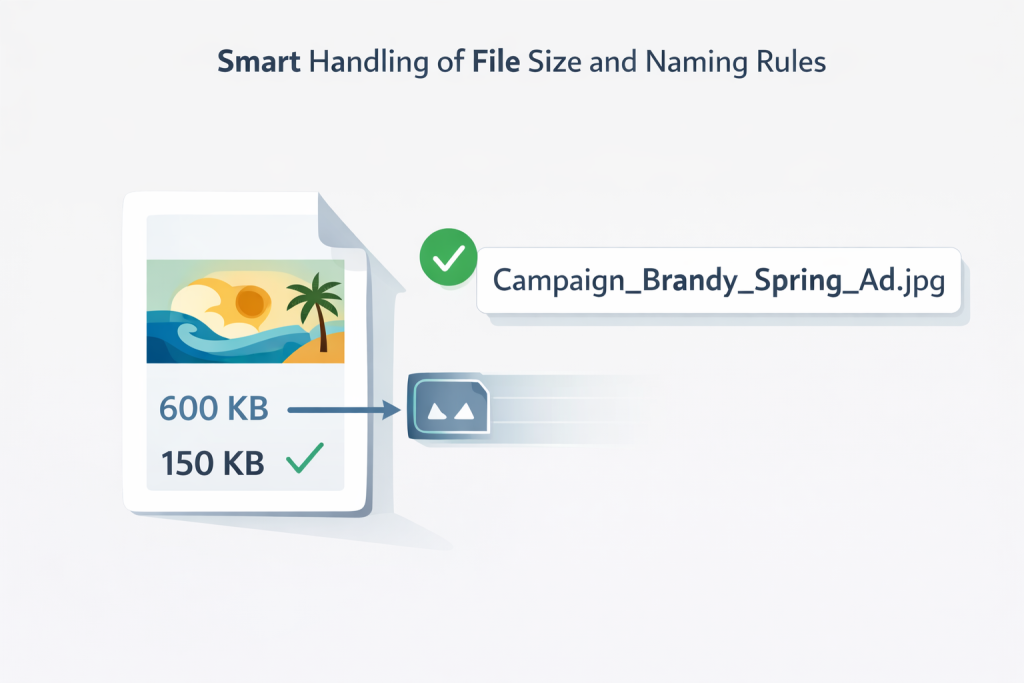
Technical constraints are often overlooked when choosing a creative automation platform. File size limits and naming conventions may seem minor, but they can derail campaigns if not handled properly.
Different platforms impose different requirements. Ad networks, social platforms, and email tools all have strict limits that must be respected for content to be published successfully.
When automation does not account for these rules, teams are forced to intervene manually, which defeats the purpose of automation altogether.
Why File Size Limits Still Cause Delays
Exceeding file size limits can prevent assets from being uploaded or approved. Teams then scramble to compress files or redesign visuals at the last minute.
This reactive approach introduces stress and increases the risk of quality loss. It also slows down campaigns that are often time sensitive.
Automation should anticipate these limits and generate outputs that meet platform requirements from the start.
The Role of Naming Conventions in Scalable Workflows
File naming may seem administrative, but it plays a critical role in asset management and performance analysis. Inconsistent naming makes it harder to track versions, compare results, and reuse assets efficiently.
Manually renaming files across channels wastes time and introduces inconsistency. Over time, this creates clutter and confusion in asset libraries.
A creative automation platform should apply naming rules automatically, ensuring every asset is compliant, searchable, and ready for use across channels.
How to Evaluate Creative Automation Platforms Without Getting Distracted
Choosing a creative automation platform can feel overwhelming, especially when demos focus on impressive features instead of real world workflows. The goal during evaluation is to understand how the platform behaves once it is used daily by creative and marketing teams.
Rather than being impressed by individual capabilities, buyers should focus on how the platform supports complete campaign execution from start to finish.
Questions to Ask During Platform Demos
During demos, ask questions that reveal how the platform handles real scenarios. Understand how assets move from creation to distribution and what happens when formats, regions, or channels change.
It is also important to ask where manual steps still exist. Automation that requires frequent human intervention is not truly scalable.
Warning Signs of Partial Automation
Partial automation often appears polished on the surface but breaks under complexity. If a platform only excels in one format or relies heavily on manual adjustments, it is likely to create bottlenecks later.
These limitations often surface only after campaigns grow in size and scope.
Why Workflow Outcomes Matter More Than Feature Lists
Long feature lists can be misleading. What matters is whether the platform reduces effort across the entire workflow and remains reliable as demands increase.
A long term perspective helps ensure the platform supports growth rather than becoming another system teams outgrow.
How Brandy Supports Creative Automation Without Compromising Control

Creative automation works best when it is connected to how brands actually operate day to day. Brandy supports this by helping teams centralize brand assets, manage consistency, and scale content workflows without adding complexity.
Instead of treating automation and brand management as separate systems, Brandy brings them together. Teams can organize approved assets, maintain clear brand guidelines, and ensure every piece of content is created from a trusted source of truth.
This approach helps creative and marketing teams move faster while staying aligned. As content scales across formats, regions, and teams, Brandy ensures that automation supports creativity rather than limiting it. The result is a workflow that feels structured but flexible, allowing teams to focus on producing meaningful, high quality campaigns with confidence.
Final Thoughts: Choosing Automation That Supports Creativity
Creative automation should exist to protect creativity, not replace it. When automation is done right, it quietly removes repetitive tasks that drain time and energy from creative teams. This allows designers and marketers to focus on ideas, storytelling, and improving campaign performance instead of managing technical details.
The most effective platforms support full automation across formats and channels, ensuring content can scale without constant manual adjustments. Built in consistency helps brands grow globally while maintaining a clear and recognizable identity in every market. At the same time, smart handling of technical constraints like file sizes and naming rules prevents delays and last minute fixes.
When these elements work together, creative work becomes smoother and more rewarding. Teams spend less time fixing problems and more time building meaningful campaigns. That freedom, rather than friction, is the true value of choosing the right creative automation platform.
Frequently Asked Questions
A creative automation platform is a tool that helps teams produce, adapt, and distribute marketing content at scale. It automates repetitive tasks such as resizing, formatting, localization, and versioning across multiple channels. This allows creative teams to focus more on strategy and ideas while maintaining consistent quality across all outputs.
Design templates offer a starting point for content creation, but they still rely heavily on manual updates and adjustments. Creative automation goes further by applying rules and logic that adapt content automatically across formats, channels, and regions. This makes it far more scalable for high volume campaigns.
Yes, a strong creative automation platform is designed to support global teams. It can manage language differences, layout direction, and localization requirements while keeping brand elements consistent. This ensures local teams can move quickly without compromising brand integrity.
Creative automation does not remove creative control when implemented correctly. Instead, it creates guardrails that protect brand standards while allowing flexibility where it matters. Teams gain more freedom to experiment because they spend less time on repetitive production work.
Teams should avoid platforms that automate only one format or channel. Partial automation often leads to hidden manual work and workflow fragmentation. It is important to choose a solution that supports the entire content lifecycle and scales with future needs.