
Insurance is not an impulse purchase. People choose insurers during moments that matter most, such as buying a first home, starting a family, protecting a business, or planning for retirement. In these moments, customers are not only comparing prices. They are asking a deeper question: can I trust this company?
That is where insurance branding plays its most powerful role. Branding shapes how people perceive your stability, credibility, and reliability long before they ever file a claim. It influences whether your policy documents feel reassuring or overwhelming, whether your website feels clear or confusing, and whether your communications feel human or robotic.
As digital first insurers raise customer expectations and non traditional brands enter the insurance space, strong branding has become a business growth engine rather than a cosmetic marketing layer. This guide explores what insurance branding really means today, why it matters more than ever, and how insurers can build brand experiences that create trust at scale.
What Insurance Branding Really Means Today?
Insurance branding is the combination of strategy, identity, messaging, and experience design that shapes how people perceive and interact with your company across every touchpoint. It goes far beyond logos or advertising campaigns and touches nearly every operational area of an insurance organization.
Insurance branding includes:
- How policies are written and structured
- How claims letters are presented
- How customer portals look and function
- How agents and brokers speak to customers
- How emails explain next steps
When done well, branding turns complex products into understandable experiences. It makes large organizations feel more human and ensures consistency in an industry where trust is everything.
Branding vs Marketing in the Insurance Context
Marketing focuses on attracting attention and driving short term action, such as promoting a new product or generating leads. Branding shapes long term perception. It determines whether people believe your company will still be there in ten or twenty years and whether they feel confident committing to an ongoing relationship.
In simple terms:
- Marketing drives awareness and demand
- Branding builds credibility and loyalty
Both matter, but in insurance, branding carries more weight because customers are choosing long term partners, not one time purchases. A strong brand becomes a shortcut for trust.
The Role of Brand in High Trust Industries
Industries such as insurance, healthcare, and financial services share a critical characteristic. Customers cannot test the product in advance. You cannot preview a claims experience or simulate a future policy outcome before buying.
Because of this, customers rely on signals. Your brand becomes that signal. It communicates stability, professionalism, and whether you take responsibility seriously. Consistent branding in insurance is therefore not decorative. It is foundational to how people decide who deserves their trust.
Why Insurance Branding Directly Impacts Business Growth?
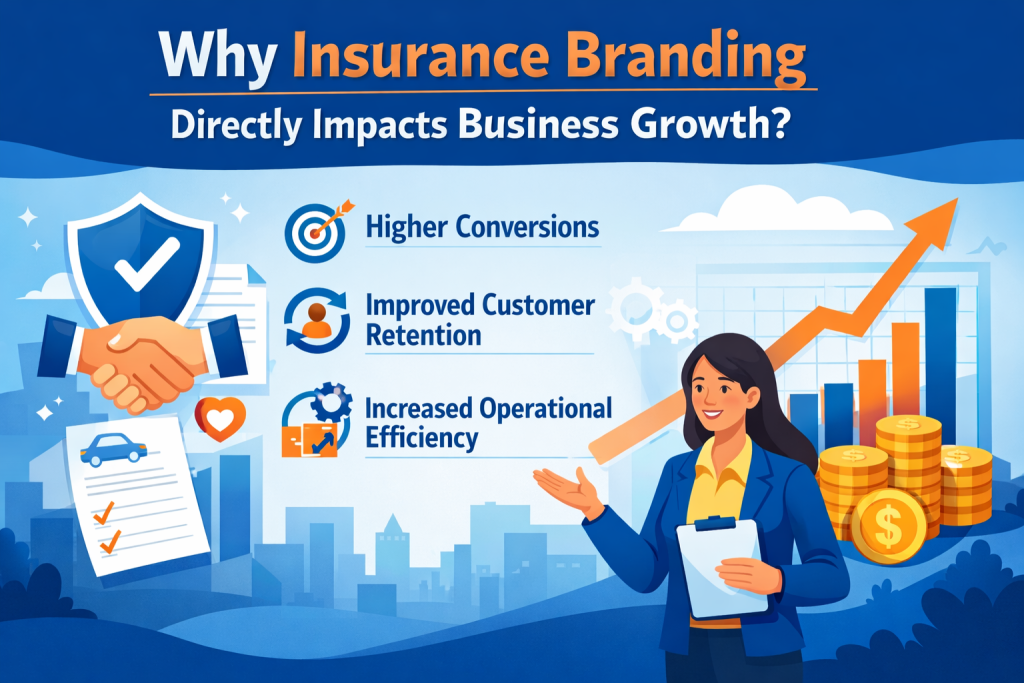
Strong insurance branding does more than improve recognition. It directly influences revenue, retention, and operational efficiency across the organization.
Branding and Customer Decision Making
When insurance options look similar on paper, people rely on perception. They choose the company that feels clearer, more established, and easier to understand. A consistent brand reduces perceived risk and reassures customers that the organization behind the policy is organized, reliable, and competent.
This reassurance:
- Increases conversion rates at the quote stage
- Reduces hesitation during purchasing
- Shortens sales cycles
Brand clarity removes friction from decision making.
Branding and Customer Retention
Most customers interact with their insurer only a few times per year, often during stressful moments. If those interactions feel disjointed, inconsistent, or confusing, trust erodes quickly.
When communications look familiar, language stays consistent, and information is easy to follow, customers feel supported. They stay longer, renew more often, and are more open to additional products. Retention is not driven only by price. It is driven by how easy it feels to do business with you, and brand consistency makes that ease possible.
The Unique Branding Challenges Insurance Companies Face
Insurance branding is more complex than branding in many other industries, not because insurers lack creativity, but because they operate inside layers of structural and regulatory complexity.
Complex Products and Jargon
Insurance products are inherently technical. Terms such as deductibles, exclusions, riders, endorsements, and waiting periods cannot be removed. However, branding determines whether these concepts are explained in plain language or buried inside dense text.
Without strong brand guidelines and content standards, complexity leaks into every customer touchpoint and makes the experience harder than it needs to be.
Regulated Language and Compliance Requirements
Insurance communications must include specific legal language, mandatory disclaimers, exact terminology, and approved formatting. These requirements often create tension between brand teams seeking clarity and legal teams requiring precision, making consistency harder to maintain without structured governance.
Without structured governance, this tension leads to slow approvals, inconsistent templates, and growing risk.
Fragmented Touchpoints Across the Customer Journey
Insurance brands exist across many channels:
- Websites and portals
- Email and SMS
- Policy documents and renewal notices
- Mobile apps
- Agent and broker presentations
- Claims communications
When each channel evolves independently, brand drift occurs. Small inconsistencies accumulate into big trust gaps.
Core Elements of a Strong Insurance Branding Strategy

A successful insurance branding strategy blends identity, messaging, and operational consistency. It aligns what you say with how you say it and how it looks across every touchpoint.
Clear Positioning and Value Proposition
Positioning answers one question: why choose you? Are you faster, more transparent, more personal, more digital first, or more specialized? Your positioning should be simple, believable, and reflected everywhere, not just in taglines but also in processes and customer experiences.
Human and Accessible Tone of Voice
Insurance customers want clarity, not cleverness. A strong tone of voice is warm, direct, plain spoken, and empathetic. It avoids jargon when possible and explains unavoidable technical terms clearly. Tone consistency across documents and channels builds familiarity and comfort.
Visual Identity Built for Digital First Experiences
Modern insurance branding favors clean layouts, readable typography, and accessible color systems. Visual identity should work across screens of all sizes, support long form reading, create hierarchy without clutter, and feel contemporary without chasing trends. Design choices strongly influence how professional and trustworthy your brand feels at first glance.
Brand Architecture for Multiple Products
Most insurers offer many product lines such as life, health, auto, home, and business insurance. Brand architecture defines how these connect. Customers should recognize one trusted company while still understanding differences between products. Clear architecture reduces confusion and supports cross selling.
Consistent Experience Across High Impact Moments
Certain moments matter more than others, including policy issuance, renewals, claims submission, claims resolution, and coverage changes. These are the moments where branding must be strongest. Consistency here builds confidence and reinforces trust.
From Fear Based Messaging to Purpose Driven Branding
For decades, insurance advertising relied heavily on fear based messaging that focused on what might go wrong. While this approach still exists, many modern insurers are shifting toward positive, purpose driven branding that emphasizes empowerment rather than anxiety.
Example of Health Focused Brand Positioning
Some health insurers now position themselves as partners in wellbeing rather than just payers of claims. They promote prevention, encourage healthy habits, and offer tools that help customers track and improve health. Branding centers on vitality, progress, and support instead of illness, reframing insurance as a service that helps people live better.
Example of Business Empowerment Branding
Business insurers are also changing tone. Instead of highlighting risk, they celebrate entrepreneurship. They tell stories about small business owners, showcase creativity and resilience, and position insurance as a safety net that enables ambition. This purpose driven approach builds emotional connection and differentiates brands in a crowded market.
What Effective Insurance Brand Assets Include?
Insurance branding is only as strong as the assets that carry it into the real world. These assets shape how customers experience your brand every day, often more than marketing campaigns ever will.
A complete insurance brand ecosystem typically includes three major asset categories.
Visual Assets
Visual assets establish recognition and consistency. They help customers instantly identify your brand and feel continuity across channels.
Common visual brand assets include:
- Logos and logo variations
- Color palettes and accessibility standards
- Typography systems
- Iconography and illustration styles
- Photography and image guidelines
These assets must work equally well on websites, mobile apps, documents, and presentations. Consistency here creates familiarity, and familiarity builds trust.
Content Assets
Content assets shape how your brand speaks.
Examples include:
- Policy documents and endorsements
- Claims letters and status updates
- Onboarding guides and welcome kits
- Product brochures and fact sheets
- Customer emails and SMS templates
When these assets follow the same tone, language standards, and structure, customers experience your brand as organized and reliable.
Digital Assets
Digital assets support everyday operations and digital journeys.
Examples include:
- Website components and landing page templates
- Customer portal UI elements
- Presentation templates
- Social media templates
- Email design modules
Centralizing these assets ensures teams do not reinvent materials or introduce inconsistency.
Brand Governance in Insurance
Brand governance is how you protect brand integrity across thousands of employees, partners, and touchpoints.
In insurance, governance is not optional. It is essential.
Why Traditional Brand Guidelines Fail
Most brand guidelines live as static PDFs. They explain how things should look and sound but do not control how work actually gets created.
In insurance organizations, this leads to predictable problems:
- Teams download old templates
- Regional offices modify designs
- Legal updates fail to reach everyone
- Different departments create their own versions
Over time, the brand fragments.
What Modern Brand Governance Requires?
Effective governance must be built into workflows, not documented separately.
Modern insurance brand governance requires:
- A single source of truth for assets
- Approved templates that cannot be altered incorrectly
- Embedded brand and compliance rules
- Version control across all materials
- Clear ownership and approval processes
Governance should make the right choice the easiest choice for employees.
How Technology Enables Insurance Brand Governance at Scale?
Technology transforms brand governance from a manual policing effort into an automated system.
Centralized Asset Libraries
A centralized library stores all approved logos, templates, images, and content blocks in one place. Teams no longer search across shared drives or email threads. Everyone works from the same source.
This reduces duplication, confusion, and outdated usage.
Templates With Embedded Brand and Compliance Rules
Modern platforms allow brand and legal rules to be built directly into templates. When someone creates a document, they automatically use approved layouts, fonts, colors, and language.
Employees do not need to remember guidelines. The system enforces them.
Automated Updates Across All Materials
When product names, disclaimers, or legal language change, updates can be pushed across every template and document automatically. This removes the dangerous gap between when content is approved and when teams actually start using it.
For insurance companies facing frequent regulatory change, this capability significantly reduces risk.
Best Practices for Insurance Branding Teams
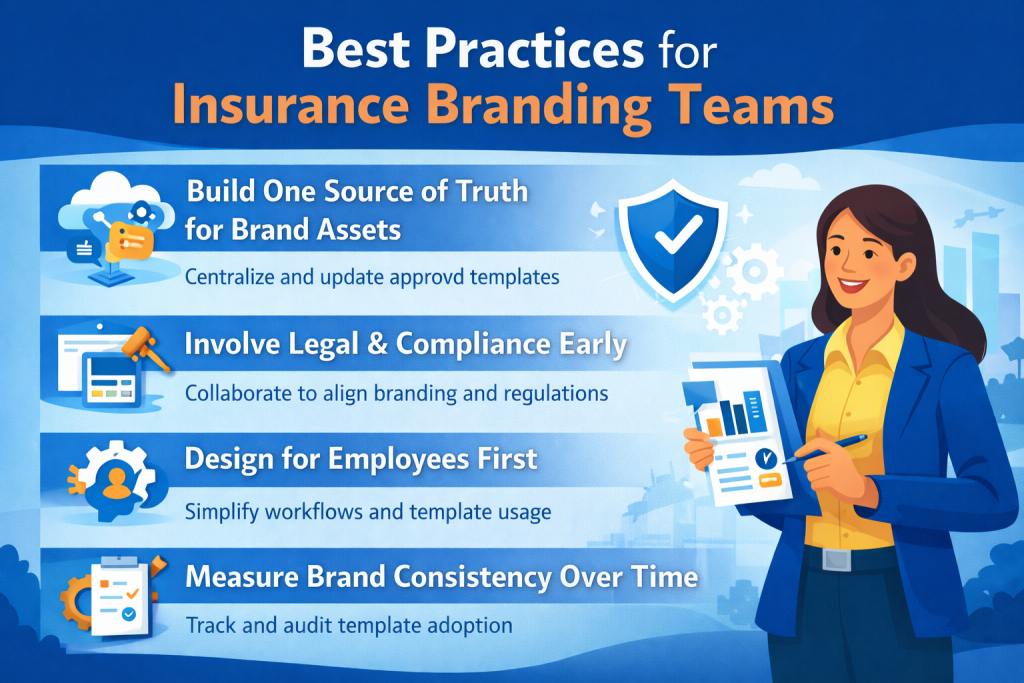
Strong insurance branding is not achieved through one big rebrand. It is built through disciplined, ongoing practices.
Build One Source of Truth for Brand Assets
Create a single platform where employees can always find the latest approved assets. Remove outdated files. Make access simple.
Involve Legal and Compliance Early
Branding and compliance should work together, not sequentially. When legal is involved early, templates can be designed correctly from the start.
Design for Employees First
If your employees cannot easily create on brand materials, your customers will never experience consistency. Internal usability directly affects external brand quality.
Measure Brand Consistency Over Time
Track how often approved templates are used. Monitor deviations. Use audits to identify where breakdowns occur. Consistency is a measurable operational metric.
Common Insurance Branding Mistakes to Avoid
Many insurance brands struggle not because of bad intentions, but because of structural gaps.
Common mistakes include:
- Treating branding as a marketing only function
- Allowing teams to modify templates freely
- Relying solely on PDF brand guidelines
- Ignoring internal workflows
- Updating visuals without updating documents
Avoiding these mistakes protects both brand equity and compliance.
Final Thoughts
Insurance branding is not about looking better than competitors. It is about building confidence at every step of the customer journey. From the first quote to the final claim resolution, your brand signals whether your organization is reliable, transparent, and easy to work with.
When branding is treated as an operational system rather than a surface level design exercise, consistency becomes automatic instead of manual. That consistency reduces risk, strengthens trust, and improves long term customer relationships.
In an industry where products often feel similar, experience becomes the real differentiator. Clear positioning, human communication, and scalable brand governance help insurers stand out in meaningful ways.
The insurers that invest in these foundations today will be better equipped to grow, adapt to regulatory change, and meet rising customer expectations without sacrificing control.
Frequently Asked Questions
Insurance branding is the strategy, identity, messaging, and experience design that shape how customers perceive and interact with an insurance company across all touchpoints.
An insurance branding strategy defines positioning, tone of voice, visual identity, brand architecture, and governance systems that ensure consistent experiences.
Branding builds trust, reduces perceived risk, improves conversion, and increases retention in a highly competitive and regulated market.
They use centralized asset libraries, approved templates, embedded rules, and governance workflows supported by technology.
Guidelines should cover positioning, tone of voice, visual identity, content standards, compliance rules, template usage, and asset governance.