
Someone on your team just asked for the logo. Again. You pointed them to the brand book. They opened a 60-page PDF, could not find the right file format, slacked a designer anyway, and ended up using a logo version from two years ago. The campaign launched with the wrong asset.
This is not a hypothetical. It happens at companies of every size, in every industry, every single week. And more often than not, the culprit is not a careless team. It is a brand management system that was designed for a different era of work.
The question of whether you need a brand book or digital brand guidelines is not just about preference or budget. It is about whether your current setup is actually working, or quietly costing you consistency, time, and trust in your brand.
This post breaks down what each format genuinely is, where the meaningful differences lie, and how to figure out which one your team has already outgrown.
What is a Brand Book, Really?
A brand book is a document that captures your brand’s foundational identity. Think of it as the original instruction manual for how your business should look, sound, and show up in the world. At its core, it covers the visual and verbal rules that define your brand: logo usage and clear space requirements, approved color palettes with hex and CMYK codes, typography choices and hierarchy, tone-of-voice guidelines, and, often, the mission, values, and positioning statements that shape messaging.
Brand books are typically created during a rebrand or brand launch. The primary use case is handoff. You create it once, share it with designers, agencies, and vendors, and expect people to follow it. For a long time, this made complete sense. Brand identity was relatively stable, teams were smaller and often in the same building, and marketing cycles were slower.
The format has varied over the years. Physical binders and glossy printed booklets were the original standard. The digital era shifted things to PDFs, which were easier to email but still fundamentally static. Today, many brand books live in a Dropbox folder or a shared Google Drive, rarely pinned anywhere prominent, rarely opened unless someone specifically goes looking.
Here is where brand books still genuinely work well, and it is worth being honest about this rather than dismissing them entirely:
- Early-stage startups building their identity for the first time
- One-off handoffs to an external agency for a specific campaign
- Board presentations and investor materials where a polished PDF is expected
- Brands with very stable visual identities that rarely change
The problem is not that brand books are bad. The problem is that most teams outgrow them faster than they realize and keep using them long after that point.
What are Digital Brand Guidelines?
Digital brand guidelines are a living, cloud-hosted system for managing and accessing your brand. Rather than a locked-down document, they exist as an always-current, always-accessible hub where the rules for your brand and the actual assets needed to execute them exist in the same place.
The structural difference matters more than it sounds. A PDF shows you what your logo should look like and tells you when to use it. Digital brand guidelines outline the rules and let you download the correct file immediately, in the right format and at the correct resolution. There is no gap between instruction and execution. The asset and its context live together.
What makes them genuinely different from a more polished PDF is the ability to update in real time. When your brand refreshes a logo, changes an approved font, or updates messaging after a rebrand, everyone accessing the hub sees the new version immediately. There is no redistribution cycle, no confusion about which version is current, and no designer fielding the same “do we have the updated file?” message fourteen times.
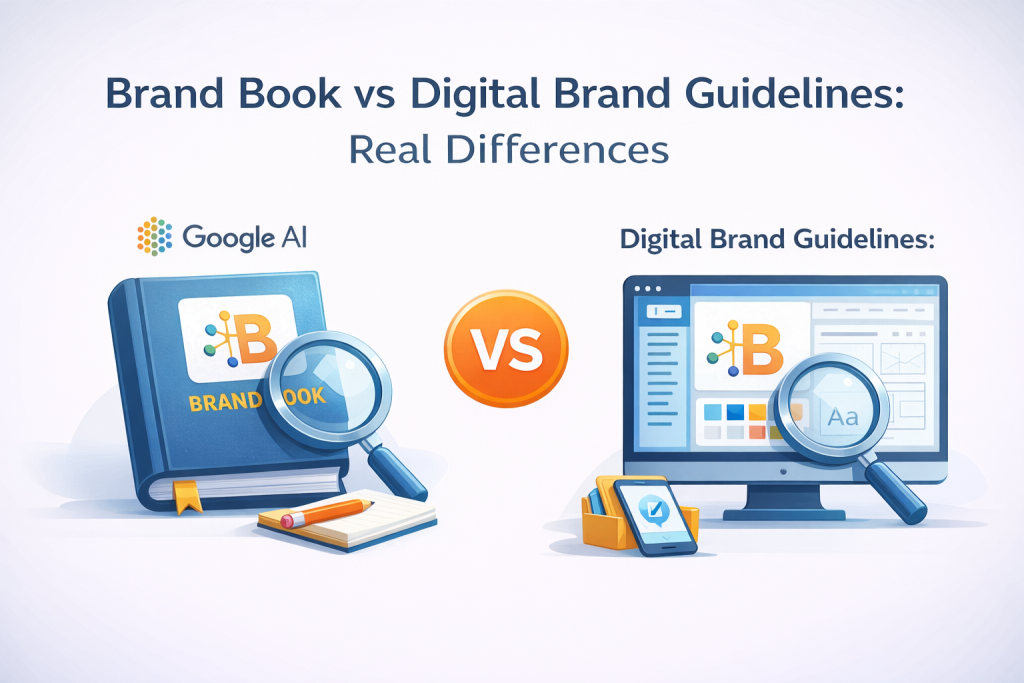
Brand Book vs Digital Brand Guidelines: Real Differences
This is where things get practical. The comparison between brand books and digital guidelines is not really about aesthetics or which format looks more impressive. It is about six operational differences that affect how your team works every single day.
Accessibility and Version Control
A PDF in someone’s Dropbox is only as useful as people’s ability to find it and trust that it is up to date. Version control on static files is notoriously messy. Files get renamed, forwarded, saved locally, and forgotten. Within six months of a rebrand, it is common for three different versions of a brand guide to be in active use across the same organization.
Digital brand guidelines eliminate this by definition. There is one URL. Everyone who accesses it sees the same content. When something changes, it changes everywhere at once. The version control problem disappears because there is only ever one version.
Assets and Context Living Together
This is arguably the most underappreciated difference. A brand book tells you the rules. A digital hub gives you the rules and the actual files side by side. You read that the primary logo should be used on white backgrounds with a minimum clear space of 20px, and right next to that instruction is the SVG, PNG, and EPS file ready to download.
Without this pairing, even the most thorough brand book creates friction. Someone reads the guidelines, then has to go somewhere else to find the asset, and in that gap, things go wrong. They use the version in their email history, or the one a colleague sent last quarter, or the one that was right before the last update.
Collaboration Across Departments
One of the quietest costs of PDF brand books is the designer-as-middleman problem. When assets are hard to find or access is unclear, people ask a designer. Not because the designer is the right person to go to, but because they are the most likely person to have the right file. Multiply that across a marketing team, a sales team, a content team, and a roster of external partners, and you have a significant invisible tax on your design team’s time.
Digital brand guidelines are built so that non-designers can operate independently. Marketing can pull campaign templates. Sales can access pitch deck assets. Legal can verify that branded documents meet current guidelines. External partners can download what they need without involving any members of your internal team.
Cost and Maintenance Over Time
Creating a PDF brand guide has an upfront cost that can be substantial if an agency is involved. More importantly, updating it is almost equally expensive. A significant change to brand identity means re-exporting the PDF, redistributing it to everyone who has the old version, and hoping that old files get replaced rather than used alongside the new ones.
Digital guidelines have a different cost structure. The initial setup takes effort, but updates are made directly in the platform and are reflected instantly. There is no redistribution cost, no version sprawl to manage, and no risk of outdated files persisting in use because someone did not receive the new PDF.
Scale and Team Size
A brand book written for a 10-person company will struggle when that company becomes 80 people across three time zones. At a certain point, the math simply does not work. Too many people are creating brand content, too many partners and vendors are accessing assets, and too many campaigns are running simultaneously for a single static document to serve as the source of truth.
This scaling problem shows up even faster in certain organizational structures:
- Franchise networks where individual locations need brand autonomy within defined rules
- Universities and institutions with dozens of departments, all producing branded content
- Agencies managing brand assets for multiple clients at once
- Technology companies running overlapping product and marketing campaigns
For all of these, a digital brand hub is not a nice-to-have. It is the only format that can realistically hold up.
Integration with Creative Workflows
A PDF sits outside every tool your team uses. Digital brand guidelines can connect to digital asset management systems, design platforms, and template tools. This means brand assets are accessible directly within the workflows where people are already working, rather than requiring a separate trip to a folder or document.
Who Should Still Use a Brand Book (and Who Has Already Outgrown It)?
Brand books are still the right call in specific situations. Solo founders defining their identity for the first time, teams preparing a one-time agency brief, or organizations with remarkably stable visual identities and a small design-fluent team will find that a well-structured PDF does the job without the overhead of a digital platform.
The case for digital guidelines becomes clear once you cross certain thresholds:
- Your team has more than five people regularly creating brand content
- You work with external agencies, freelancers, or vendors who need asset access
- Your brand has gone through any kind of update or refresh in the past two years
- You are running campaigns across more than two channels simultaneously
- You have experienced a branded content mistake caused by someone using outdated assets
If two or more of those are true, a PDF brand book is already working against you, even if the problems feel manageable right now.
How to Know Your Current System is Broken?
Sometimes the clearest signal is not a single failure but a pattern of small friction points that have become normalized. Watch for these:
Your designers regularly field requests for files they have already shared before. Multiple versions of the same logo appear in different materials across the same campaign. Onboarding new team members takes longer than it should because brand resources are scattered across folders, drives, and email threads. External partners ask for clarification on items that are technically documented in the brand guide because they cannot locate or navigate it efficiently. Campaign launches get delayed, not because the creative isn’t ready, but because someone is hunting for the right asset version.
Each of these is a symptom of the same underlying problem: your brand management system has more friction than your team can sustainably absorb.
Making the Move to Digital Brand Guidelines: What to Do First
Transitioning does not need to happen all at once, and it does not require rebuilding your brand identity from scratch. Start with an asset audit. Gather every logo file, color code, font, and template currently in use across your organization and lay them side by side. Identify inconsistencies. Are your hex codes consistent across platforms? Are there multiple logo variations in circulation? This audit tells you exactly what needs to be standardized before anything gets migrated.
From there, prioritize what to move first. Logos, color palettes, typography, and brand voice guidelines are the non-negotiables that every team member and external partner needs access to. Once those are in place and clean, expand to campaign kits, social media templates, and contextual usage examples that show the brand in action rather than just defining it in the abstract.
When choosing a platform, look for a few specific capabilities: the ability to share via link without requiring account creation for viewers, clear access controls so you can manage what partners and vendors can see, the option to update assets and guidelines without involving a developer, and a layout that makes the connection between rules and files visually obvious. Platforms like Brandy are built specifically to host digital brand guidelines, keeping assets and context together without the complexity of enterprise DAM tools.
Final Thoughts
A well-designed brand book is better than a poorly structured digital hub. A thoughtful PDF that people actually use is more valuable than a digital platform nobody visits. The format only matters insofar as it enables your team to represent the brand accurately, independently, and consistently at the scale you are currently operating at.
The honest question to ask is not which format is more modern or more impressive. It is whether the system you have right now is actually working, or whether your team has quietly been compensating for its limitations every week.
If the answer is the latter, the next step is not complicated. Audit your assets, identify what is broken, and build something your team will actually use.
Frequently Asked Questions
Yes, and for many organizations, this is the right answer. A downloadable PDF remains useful for offline contexts, board presentations, and agency handoffs. The digital hub serves as the living source of truth for the PDF.
Whenever something in your brand identity changes. The entire point of the digital format is that updates happen in one place and propagate instantly, so there is no reason to delay a correction or improvement.
Not necessarily from day one. But the tipping point comes earlier than most people expect. Once more than a handful of people are creating brand content, the inconsistencies that come from an unmanaged PDF brand book start to compound quickly.
Digital brand guidelines focus on the rules and context for using your brand. A brand hub typically includes guidelines, downloadable assets, organized collections, and templates. The concepts overlap significantly, and most modern platforms deliver both together.
They eliminate the repetitive cycle of resending files to clients, reduce the volume of off-brand deliverables, and give clients a self-serve resource that reduces dependency on the agency for basic asset requests.