
Internal communication is no longer a background function handled quietly by HR or operations. It has become a defining factor in how organizations scale, protect their brand, and keep people engaged in an increasingly complex work environment.
When communication works, teams understand priorities, trust leadership, and feel connected to the company’s mission. People know where to find information, which messages matter, and how their work contributes to broader goals.
When communication fails, the symptoms appear quickly. Confusion replaces clarity. Silos form. Brand messages drift. Employees start relying on assumptions instead of shared understanding.
Most of these problems do not come from a lack of effort. They come from a lack of structure.
A strong internal communication strategy creates that structure. It connects people, culture, and brand through intentional messaging, clear governance, and reliable systems. This guide walks through what internal communication really means today, why it matters more than ever, and the core communication types every organization needs to operate with confidence.
What Is Internal Communication and Why It Matters More Than Ever?
Internal communication is the framework organizations use to share information, direction, and context across their workforce. It includes leadership updates, training materials, brand guidance, operational processes, change announcements, and everyday collaboration.
It is not limited to broadcasting messages. True internal communication ensures people can easily access what they need, understand why it matters, and respond when necessary.
Modern workplaces are more distributed than ever. Teams operate across time zones. Roles evolve quickly. New tools are constantly introduced. Without a deliberate communication strategy, information becomes fragmented and difficult to trust.
Effective internal communication solves this by creating consistency.
Employees know where official information lives. They understand which channels to use. They recognize the tone and voice of the organization. Over time, this consistency builds confidence and reduces friction.
Internal communication also plays a direct role in brand strength. Employees are the first audience for your brand story. If they do not understand your positioning, values, and promise, external consistency becomes impossible to maintain.
Strong internal communication ensures your people are aligned before your messaging ever reaches the outside world.
The Definition Beyond Information Sharing
Many organizations still think of internal communication as sending emails, posting announcements, or publishing intranet updates. These activities are part of the picture, but they do not define success.
Effective internal communication:
- Provides context, not just instructions
- Explains decisions, not only outcomes
- Enables action, not only awareness
It supports employees in doing their work better. That means giving them clear guidance, easy access to approved resources, and channels to ask questions and share feedback.
When internal communication is treated as enablement rather than broadcasting, it becomes a performance multiplier instead of an administrative task.
Internal Communication vs External Communication
External communication focuses on shaping perception in the market. Internal communication focuses on shaping experience inside the organization.
The two are deeply connected.
If your external messaging promotes innovation, collaboration, and transparency, employees must experience those qualities internally. Otherwise, the brand promise feels hollow.
Strong organizations design internal and external communication to reinforce the same story. Messaging may be tailored to different audiences, but the core narrative remains consistent.
This alignment is what turns brand values from statements into lived behaviors.
The Link Between Communication, Culture, and Brand Identity
Culture is built through repeated signals. Communication delivers most of those signals.
What leaders prioritize. How success is recognized. Which stories are shared. How mistakes are addressed. These messages shape how people behave and what they believe is acceptable.
Brand identity works the same way.
Logos, colors, and typography matter, but they are only one layer. The deeper layer is how employees interpret and express the brand in everyday interactions.
Internal communication connects brand identity to daily work. It teaches employees what the brand stands for and how to represent it consistently.
When this connection is strong, employees become confident brand stewards. When it is weak, brand consistency becomes fragile.
The 7 Core Types of Internal Communication Every Organization Needs

No single communication channel or format can meet every need. Effective internal communication strategies intentionally combine multiple types of communication, each serving a specific purpose.
Together, they create a balanced ecosystem that supports alignment, clarity, and engagement.
Top Down Communication
Top down communication flows from leadership to the organization. It includes strategic updates, company performance, priorities, and long term vision.
Its primary goal is alignment.
Employees should clearly understand what matters most right now and where the organization is heading. This reduces uncertainty and helps people make better decisions in their own roles.
Top down communication works best when it is:
- Regular and predictable
- Honest and human
- Focused on clarity over polish
Town halls, leadership videos, and executive messages are common formats. What matters most is that leaders show up consistently and speak in plain language.
Change Communication
Change communication explains organizational shifts before confusion sets in.
This includes system changes, new processes, restructuring, policy updates, and strategic pivots.
Effective change communication answers four questions:
- What is changing
- Why it is changing
- When it will happen
- How it affects employees
When these questions are addressed early, resistance decreases and adoption improves.
Information and Knowledge Communication
This type of communication enables people to perform their work effectively.
It includes onboarding materials, training documentation, process guides, and role specific resources.
When knowledge is scattered across folders, chats, and outdated documents, productivity drops. People spend time searching or recreating information that already exists.
Centralized, well organized knowledge communication reduces friction and increases confidence.
Crisis Communication
Crisis communication focuses on speed, transparency, and trust.
During incidents or disruptions, employees need timely updates and clear guidance. Silence creates anxiety. Overly controlled messaging creates skepticism.
Honest communication, even when information is incomplete, builds credibility.
Two Way Communication
Two way communication creates space for dialogue.
It allows employees to ask questions, share feedback, and contribute ideas. This can happen through surveys, feedback tools, open forums, or direct manager conversations.
When people feel heard, engagement increases. When feedback is ignored, participation declines.
Peer to Peer Communication
Peer to peer communication enables collaboration across teams and departments.
It supports knowledge sharing, problem solving, and relationship building.
Organizations should invest in tools and processes that make peer communication easy and accessible.
Culture and Brand Communication
Culture and brand communication reinforces values, behaviors, and identity.
It includes recognition programs, storytelling, internal campaigns, and sharing examples of great work.
This type of communication reminds employees what the organization stands for and what success looks like beyond metrics.
The Business Impact: 5 Measurable Benefits of Strong Internal Communication
Strong internal communication is not a soft initiative. It delivers tangible business outcomes that directly affect performance, retention, and brand strength.
When communication is intentional and well structured, organizations see improvements across multiple dimensions.
Increased Employee Engagement and Retention
Employees who understand the company’s direction and feel included in the conversation are more engaged in their work. Engagement influences how much effort people invest, how long they stay, and how positively they speak about the organization.
Clear communication builds trust. Trust builds loyalty.
When employees receive consistent updates, understand how decisions are made, and have access to the information they need, they feel respected and valued. This reduces uncertainty and burnout, two major drivers of turnover.
Over time, strong internal communication contributes to a more stable, motivated workforce.
Faster Decision Making and Execution
When people know priorities and have access to accurate information, they make better decisions faster.
Teams do not need to wait for clarification or chase context. They understand what success looks like and how their work fits into broader goals.
This reduces bottlenecks and shortens execution cycles. Projects move forward with fewer revisions and less rework.
Speed becomes a competitive advantage.
Stronger Brand Consistency Across Teams
Every internal message shapes how employees interpret the brand.
When brand guidelines, approved templates, and messaging frameworks are easy to access, employees naturally communicate in a consistent way. This consistency carries through to customer interactions, presentations, proposals, and campaigns.
Strong internal communication acts as the first layer of brand governance.
Improved Cross Functional Collaboration
Misalignment between teams often comes from missing or inconsistent information.
Clear communication reduces misunderstandings and helps teams coordinate more effectively. People know who owns what, where to find resources, and how to work together.
This leads to smoother handoffs and fewer conflicts.
Reduced Operational Risk and Miscommunication
Outdated documents, unofficial templates, and unclear processes increase risk.
Strong internal communication creates clarity around what is approved, current, and accurate. This reduces errors, compliance issues, and reputational risk.
Why Most Internal Communication Strategies Fail?
Many organizations invest in communication tools but still struggle with alignment. The problem is rarely technology alone. It is usually a lack of structure and governance.
Tool Overload Without Governance
Teams use multiple platforms for messaging, file sharing, collaboration, and knowledge storage.
Without clear ownership and standards, information becomes fragmented. Employees do not know which source to trust. Adding more tools does not solve this problem. Defining how tools are used does.
Inconsistent Messaging Across Departments
When each department communicates in its own way, the organization develops multiple internal narratives.
Employees receive mixed signals about priorities and values. Brand consistency weakens. A shared communication framework prevents this fragmentation.
Lack of Leadership Visibility
If leaders are silent or inconsistent, employees feel disconnected from direction. Strong internal communication requires visible, regular leadership participation.
No Central Source of Truth for Brand and Content
When brand assets, templates, and guidelines are scattered, employees create their own versions.
This leads to inconsistency and wasted effort. Centralization is essential.
How to Build an Internal Communication Strategy That Actually Works?
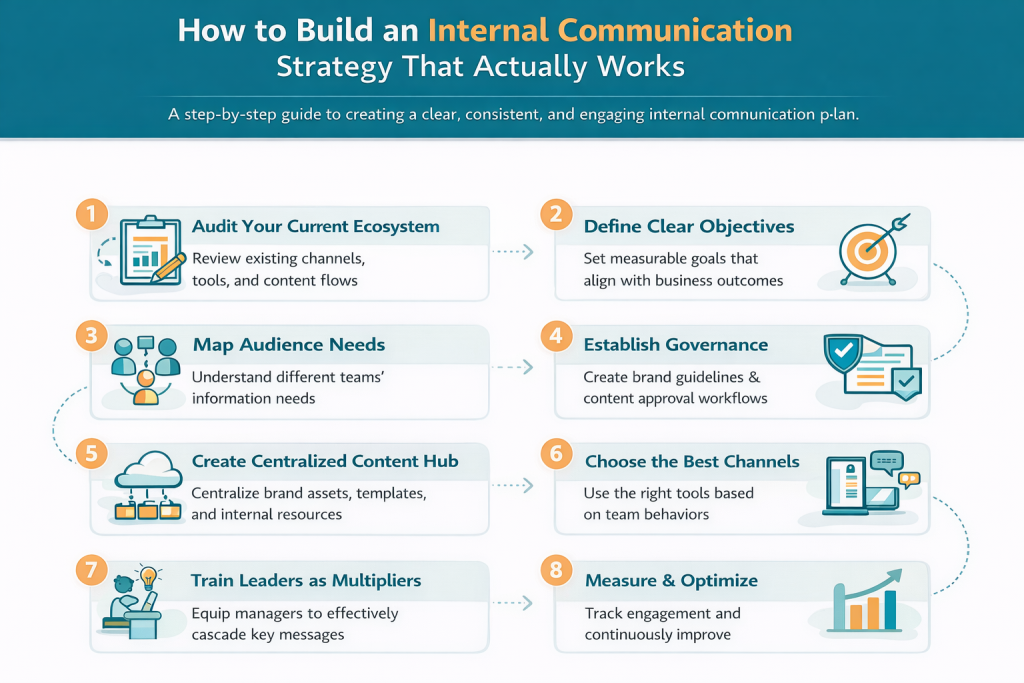
An effective strategy is built intentionally. It balances people, process, and platform.
Step 1: Audit Your Current Communication Ecosystem
Map all channels, tools, and content sources. Identify what is working, what is ignored, and where friction exists. Talk to employees about their experience. Their input reveals blind spots.
Step 2: Define Clear Objectives Linked to Business Outcomes
Decide what you want internal communication to achieve.
Examples include improving engagement, increasing brand consistency, or accelerating onboarding. Clear objectives guide every other decision.
Step 3: Map Audience Segments and Communication Needs
Different teams need different information.
Executives, managers, frontline employees, and global offices each have unique needs. Segmenting audiences ensures relevance.
Step 4: Establish Governance and Brand Guidelines
Define tone of voice, messaging principles, approval workflows, and content ownership. This creates consistency without slowing teams down.
Step 5: Create a Centralized Content Hub
Employees should know exactly where to find:
- Brand guidelines
- Approved templates
- Training materials
- Internal announcements
Centralization reduces confusion and duplication.
Step 6: Choose Channels Based on Behavior
Use channels employees already engage with. Email, intranet, collaboration tools, video, and mobile platforms all have a role.
The key is clarity around what each channel is used for.
Step 7: Train Leaders as Communication Multipliers
Managers play a critical role in reinforcing messages.
Equip them with talking points, context, and assets so they can cascade information effectively.
The Role of Digital Asset Management in Internal Communication
Digital asset management supports internal communication by creating a single source of truth for brand and content.
It centralizes logos, templates, presentations, images, videos, and guidelines in one secure location.
This ensures employees always use approved, up to date assets.
Digital asset management also enables permissions, version control, and governance. Teams can access what they need without risking misuse.
For internal communication, this means faster content creation, stronger brand consistency, and lower operational risk.
Measuring Internal Communication Success the Right Way
Success is measured by engagement, not volume.
Track metrics such as:
- Open and click through rates
- Intranet usage
- Participation in initiatives
- Employee survey feedback
Look for patterns over time rather than isolated numbers.
Qualitative feedback is just as important as quantitative data.
Final Thoughts
Internal communication is not a side project. It is the system that determines how well your organization functions, grows, and protects its brand.
When communication is clear, consistent, and accessible, people feel confident in their roles because they understand priorities, trust leadership decisions, and know how to represent the brand accurately in every interaction.
This does not happen by accident. It requires intention, structure, and the right foundation. A strong internal communication strategy connects people, processes, and content in one cohesive ecosystem.
For growing organizations, that foundation must include a reliable way to manage brand assets, templates, and guidelines in one central place. When employees can easily find and use approved content, communication becomes faster, more consistent, and far less risky.
Brandy helps teams bring internal communication and brand governance together through centralized digital asset management, brand portals, and templated content creation. The result is a connected organization where everyone communicates with clarity and confidence.
Strong brands are built from the inside out. Internal communication is where that work begins.