You spent weeks building the perfect brand. A logo that clicks, colors that feel right, a voice that sounds like you. Then six months later, your agency uses the wrong logo variant. Your new hire writes in a tone that doesn’t align with the brand. A partner slaps your logo on a neon background.
None of that happens with clear brand guidelines. But here’s the thing most guides won’t tell you: the problem usually isn’t missing guidelines. It’s guidelines that nobody can find, nobody understands, and nobody updates.
This is the only guide you need to build brand guidelines that actually get followed, from first draft to long-term maintenance.
What are Brand Guidelines?
Brand guidelines are a documented set of rules that define how your brand looks, sounds, and behaves across every channel and format. They cover visual identity (logo, colors, typography, imagery), brand voice, tone of communication, and how your brand should be applied across both digital and physical touchpoints.
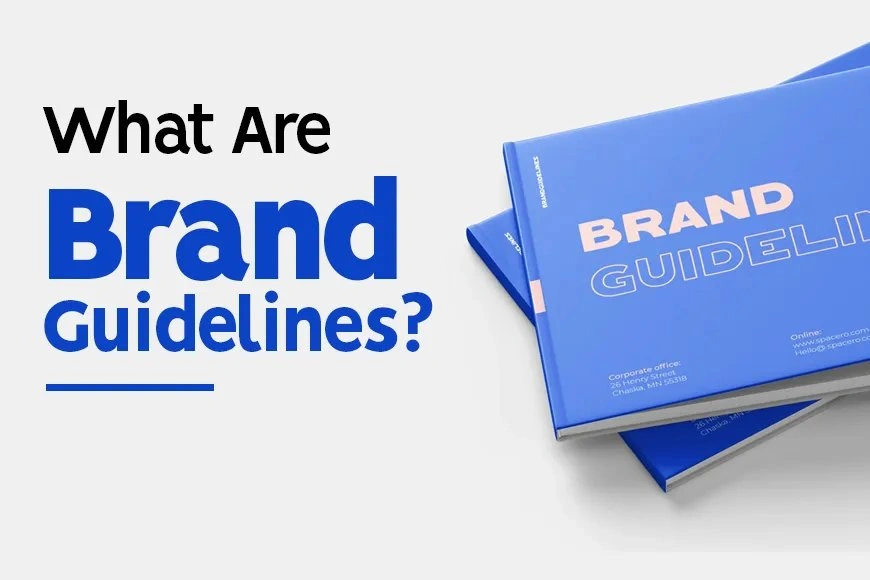
Think of brand guidelines less as a rulebook and more as a decision-making shortcut. When a designer needs to build a new landing page, a freelancer is writing ad copy, or an agency is producing a campaign, brand guidelines eliminate guesswork and prevent the slow, expensive drift of inconsistency.
Strong brand guidelines answer three questions for anyone working with your brand: What should this look like? How should this sound? And what is and isn’t acceptable?
Why Brand Guidelines Matter More Than Ever in 2026?
The average consumer encounters your brand across more touchpoints than ever before: social media feeds, email inboxes, search results, video ads, physical spaces, and word-of-mouth referrals. Research consistently shows it takes between 6 and 8 meaningful interactions before a prospect is ready to buy. Every inconsistent touchpoint wastes one of those interactions.
Brands that maintain consistent visual and verbal identities across channels are more recognizable, more trusted, and easier to remember. Consistency builds the kind of familiarity that eventually becomes preference.
Beyond the customer-facing benefits, brand guidelines create internal efficiency. Designers stop asking for approvals on things that should already be decided. Marketers don’t need to reinvent the wheel with every campaign. Agencies and contractors can get up to speed faster. Time saved in the creative process compounds significantly over time.
Why Most Brand Guidelines Fail (And How to Fix It Before You Start)?
Before building your guidelines, it’s worth being honest about why brand guidelines fail in practice. The same mistakes keep showing up.
They’re too long. A 60-slide PDF is well-intentioned but impractical. Nobody reads it cover to cover under deadline pressure, and nobody searches through it when they need a quick answer.
They’re impossible to find. Files in “Marketing > Assets > Brand > Final > Brand_Final_v3_FINAL” aren’t used. If a team member can’t locate what they need in 30 seconds, your guidelines might as well not exist.
They go stale. A guideline that references a logo you redesigned 18 months ago actively damages your brand. Outdated documentation trains people to ignore the whole system.
They ignore real-world scenarios. Guidelines that only cover ideal conditions fall apart the moment someone needs to adapt the logo for a podcast cover, a conference badge, or a co-branded campaign.
Knowing these failure modes changes how you build. Every decision you make during the process should ask: Will a real person actually use this?
What Your Brand Guidelines Should Cover?
Your brand guidelines should clearly define how your brand looks, feels, and communicates across every touchpoint. They act as a rulebook that ensures consistency, recognition, and trust in every customer interaction.
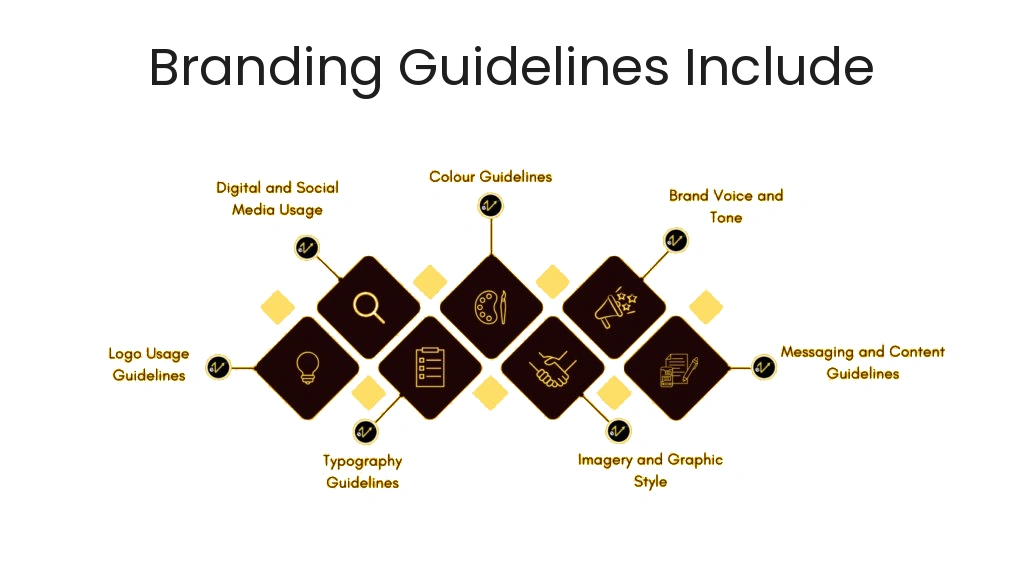
From logo usage and color palette to tone of voice and imagery style, strong guidelines keep every design and message aligned with your brand identity.
Brand Foundation
Before a single hex code gets documented, define why your brand exists. This section gives context and rationale to every creative decision that follows.
Your mission explains what your company does and who it serves today, while your vision defines the long-term direction you are working toward. Your values guide everyday decisions and behavior across the organization. Positioning highlights how you stand apart from competitors, and your target audience defines exactly who you are speaking to, including their needs, goals, and challenges.
This section rarely gets the attention it deserves. But when a designer or copywriter understands the why behind the brand, they make far better judgment calls on everything downstream. It’s the difference between a team that follows the rules and one that understands them.
Visual Identity
This is the section most people think of first. Visual identity is how your brand communicates before anyone reads a word.
Logo
Your logo section should cover the primary logo, secondary or horizontal versions, icon-only marks, and approved lockups. Define minimum sizes, clear space, and which background colors are allowed or restricted for both digital and print use. Include visual examples of incorrect usage, like stretching, color changes, drop shadows, or placing the logo on busy backgrounds. Showing what not to do often prevents more mistakes than written rules alone.
Color Palette
Define your primary, secondary, accent, and neutral colors with HEX, RGB, and CMYK values for consistent use across digital and print. Include accessibility guidance and confirm your key color combinations meet WCAG contrast standards for readable, inclusive design.
Typography
Document your primary typeface for headlines and display use, your secondary typeface for body copy, and the system font fallbacks for environments where brand fonts aren’t available. Establish a type scale covering the sizes and weights for H1 through body text and captions, as well as line spacing and tracking rules. A team that shares a type system creates work that looks cohesive without effort.
Imagery and Photography
Describe the visual style of your photography and illustration. What subjects, lighting, and compositions feel on-brand? What should be avoided: clichéd stock imagery, inconsistent color grading, or a visual tone that doesn’t match your brand personality? If you use illustrations or icons, specify the style and provide the approved library. Imagery is where many brands become inconsistent fastest, because it feels more subjective than color or type.
Brand Voice and Tone
Your voice is your brand’s consistent personality. Your tone adapts to the situation. Both need to be documented clearly, and both are often underdeveloped in brand guidelines.
Defining Your Voice
Rather than listing abstract adjectives, define your voice through contrast. This format is more useful in practice:
We are confident without arrogance, approachable without being careless, clear without being blunt, and knowledgeable without relying on jargon.
Four to five contrasting pairs give writers a usable reference rather than a vague aspiration.
Tone in Context
Show how the tone shifts across different situations your brand regularly encounters. A product launch announcement sounds different from a customer complaint response. A social media caption reads differently from an investor update. Document the most common communication scenarios your team faces and describe how the tone should adjust in each one, while the voice remains the same.
Language Do’s and Don’ts
Include preferred terminology. Do you say “clients” or “customers”? “Platform” or “tool”? Document words or phrases the brand avoids, punctuation and capitalization preferences, and how numbers, dates, and formatting are handled in copy. These small details are where written communication falls apart without guidance.
Brand Applications
Show how your brand translates into real-world formats. Rules without examples leave too much to interpretation.
Digital Applications
Cover website design standards, including header treatments, button styles, grid systems, and component guidelines if applicable. Document email template standards, including header, footer, and CTA styling. For social media, provide platform-specific guidance on profile images, cover photos, and post templates. Include a presentation or slide deck template that any team member can pick up and use.
Print and Offline Applications
Cover business cards, letterhead, branded documents, and packaging if relevant. Include event signage, display materials, and any merchandise your brand produces. Physical applications are often neglected in favor of digital, but they matter enormously for brands with any offline presence.
Third-Party and Partner Usage
If agencies, affiliates, or co-brand partners use your assets, this section protects your brand from well-intentioned misuse. Specify which assets are available for external use and which are restricted. Define co-branding rules: how should partner logos be sized and placed? Establish an approval process so nothing goes live without sign-off. And make clear where partners can download official, current assets.
How to Create Brand Guidelines: Step by Step
Here is a simple step-by-step guide to creating brand guidelines. This will help you build a clear, consistent, and easy-to-follow brand system.
Step 1: Run a Brand Audit Before You Build Anything
Pull examples of your brand from every active channel: website, social media, email campaigns, sales decks, and printed materials. Look for inconsistencies, outdated elements, and places where the brand has drifted from its intended identity. What looks off? What’s working well and should be codified?
Your audit becomes the brief for your guidelines. It tells you what needs fixing and what needs preserving.
Step 2: Define Your Brand Foundation
Write your mission, vision, values, and audience profile before touching any design files. These anchor every creative decision that follows. Even if these are already defined somewhere, revisit them now. Brand guidelines are a useful forcing function to confirm your foundation still reflects where the company is today.
Step 3: Document Visual Identity Systematically
Work through logo, color, typography, and imagery in sequence. For each element, define the rule, show a correct example, show a common incorrect example, and provide the file or asset. Figma is particularly useful here because you can show zoomable, live examples alongside the specifications, which is much clearer than static screenshots.
Step 4: Write Your Voice and Tone Guide
The easiest way to start: pull 10 to 15 pieces of content that feel perfectly on-brand: a great email, a tweet that nailed the tone, a product description that felt exactly right. Read them together and identify what they have in common. That’s your voice. From there, document how the tone adjusts across the four or five scenarios most relevant to your business.
Step 5: Build Templates Before You Publish
Templates are the most underrated part of any brand system. An on-brand social media template does more for day-to-day consistency than three pages of rules ever will. Before publishing your guidelines, build templates for the formats your team uses most: social posts for each active platform, email header and footer, presentation template, and document letterhead. Make them available alongside the guidelines, not buried in a separate folder.
Step 6: Store Everything in One Central, Accessible Place
This is where most brands fall short. Guidelines only work if the right person can find the right asset in under 60 seconds.
Scattered files across shared drives, Slack messages, and email threads are a slow killer of brand consistency. The answer is a dedicated brand hub: one place where your guidelines, logos, color codes, fonts, templates, and usage rules all live together, always current and accessible to anyone who needs them.
Step 7: Get Cross-Team Input Before Finalizing
Brand guidelines affect everyone who touches the brand: design, marketing, sales, customer support, and external partners. Before you finalize, share a draft with representatives from each team. Ask what’s unclear, what’s missing, and what scenarios aren’t covered. Guidelines are built with cross-team input. Guidelines handed down from above get ignored.
Step 8: Establish Ownership and a Review Cycle
Set a recurring calendar reminder to review your brand guidelines at least once a year, and after any significant brand event, such as a rebrand, product launch, major campaign, or change in positioning. Assign a clear owner, so updates don’t fall through the cracks. No owner means no updates, which means guidelines that gradually become useless.
How Brandy Helps You Manage Brand Guidelines the Right Way
Creating strong brand guidelines is only half the challenge. The other half is making sure they’re actually used by your internal team, your agencies, your freelancers, and your partners.
That’s exactly what Brandy is built for.
Brandy is a brand asset management platform that gives your entire brand a permanent, organized home that everyone can access. That means your guidelines, logos, fonts, color palettes, templates, and usage rules are all in one place. Instead of hunting through shared drives or asking a designer to resend the approved logo for the fourth time, your team has a single source of truth they can access from any device, at any time.

For internal teams, Brandy means everyone is always working from the current, approved version of your brand assets. No more outdated logos being used in decks, no more off-brand color choices from someone who wasn’t sure which shade to use.
For external partners and agencies, Brandy lets you share specific assets and guidelines without giving access to everything. Partners get what they need to represent your brand correctly, and you stay in control of what’s available.
For brand managers, Brandy makes updating guidelines simple. When your color palette evolves, or you launch a new logo variant, you update it once in Brandy, and everyone is immediately working from the new version. No more version confusion, no more chasing down outdated files.
For growing teams, Brandy scales with you. As you add team members, bring on new agencies, or expand into new markets, your brand foundation stays consistent because the source of truth is always in one place.
Brand guidelines in a PDF are just static files, but in Brandy, they become a living system that stays updated, usable, and actually drives consistency across your brand
Brand Guidelines vs Style Guide: Understanding the Difference
These terms get used interchangeably, but they serve different purposes.
A brand guide focuses on your brand’s visual identity and how it looks. It covers logos, colors, typography, imagery, and design applications across formats.
A style guide focuses on written communication and how your brand sounds. It covers grammar and punctuation preferences, capitalization rules, terminology choices, tone of voice, and editorial standards.
Many organizations combine both into a single document. Others keep them separate, especially when the writing style guide needs to go deeper for content and editorial teams. Either approach works. What matters is that both exist, are accessible, and are kept up to date.
Brand Guideline Examples Worth Studying
Spotify demonstrates thorough logo usage documentation, including minimum sizes, clear space requirements, and approved contexts for the full logo versus the icon alone.
Netflix provides specific guidance on contrast ratios and acceptable logo treatments, with clear visual examples of what is and isn’t permitted, including why a white logo is only approved as a video watermark.
Burger King shows how brand guidelines can extend to custom typography, with a proprietary typeface designed to echo the visual language of its food.
Starbucks publishes an interactive brand style guide that shows how core elements like the Siren logo and green palette translate across channels, from packaging to digital to in-store environments.
Walmart covers logo, photography, typography, illustration, iconography, voice, and editorial style in a unified system, with the signature blue given explicit treatment as the primary brand color.
What these brands share isn’t just strong guidelines. It’s that the guidelines are accessible, specific, and maintained over time.
Common Brand Guideline Mistakes to Avoid
Providing assets without context. A logo file with no usage guidance will be misused. Every asset needs rules attached.
Making the same rules for every channel. Instagram content and LinkedIn content require different approaches. Guidelines that ignore platform context create either robotic consistency or practical uselessness.
Forgetting to include the target audience. Messaging and visuals should always connect back to who they’re intended for.
Neglecting third-party usage. Without clear rules for partners and agencies, your brand will drift in directions you didn’t approve.
Never update the document. Brand guidelines that aren’t maintained become a liability. Schedule reviews and assign ownership before you publish.
Building guidelines in isolation. The people who use your guidelines daily, including designers, copywriters, and marketers, need to have input into them. Build with your team, not just for them.
Final Thought
The best brand guidelines aren’t the most comprehensive. They’re the ones that get used.
Build for the person who’s in a hurry, working with an unfamiliar format, or coming to your brand as an outside agency for the first time. Make the rules crystal clear, keep all brand assets easily accessible, and use concrete examples so there’s no room for confusion or misinterpretation.
And give your guidelines a permanent home: not a shared folder, not an email attachment, not a PDF that gets downloaded and forgotten. A living brand hub that your whole team can access, trust, and rely on.
That’s the difference between brand guidelines that exist and brand guidelines that work.
Ready to give your brand assets a home they deserve? Start with Brandy, brand management built for teams who take consistency seriously.