
Retail is evolving faster than at any point in its history. Digital channels continue to expand, customer expectations keep rising, and the volume of content required to support modern retail has grown beyond what traditional systems can handle. Every product launch, seasonal campaign, and localized promotion now depends on accurate, on brand digital assets being delivered at speed.
Forrester’s 2025 research makes one reality clear. Retail brands are no longer struggling with a lack of creativity. They are struggling with scale, coordination, and control. As online retail growth continues to outpace total retail growth, marketing teams are expected to deliver more personalized content across more channels without compromising brand consistency or compliance.
This is where Digital Asset Management in retail has shifted from a supporting tool to core infrastructure. According to Forrester, DAM is becoming the system that connects content creation, brand governance, and omnichannel execution. It enables retailers to move faster, reduce operational friction, and protect brand value in an always on marketplace.
This article explores what Forrester’s 2025 insights reveal about the role of Digital Asset Management in retail and why it has become essential for brands that want to compete and grow at scale.
Why Digital Asset Management in Retail Has Become Mission Critical
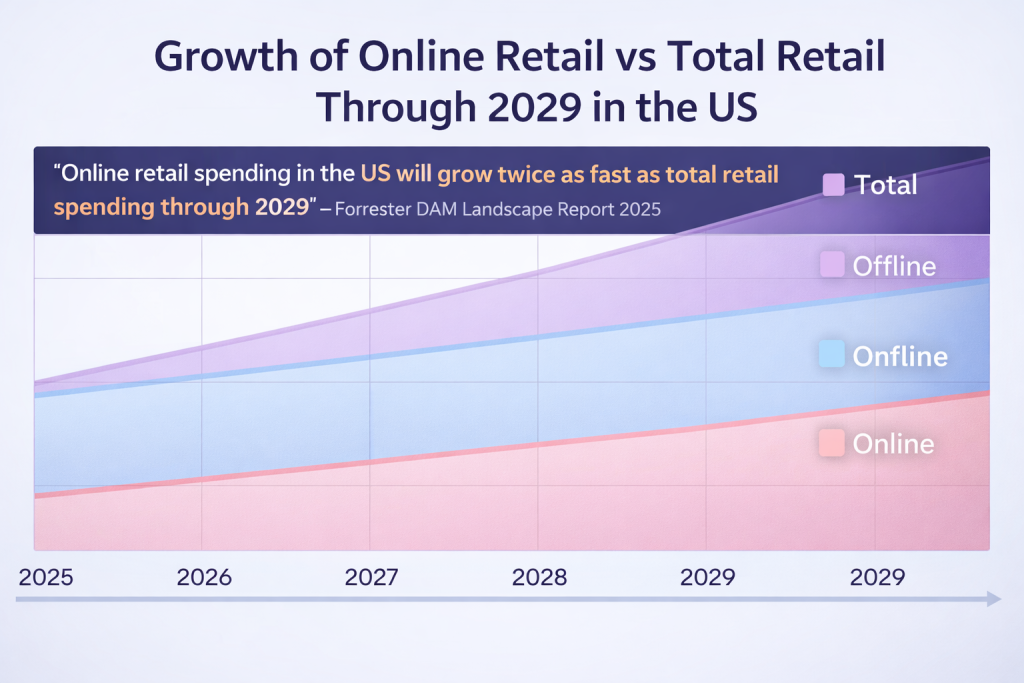
Retail marketing now operates in one of the most demanding content environments of any industry. Product assortments change frequently, campaigns run across dozens of channels, and customers expect a consistent experience whether they are browsing online, using a mobile app, or visiting a physical store. Forrester’s 2025 findings highlight that this growing complexity is the primary reason retail brands are accelerating investment in Digital Asset Management.
At its core, the challenge is not creativity. It is coordination. Without a central system, assets live in disconnected tools, teams reuse outdated files, and brand standards become difficult to enforce. As content volumes increase, these small inefficiencies quickly turn into missed opportunities and brand risk.
Retail Is the Most Content Intensive Industry
Retail teams produce and manage an enormous range of assets. Product images, lifestyle photography, videos, banners, social media creatives, and in store materials are constantly refreshed. Seasonal promotions and frequent launches multiply this demand even further.
Forrester points out that retail brands must support high velocity content cycles while maintaining accuracy. A single product update may require dozens of asset variations across regions and channels. Without Digital Asset Management in retail, this scale becomes unmanageable.
How Content Complexity Slows Retail Growth
When assets are scattered across folders and tools, teams spend valuable time searching, recreating, or validating content. Version confusion leads to incorrect pricing visuals, outdated packaging images, or off brand promotions reaching customers.
These issues directly affect speed to market. Campaigns launch later than planned, ecommerce updates lag behind inventory changes, and local teams hesitate to act because they are unsure which assets are approved. Over time, this slows growth and erodes confidence across teams.
What Forrester Identifies as the Core DAM Drivers in Retail
Forrester’s 2025 analysis shows that retailers adopt DAM to regain control over content operations. The goal is not just storage. It is visibility, governance, and reuse. A modern DAM provides a single source of truth for digital assets, ensuring teams can move quickly without sacrificing consistency.
By centralizing assets, permissions, and workflows, Digital Asset Management in retail becomes the foundation for faster execution, lower operational cost, and stronger brand alignment across every customer touchpoint.
How Forrester 2025 Reframes DAM as a Retail Growth Engine
Forrester’s 2025 perspective makes it clear that Digital Asset Management in retail is no longer viewed as a background system. It has become a growth enabler that directly impacts how quickly retailers can respond to market demand, launch campaigns, and deliver consistent brand experiences. The shift is from managing files to orchestrating content operations at scale.
Retail brands that treat DAM as infrastructure rather than storage gain a measurable advantage in speed, coordination, and customer trust.
From File Repository to Content Command Center
Traditional asset libraries were built to store and retrieve files. Modern DAM platforms function as a central command center for retail content. They connect assets to context, usage rules, and workflows, giving teams clarity instead of clutter.
Forrester highlights that leading retailers use DAM as the system of record for approved content. This ensures that every team works from the same source of truth, reducing rework and eliminating uncertainty around which assets are current and compliant.
Faster Time to Market for Retail Campaigns
Speed is a competitive advantage in retail. Whether launching a seasonal promotion or responding to market trends, delays cost revenue. DAM removes friction by making assets easy to find, reuse, and adapt.
With structured metadata and clear approvals, teams no longer wait for manual confirmations. Campaigns move from concept to execution faster, allowing retailers to stay relevant in fast moving markets.
Omnichannel Consistency Across Digital and Physical Touchpoints
Retail brands operate across websites, apps, marketplaces, social media, email, and physical locations. Forrester emphasizes that consistency across these touchpoints is critical to building trust.
Digital Asset Management in retail ensures that the same approved visuals, messaging, and product representations appear everywhere. This alignment strengthens brand recognition and reduces customer confusion, regardless of where the interaction occurs.
Operational Efficiency Across Marketing and Ecommerce Teams
DAM also improves collaboration between marketing, ecommerce, and merchandising teams. Assets flow more easily between departments, and updates propagate faster across channels.
Forrester notes that when DAM is embedded into daily workflows, teams spend less time managing assets and more time optimizing performance. The result is a more agile retail operation that can scale content output without increasing complexity.
How DAM Protects Retail Brands at Scale
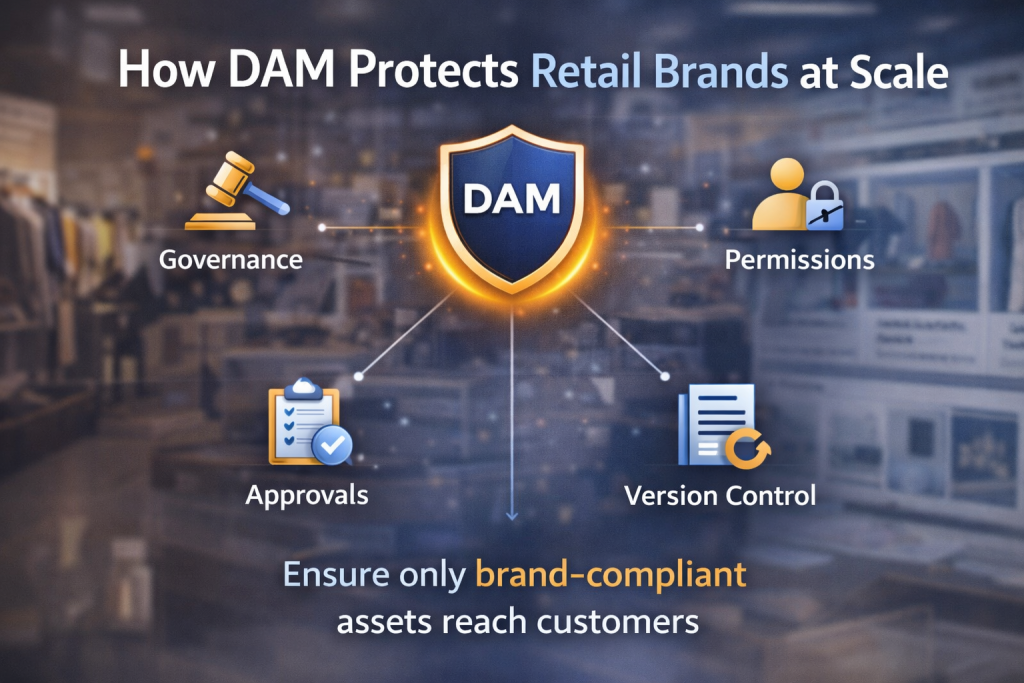
As retail brands expand across regions and channels, protecting brand integrity becomes increasingly difficult. Forrester’s 2025 insights highlight that one of the most important roles of Digital Asset Management in retail is governance. Without structured controls, speed and scale can easily lead to inconsistency and risk.
A modern DAM provides the framework retailers need to grow without losing control.
Maintaining Brand Consistency Across Regions and Markets
Global and regional teams often need flexibility to adapt campaigns for local audiences. The challenge is allowing that flexibility without compromising brand standards. DAM enables this balance by giving teams access to approved assets, templates, and guidelines within clear boundaries.
Forrester points out that retailers using DAM can empower local teams to move quickly while maintaining alignment with global brand rules. This reduces friction between headquarters and regional teams and ensures consistent brand expression everywhere.
Built In Compliance and Rights Management
Retail content frequently includes licensed imagery, talent agreements, and regulatory requirements. Managing these manually becomes risky as asset volumes grow. DAM platforms help track usage rights, expiration dates, and approval history directly within the asset lifecycle.
Forrester emphasizes that built in governance reduces the likelihood of non compliant assets reaching customers. This protects retailers from legal exposure and reputational damage without slowing down marketing teams.
Why Accurate Assets Build Customer Trust
Customers expect product visuals and information to reflect reality. Outdated or incorrect assets lead to disappointment, returns, and lost trust. DAM ensures that only current and approved assets are available for use across ecommerce and marketing channels.
By maintaining accuracy and consistency, Digital Asset Management in retail supports better customer experiences and reinforces confidence in the brand. Over time, this trust becomes a competitive advantage that directly influences loyalty and conversion.
The Role of AI in the Future of Digital Asset Management in Retail
Forrester’s 2025 research shows that the next phase of Digital Asset Management in retail is being shaped by AI. As content volumes increase and personalization becomes the expectation, manual processes are no longer enough. Retailers are turning to intelligent automation to keep pace without sacrificing brand control.
AI does not replace creative teams. It supports them by removing friction, accelerating execution, and enforcing consistency at scale.
How AI Is Changing Retail Content Creation and Distribution
AI is helping retail teams manage repetitive and time consuming tasks that slow down campaigns. Automated tagging, smart search, and content recommendations reduce the effort required to organize and retrieve assets. Teams spend less time managing files and more time focusing on strategy and creativity.
Forrester highlights that AI powered DAM systems improve discoverability across large asset libraries. This is especially valuable for retailers managing thousands of product visuals and variations across regions.
Personalization at Scale Without Losing Control
Personalized retail experiences require content that adapts to customer context while staying on brand. DAM enabled AI supports this by delivering the right asset variation based on channel, region, or audience while respecting brand rules.
Forrester notes that this balance between personalization and governance is critical. Without structure, personalization creates risk. With DAM and AI working together, retailers can scale tailored experiences without fragmenting their brand.
Creative Enablement Beyond Design Teams
AI also expands who can safely work with content. Non designers can adapt assets using approved templates and automated checks. This reduces bottlenecks while protecting quality.
Forrester emphasizes that democratizing content creation only works when guardrails are in place. DAM provides those guardrails, ensuring every output remains aligned with brand standards.
Why Governance Matters More as AI Expands
As automation increases, governance becomes more important, not less. Metadata quality, approval logic, and brand rules must be clearly defined for AI systems to function responsibly.
Forrester’s perspective reinforces that retailers who invest in structured DAM foundations are best positioned to benefit from AI without losing trust or control.
What Retail Leaders Should Look for in a Modern DAM Platform
Forrester’s 2025 insights make it clear that not all DAM platforms are built for the realities of retail. As content operations grow more complex, retail leaders must evaluate DAM solutions through the lens of scale, governance, and long term adaptability rather than short term convenience.
A modern DAM for retail should support high volume content, fast execution, and strict brand control without creating friction for teams.
First, scalability is essential. Retail brands need a platform that can handle growing asset libraries, increasing users, and expanding regions without performance issues. DAM should scale smoothly as product lines and channels multiply.
Second, usability drives adoption. If teams struggle to find or reuse assets, the system will fail regardless of its capabilities. Forrester emphasizes that intuitive interfaces and clear workflows are critical for widespread use across marketing, ecommerce, and partner teams.
Third, governance must be embedded, not bolted on. Permissions, approvals, and usage rules should be part of everyday workflows. This ensures speed and compliance can coexist rather than compete.
Finally, AI readiness matters. Retail leaders should look for DAM platforms built on strong metadata structures that support intelligent automation and future personalization needs. The right DAM is not just a tool for today but a foundation for how retail brands will operate in the years ahead.
How Brandy Complements DAM for Retail Brand Clarity

While a DAM platform manages storage, access, and distribution of assets, many retail teams still struggle with one core challenge: brand clarity. Assets may be available, but teams are often unsure how they should be used, adapted, or combined across campaigns and regions. This is where Brandy fits naturally alongside Digital Asset Management in retail.
Brandy helps retail teams define and document their brand system in a way that is clear, accessible, and actionable. Brand guidelines, approved visuals, messaging rules, and usage context are brought together in one place, giving teams confidence before they even enter a DAM workflow. This clarity reduces back and forth, speeds up approvals, and minimizes misuse.
For retail organizations operating at scale, Brandy acts as the alignment layer. It ensures that global and local teams share the same understanding of the brand while still allowing flexibility for regional execution. When paired with a DAM, Brandy helps ensure that assets are not just stored and distributed efficiently, but used correctly and consistently.
Together, DAM and Brandy support faster retail execution without sacrificing brand integrity. Retail leaders gain a system that scales content operations while keeping brand expression clear, trusted, and repeatable across every channel and market.
DAM Is the Infrastructure Powering Modern Retail Growth
Forrester’s 2025 insights make one thing clear. Retail brands that succeed in the coming years will be those that treat Digital Asset Management as core infrastructure, not a supporting tool. As content volumes grow and customer expectations continue to rise, the ability to manage, govern, and scale digital assets becomes a competitive necessity.
Digital Asset Management in retail enables speed without chaos. It allows teams to launch campaigns faster, maintain consistency across channels, and protect brand value as operations expand. When paired with strong governance and AI ready foundations, DAM helps retailers meet personalization demands while staying in control.
Retail is no longer defined by products alone. It is defined by the experiences brands create across every touchpoint. DAM is the system that makes those experiences possible at scale. For retail leaders, the message from Forrester is clear. Investing in modern Digital Asset Management today is an investment in growth, trust, and long term brand resilience.