
The way consumers discover and choose products has shifted almost entirely to digital environments. Search results, online marketplaces, retailer apps, and brand websites now determine which products get attention and which are ignored. For consumer packaged goods brands, every image, video, product description, and comparison chart directly influences revenue and brand perception.
At the same time, content operations have become significantly more complex. Personalization, localization, retail specific requirements, and omnichannel publishing demand thousands of asset variations. Artificial intelligence accelerates content creation, but without governance it also increases the risk of inconsistent messaging, incorrect claims, and regulatory exposure.
To compete effectively, CPG brands must modernize how they manage content. Scattered file storage and manual processes cannot support digital shelf demands. A modern Digital Asset Management platform acting as a system of record enables brands to protect integrity, increase speed, and execute with precision across every digital touchpoint.
What Winning the Digital Shelf Really Means for CPG Brands?
Winning the digital shelf is about far more than attractive visuals. It requires delivering accurate, compelling, compliant, and consistent product content wherever shoppers encounter your brand. From retailer listings to brand owned ecommerce stores, every interaction reinforces or weakens trust.
Consumers evaluate digital listings quickly. They scan visual clarity, packaging accuracy, ingredient details, feature explanations, and supporting lifestyle imagery. Rich content such as comparison charts and product demonstrations influences decisions long before pricing becomes the deciding factor.
For CPG organizations, digital shelf excellence is not a marketing campaign. It is an operational capability built on reliable content governance and seamless distribution.
How Consumers Evaluate Products in Digital Environments?
Online shoppers cannot physically examine products, so they rely entirely on digital cues. High resolution images, zoom functionality, consistent branding, and clearly structured descriptions reduce uncertainty. When content is polished and cohesive, it signals professionalism and reliability.
If information appears outdated, inconsistent, or incomplete, hesitation increases. Even small inconsistencies can reduce conversion rates because trust erodes quickly in digital environments.
Hidden Revenue Impact of Poor Product Content
Content issues rarely cause dramatic failure. Instead, they quietly reduce click through rates, lower conversion, and increase return rates. Marketplaces may suppress listings that fail to meet content standards, and retail partners may delay launches when assets do not comply with requirements.
Over time, these inefficiencies compound into measurable revenue loss and increased operational cost.
The Content Explosion Facing Modern CPG Organizations
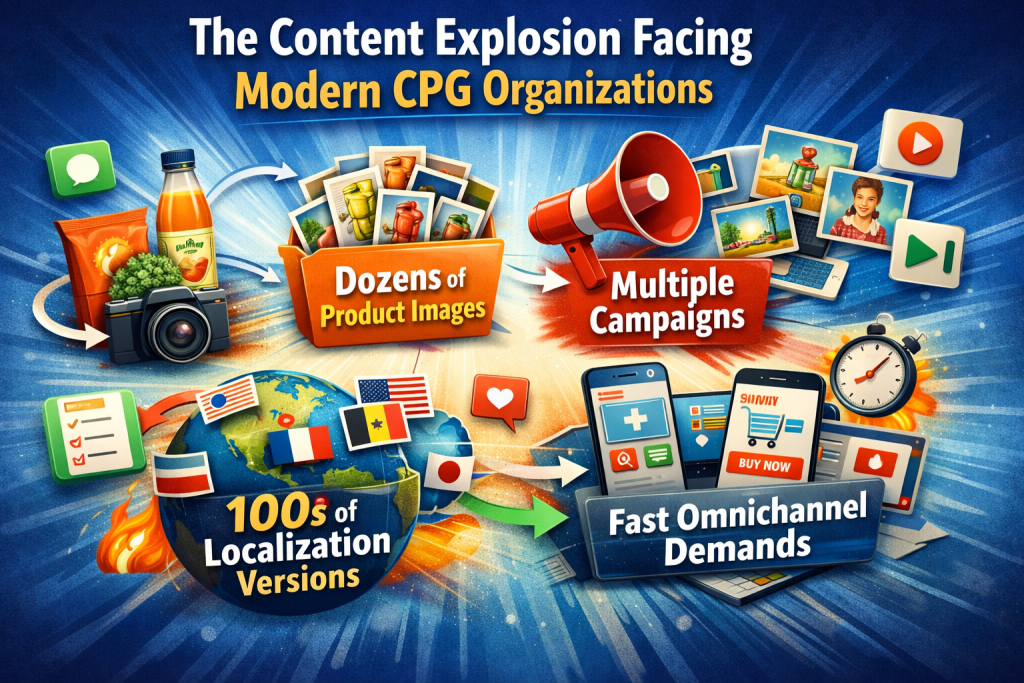
The volume of content required to support modern commerce continues to expand. Each product may require multiple image sets, localized descriptions, packaging updates, campaign visuals, and retailer specific adaptations. Global expansion further multiplies this complexity.
At the same time, brands are expected to move faster. Product launches, seasonal campaigns, and promotional activations operate on compressed timelines while quality standards remain high.
Why Every Product Requires Multiple Content Variations?
A single product often requires numerous formats and versions. Retailers demand specific dimensions and backgrounds. Social platforms require different aspect ratios. Ecommerce sites need hero images, thumbnails, and lifestyle photography. International markets require translated packaging and region specific compliance adjustments.
Without centralized control, asset duplication increases and version management becomes chaotic.
How Artificial Intelligence Increases Speed and Risk?
AI tools allow rapid generation of images and copy. They support scalability and efficiency, especially for personalization and localization. However, AI does not inherently understand brand guidelines, legal restrictions, or regulatory frameworks.
Without embedded governance, AI generated content can introduce inaccuracies or non compliant messaging that spreads quickly across channels.
Why Traditional File Storage Fails CPG Brands?
Shared drives, email attachments, and generic cloud folders were never designed to support enterprise scale content ecosystems. They lack structured metadata, approval workflows, and version governance.
As content volume increases, these systems create more friction than value.
Operational Cost of Fragmented Asset Storage
When assets are scattered across multiple repositories, teams spend excessive time searching. Duplicate files accumulate, outdated versions remain in circulation, and creative teams unknowingly recreate existing materials.
This fragmentation slows launches and increases production expenses.
Compliance Risks of Uncontrolled Assets
CPG brands operate within regulated environments where claims, ingredients, and packaging details must remain accurate. Using outdated imagery or incorrect product information can trigger regulatory penalties and damage retailer relationships.
Without a single authoritative source, enforcing compliance consistently becomes nearly impossible.
Digital Asset Management as the System of Record
A modern DAM functions as the authoritative source for every approved digital asset. It governs the full lifecycle from creation and review to distribution and retirement.
By centralizing content within a controlled environment, DAM provides transparency and accountability across teams.
What System of Record Means in a CPG Context?
In a CPG environment, a system of record ensures that every asset has a designated owner, documented approval status, and trackable version history. Audit trails record changes and usage, enabling full visibility across markets and teams.
This structure builds confidence that only approved and current assets are activated across channels.
How DAM Connects Creative Marketing Ecommerce and IT?
Creative teams produce and upload assets. Marketing teams adapt them for campaigns. Ecommerce teams publish them to retailer platforms and brand sites. IT teams manage integrations and security protocols.
A centralized DAM platform enables these groups to collaborate efficiently while maintaining governance and alignment.
Core Capabilities CPG Brands Need in a Modern DAM
CPG organizations require more than basic storage functionality. They need capabilities that support scale, compliance, and performance optimization.
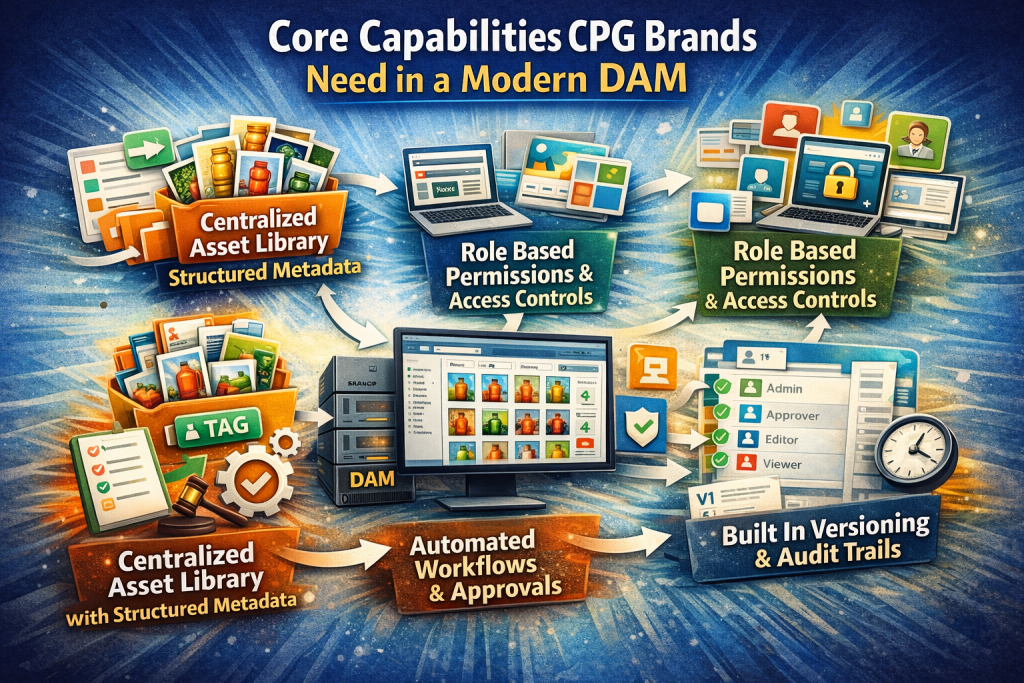
Centralized Asset Library with Structured Metadata
Assets must be categorized by product line, region, campaign, language, usage rights, and compliance status. Structured metadata ensures that teams can quickly locate and reuse approved content.
Role Based Permissions and Access Controls
Granular access controls define who can upload, edit, approve, and distribute assets. These permissions protect brand integrity and prevent unauthorized usage.
Automated Workflows and Approvals
Defined workflows ensure that legal, regulatory, and brand reviews occur before assets are published. Automation reduces delays and enforces consistent review standards.
Built In Versioning and Audit Trails
Version control allows teams to track updates and retire outdated assets. Audit trails support compliance documentation and accountability across global operations.
Turning DAM into a Content Production Engine
When implemented strategically, DAM becomes an active enabler of content creation rather than a passive archive. It streamlines production while maintaining control.
Templates standardize layouts and brand elements, enabling rapid adaptation for different markets and channels. Teams can adjust language or imagery without redesigning core assets, preserving consistency at scale.
Dynamic renditions automatically generate required file formats and sizes for specific platforms. This eliminates manual resizing and ensures technical compliance across retail and social channels.
By integrating with downstream systems, DAM allows approved assets to flow directly into ecommerce platforms, CMS environments, and marketing tools. This reduces manual uploads and accelerates time to market.
Governing Brand and Regulatory Compliance at Scale
Governance must be embedded into daily workflows rather than enforced retrospectively. Automated metadata requirements, approval checkpoints, and role based permissions ensure compliance from the moment an asset enters the system.
Advanced automation can identify expired claims, missing disclaimers, or outdated packaging visuals. Assets can be flagged or archived automatically, reducing reliance on manual oversight.
This proactive governance approach protects brand reputation and retailer relationships while supporting operational efficiency.
Integrating DAM Across the CPG Technology Ecosystem
Maximum value emerges when DAM connects seamlessly with other enterprise systems. Integration with Product Information Management platforms ensures alignment between structured product data and visual assets. Images and descriptions remain synchronized with correct SKUs and product attributes.
Integration with content management and ecommerce platforms allows assets to flow directly into digital storefronts. This reduces manual intervention and ensures consistency across markets.
By serving as the operational backbone of the content ecosystem, DAM unifies creative, marketing, commerce, and IT workflows.
Measuring Digital Shelf Performance with DAM Analytics
Effective content strategy requires measurable outcomes. DAM analytics provide visibility into asset usage, reuse rates, and activation timelines. Teams can identify which assets are most frequently downloaded and deployed, indicating strong return on creative investment.
Time to market metrics reveal workflow bottlenecks and opportunities for optimization. By connecting asset performance to campaign results and channel engagement, organizations can quantify marketing impact and digital shelf effectiveness.
Data driven insight replaces assumption, enabling continuous improvement.
Step by Step Framework for Building a DAM Strategy
A strong DAM strategy is not built through software alone. It is built through clear structure, governance, and alignment between teams, systems, and business goals.
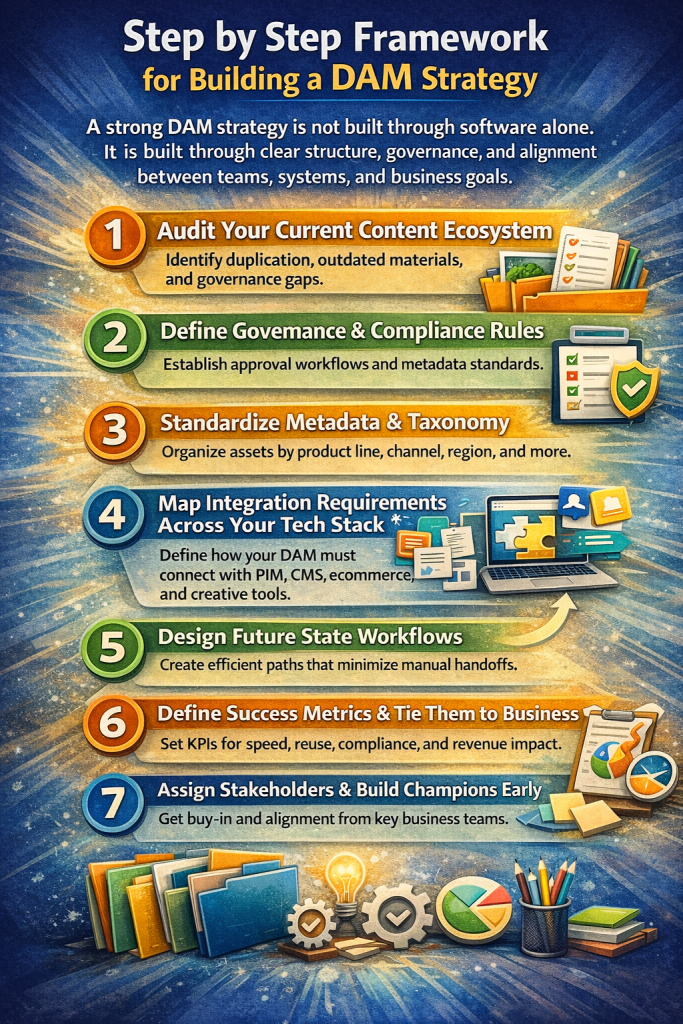
The following steps provide a practical framework CPG brands can use to design and implement a DAM program that delivers long term value.
Step 1: Audit Your Current Content Ecosystem
Start by mapping where your assets live today. Include shared drives, cloud folders, email threads, agency portals, and any legacy DAM or brand portal tools. As you map locations, identify duplicate files, outdated packaging visuals, missing approved versions, and assets that teams cannot confidently reuse. This step reveals where time is being wasted and where compliance risk is being created.
Step 2: Define Governance and Compliance Rules Before Migration
Before you move files into a DAM, define the rules that will control how assets enter, move, and get approved. Set ownership by brand or product line, establish approval stages, define who can upload and publish, and decide which metadata is mandatory. This is also the right time to document compliance requirements by category and region, so approvals are not based on tribal knowledge.
Step 3: Standardize Metadata and Taxonomy
A DAM is only as useful as its structure. Create a taxonomy that matches how your teams actually search and work. Build metadata around product, SKU, region, language, channel, campaign, usage rights, and lifecycle status. Standardization prevents the classic problem where assets are technically stored but practically impossible to find, reuse, or govern.
Step 4: Map Integration Requirements Across Your Tech Stack
List the tools that must exchange assets with your DAM. For most CPG brands, this includes PIM for product data alignment, CMS for web publishing, ecommerce and marketplace workflows for activation, and creative tools for production. Define which system is the source of truth for each data type, then design how assets and metadata will sync to avoid mismatches across channels.
Step 5: Design Future State Workflows That Reduce Manual Handoffs
Document how assets should flow from creation to activation. Include intake, review, legal checks, localization, final approval, distribution, and retirement. Remove unnecessary steps that force teams to export, rename, re upload, or request files through chat and email. The goal is to make the approved path the easiest path, so adoption happens naturally.
Step 6: Define Success Metrics and Tie Them to Business Outcomes
Set KPIs that reflect real impact, not just usage. Track faster time to market, higher asset reuse, reduced duplication, fewer compliance issues, and fewer last minute content delays. Connect these metrics to revenue outcomes such as improved conversion on retailer pages, fewer returns caused by inaccurate content, and faster campaign launches across regions.
Step 7: Assign Stakeholders and Build Champions Early
A DAM touches multiple teams, so ownership cannot sit with one function alone. Identify stakeholders across creative, marketing, ecommerce, legal, and IT. Assign champions who can reinforce governance, support onboarding, and keep workflows aligned after launch. Champions help prevent the system from becoming a storage location that teams bypass when deadlines hit.
How Brandy Supports Digital Shelf Ready CPG Content Operations

Brandy provides a centralized platform for managing digital assets, brand guidelines, and approval workflows within one structured environment. CPG teams use Brandy to organize assets with clear metadata, enforce brand consistency, and control distribution across markets and channels.
Built in governance capabilities support compliance while automation reduces repetitive manual work. Integration readiness ensures that approved assets can move efficiently into ecommerce and marketing platforms.
By transforming content management into a strategic advantage, Brandy enables CPG brands to compete more effectively across the digital shelf.
Building a Digital Shelf Advantage That Compounds Over Time
Digital shelf dominance does not come from isolated campaigns. It results from disciplined content governance, operational efficiency, and strategic integration. A modern DAM strategy provides the control, speed, and insight required to scale confidently.
When content operations function smoothly, product launches accelerate, compliance risk decreases, and brand consistency strengthens across markets. Over time, these advantages compound into stronger retailer relationships, higher conversion rates, and sustainable growth.