
Every marketer, whether part of a growing team or managing campaigns alone, feels the constant pressure to achieve more with limited time and resources. Budgets are shrinking, audience attention spans are shorter than ever, and competition continues to rise. In such a fast-moving environment, success depends on how efficiently you can use what you already have.
Marketing efficiency is not about cutting costs or doing less. It is about getting the most out of every strategy, campaign, and piece of content you create. It means understanding where your time and money go, optimizing the workflow, and improving how your team collaborates. The goal is to make smarter choices that lead to stronger results.
When brands work efficiently, they achieve clarity and consistency in every marketing effort. Campaigns become more impactful, creative resources are better utilized, and teams spend less time searching for assets or fixing repetitive mistakes. This balance of structure and creativity separates thriving brands from those constantly struggling to keep up.
In the following sections, we will explore what marketing efficiency truly means, why it matters, and practical ways to improve it. You will also learn how modern tools like Brandy help streamline collaboration, centralize brand assets, and give marketers the freedom to focus on what really drives growth.
What Is Marketing Efficiency and Why It Matters
Marketing efficiency is the ability to produce the best possible results using the least amount of time, effort, and money. It is not simply about spending less; it is about spending wisely. Every marketing decision, from ad placement to content creation, should serve a clear purpose and deliver measurable value.
Think of marketing efficiency as fine-tuning your engine rather than replacing it. You look at where your efforts are working, where they are not, and how to redirect your resources toward activities that actually move the needle. When efficiency improves, your campaigns perform better without increasing your workload or costs.
One of the most helpful ways to measure efficiency is through the Marketing Efficiency Ratio, often called MER. It is calculated by dividing your total sales revenue by your total marketing spend. For example, if your company made one million dollars in sales and spent two hundred thousand dollars on marketing, your MER would be five. This means every dollar spent generated five dollars in return.
A higher MER shows stronger efficiency, but what qualifies as “good” can vary by business size and stage. A startup might accept a lower ratio as it builds visibility, while an established company aims for consistent returns with minimal waste. The key idea is to monitor how efficiently your marketing investments convert into tangible outcomes over time.
When your processes, tools, and people align around this goal, marketing efficiency becomes more than a number, it becomes a mindset that drives sustainable growth.
Marketing Efficiency vs Marketing Effectiveness

Many marketers use the words efficiency and effectiveness interchangeably, but they measure two very different things. Marketing efficiency focuses on how you use your resources, while marketing effectiveness measures what results you achieve from those efforts.
Imagine running a digital marketing campaign that cuts your advertising cost in half but delivers the same number of conversions. That is marketing efficiency at work. On the other hand, if your campaign brings in twice as many qualified leads or purchases, even with the same marketing spend, that reflects marketing effectiveness.
Efficiency is about doing things right, streamlining your workflows, optimizing ad spend, and reducing unnecessary marketing costs. Effectiveness is about doing the right things, choosing the strategies and campaign elements that actually connect with customers and move them through the marketing funnel. Both are essential, but when used together, they build a powerful marketing engine.
A truly successful marketing team aims to balance the two. You can run the most cost-efficient campaign, but if it fails to attract the right customers, your marketing performance will fall short. Similarly, a highly effective campaign that ignores budget discipline can quickly burn through your total ad spend. The goal is to align both so that every dollar spent produces meaningful engagement and revenue growth.
By measuring marketing efficiency and effectiveness side by side, through metrics such as conversion rate, customer acquisition cost, and return on ad spend, you can determine not just how much you earn but how smartly you earn it. This clarity helps marketing leaders refine strategies, allocate resources wisely, and generate sustainable success over time.
Key Metrics That Define Marketing Efficiency
Improving marketing efficiency starts with knowing what to measure. Without clear data, it is impossible to determine whether your marketing strategy is working or just draining your budget. Metrics give your marketing team visibility into what is driving results, what is wasting resources, and where optimization will have the greatest impact.
The most important metric to understand is the Marketing Efficiency Ratio (MER). This measures how effectively your marketing efforts convert spending into revenue. To calculate MER, divide your total sales revenue by your total marketing spend during the same period. For instance, if your company generates one million dollars in sales with two hundred thousand dollars in total ad spend, your MER would be five. The higher this number, the more efficient your marketing activities are.
However, the MER is only one part of the full picture. To build a balanced view of marketing performance, marketers should also monitor a mix of key performance indicators:
- Customer Acquisition Cost (CAC): The total marketing and advertising cost required to gain a new customer. Lowering CAC without compromising quality is a sign of strong efficiency.
- Return on Ad Spend (ROAS): The revenue generated for every dollar spent on advertising. ROAS helps you understand how well your ads convert attention into sales.
- Conversion Rate: The percentage of people who take the desired action, such as making a purchase or signing up. Higher conversion rates show that your campaigns are targeting the right audience.
- Cost per Lead (CPL): The total cost spent to generate one lead. A lower CPL indicates better targeting and more focused campaigns.
- Customer Lifetime Value (CLV): The total revenue a customer brings during their relationship with your business. When CLV rises while CAC falls, marketing efficiency improves dramatically.
Tracking these metrics over time reveals trends that can transform how your marketing works. You can identify which campaigns, channels, or messages generate the most revenue with the least expense. When data is centralized and easily accessible, teams can make faster and smarter decisions.
Modern brands use tools that organize marketing assets and performance data in one place. This not only saves time but also ensures that teams spend less energy chasing information and more time optimizing what truly matters, building strategies that drive measurable business growth.
Audit Before You Act: Evaluating Your Marketing System
Before you can improve your marketing efficiency, you first need to understand where you currently stand. A marketing audit is the foundation of every optimization effort. It allows you to see what is working, what is wasting money, and what needs to be completely rethought. Think of it as a health check for your entire marketing system.
Start by reviewing all your active marketing campaigns and channels. Look at how much you spend on each one and what results they generate. Are certain channels consistently driving sales while others show little return? Are your ads attracting potential customers or just spending valuable ad dollars with no real conversions? This clarity helps you decide where to cut back, reinvest, or redesign your campaigns.
Next, examine your marketing assets and internal processes. Are you reusing existing creative materials effectively, or is your marketing team recreating similar assets repeatedly? Duplicate efforts often inflate marketing costs without improving results. A centralized system for storing and sharing approved marketing materials can save both time and money while improving brand consistency.
It is also important to evaluate how your marketing budget is being managed. Are you allocating enough toward campaigns that move customers through the sales funnel, or are you spending heavily on awareness with limited return? Reviewing these spending patterns helps you strike the right balance between reach and conversion.
Finally, review your marketing performance metrics in context. Data without interpretation is just noise. Compare your performance over different periods, analyze seasonality, and track progress against specific goals. By doing this, you can determine whether your marketing strategy is moving the business forward or simply maintaining the status quo.
A complete audit does not just highlight inefficiencies. It uncovers hidden opportunities. Sometimes small changes, like adjusting targeting or refining your content calendar, can make a significant difference in how efficiently your marketing team operates. Once you know where your time and money are going, you can begin to optimize every effort with purpose.
Improve Collaboration and Internal Communication
Marketing efficiency is not only about analytics and budgets; it also depends on how well your team communicates. Even the most creative strategy can fail if the people behind it are not aligned. When communication breaks down, projects slow down, deadlines get missed, and marketing costs rise. A connected marketing team that shares information openly can move faster and produce better results.
Start by creating clear systems for communication. Every marketing effort, whether a campaign, a content project, or a product launch, should have a shared space where updates, files, and progress are easy to track. When everyone knows what others are working on, duplication of effort is reduced, and decisions happen more quickly. Instead of endless email chains or scattered chat messages, use organized communication tools that make teamwork more visible and accountable.
Transparency also builds trust within a marketing team. When team members understand the goals, metrics, and timelines, they take ownership of their work. This accountability boosts productivity and ensures that everyone contributes to the same objectives. Regular check-ins help identify roadblocks early so they can be fixed before they slow down the campaign.
Centralizing your brand and marketing assets further improves collaboration. A shared digital library for images, templates, videos, and content guidelines saves countless hours otherwise spent searching for files. Platforms like Brandy make this process seamless by providing one place where marketers, designers, and stakeholders can access the most up-to-date brand assets anytime. This eliminates version confusion and keeps every piece of communication consistent with your brand identity.
Efficient communication is also about balance. Not every discussion needs a meeting, and not every update requires a long report. Encourage a culture where information is shared clearly and concisely. When everyone understands the plan, the marketing team becomes more focused, campaigns launch faster, and resources are used wisely.
A well-connected team turns communication into a competitive advantage. When collaboration is smooth and information flows freely, marketing performance improves naturally, because everyone is working together toward the same result.
Automate Smartly and Let Data Lead Decisions
A truly efficient marketing strategy relies on data, not assumptions. When decisions are based on real numbers rather than guesswork, every marketing effort becomes sharper and more purposeful. Data reveals patterns that human intuition alone can miss, such as which campaigns generate the best return on ad spend or which audiences convert more efficiently through specific channels.
Begin by tracking your marketing performance across all platforms. Collect insights from your ads, email campaigns, website analytics, and social media engagement. By connecting these metrics, you can identify where each dollar spent drives the most revenue generated. Once you understand your customer journey, it becomes easier to focus on the areas that influence conversions instead of spreading resources too thin.
Automation plays a major role in improving efficiency. It removes repetitive, manual tasks that drain time and focus. For example, automated email sequences can nurture leads through the sales funnel while your team focuses on strategy. Social scheduling tools help maintain consistent posting without daily management. You can even automate campaign reports so that marketing teams spend less time compiling data and more time interpreting it.
However, automation should never replace human creativity or critical thinking. The best results come when data and automation work together. Use automated workflows to handle routine activities, then use your team’s expertise to interpret results, test new ideas, and personalize messaging for different audiences.
Automation also helps control marketing costs by minimizing human error and reducing redundant work. For instance, connecting your ad platforms with analytics dashboards allows you to automatically pause underperforming ads or shift budgets toward higher-performing ones. Over time, this creates a feedback loop that consistently refines your campaigns for greater ROI.
Tools like Brandy further simplify this process by keeping all brand assets and marketing materials organized in one platform. When assets are easy to find and workflows are automated, marketing teams save hours each week that can be reinvested in creative planning or campaign optimization.
Data-driven decision-making ensures your marketing activities stay aligned with business goals, while automation ensures those strategies are executed efficiently. Together, they form the foundation for a marketing system that is smarter, faster, and always improving.
Create Purpose-Driven Content That Covers the Full Funnel
Content lies at the heart of every marketing strategy. But producing large volumes of content does not automatically make your marketing efficient. True efficiency comes from creating purpose-driven content that supports every stage of the customer journey, from awareness to purchase and beyond. When every article, video, or campaign asset has a clear goal, your marketing team can generate more impact with less effort.
Start by mapping your content to the marketing funnel. At the top of the funnel, focus on awareness content that attracts potential customers, such as blog posts, guides, and videos. In the middle, create content that nurtures interest, such as case studies, comparisons, and webinars that help audiences understand why your solution is valuable. At the bottom of the funnel, use targeted offers, testimonials, and product demos that convert prospects into paying customers. This structure ensures that your marketing efforts guide people smoothly through the buying process.
Repurposing content is another smart way to increase efficiency. A single research report can become multiple blog posts, infographics, and social snippets. A long-form video can be transformed into short clips for different platforms. This approach not only reduces production time but also ensures brand consistency across channels.
Data also plays a key role here. Track which types of content drive engagement and revenue. If one blog post consistently attracts high-quality traffic, consider expanding that topic into a full campaign. Similarly, if a certain video format or message earns more conversions, invest in similar styles. Let performance metrics, not assumptions, guide your content direction.
Maintaining organized marketing assets is crucial for consistent execution. A centralized platform like Brandy allows teams to store all content materials, visuals, templates, brand guidelines, and copy in one place. This keeps your marketing campaigns aligned and helps ensure that every piece of content reflects your brand identity perfectly.
Purpose-driven content saves time, strengthens your messaging, and builds long-term credibility. Instead of chasing quick wins, it allows your marketing team to focus on quality and strategy, creating a content engine that educates, engages, and ultimately drives sustained business growth.
Build Long-Term Strategies Rooted in Data and Insight
Marketing efficiency is not achieved overnight. It grows from a long-term strategy that blends clear planning with reliable data. Many brands waste energy by jumping from one campaign to another without a cohesive plan. A strong long-term marketing strategy helps your team stay focused, reduce reaction-based decisions, and build consistent progress toward your business goals.
Begin by analyzing historical data to understand what has worked before. Review which marketing channels brought in the highest conversion rates, where your ad spend delivered the strongest return, and which campaigns built genuine brand loyalty. This information provides a solid foundation for planning future marketing efforts.
Next, use data to forecast future trends. Predictive insights from past campaigns can help you anticipate customer behavior, seasonal changes, and content performance. By combining this foresight with measurable goals, you can build a marketing plan that adapts easily to market shifts while staying aligned with your company’s objectives.
A long-term strategy also requires setting realistic budgets that support growth instead of limiting it. Efficient marketing is not about cutting costs. It is about allocating your budget wisely. Invest in channels that consistently perform well, but keep room for experimentation. The most successful organizations use a blend of proven strategies and calculated innovation to maintain momentum.
Your marketing team should regularly revisit and refine these strategies based on fresh data. This ongoing cycle of review and adjustment ensures that your marketing activities continue to align with customer needs and market trends. It also prevents wasted ad dollars on campaigns that no longer deliver results.
Consistency is another essential factor. A long-term approach means maintaining a unified voice and visual identity across every touchpoint of the customer journey. Centralizing your marketing assets in tools like Brandy helps you preserve this consistency, allowing every team member to access approved visuals, copy, and templates.
When marketing strategies are grounded in insight and supported by collaboration, efficiency becomes part of your company’s culture. Instead of reacting to short-term challenges, your team works with intention, driving steady, predictable growth that compounds over time.
Measure, Test, and Optimize Continuously
Improving marketing efficiency is not a one-time project. It is an ongoing process of measurement, testing, and refinement. The most successful marketing teams treat every campaign as a learning opportunity. They measure what worked, identify what did not, and use those insights to make smarter decisions next time.
Start by setting clear performance benchmarks before launching any campaign. Define what success looks like in measurable terms such as a specific conversion rate, customer acquisition cost, or return on ad spend. When you know your targets, you can track whether your marketing efforts are moving in the right direction.
Testing is the next critical step. A/B testing, for example, helps you compare two versions of an ad, landing page, or email to see which performs better. Even small changes, like a headline, image, or call-to-action, can produce major improvements in campaign effectiveness. The key is to test one element at a time and use data to guide every adjustment.
Optimization happens when insights from these tests are applied consistently. If one campaign format delivers better engagement, integrate that learning into future marketing strategies. Over time, these incremental improvements compound into significant gains in efficiency and results.
Continuous measurement also prevents wasted resources. By tracking real-time analytics, you can pause underperforming ads, reallocate your marketing budget, or modify audience targeting before a campaign finishes. This approach keeps every dollar spent purposeful and contributes directly to overall business growth.
Encourage your marketing team to share these findings across departments. When everyone from content creators to sales teams understands what drives performance, collaboration becomes more strategic. Tools like Brandy can support this process by giving teams easy access to campaign assets and data, ensuring that optimization happens faster and more efficiently.
When you make testing and optimization a consistent habit, your marketing becomes smarter with each cycle. The result is a system that adapts quickly, wastes less, and continually improves its ability to turn creative ideas into measurable results.
Avoid the Common Marketing Efficiency Traps
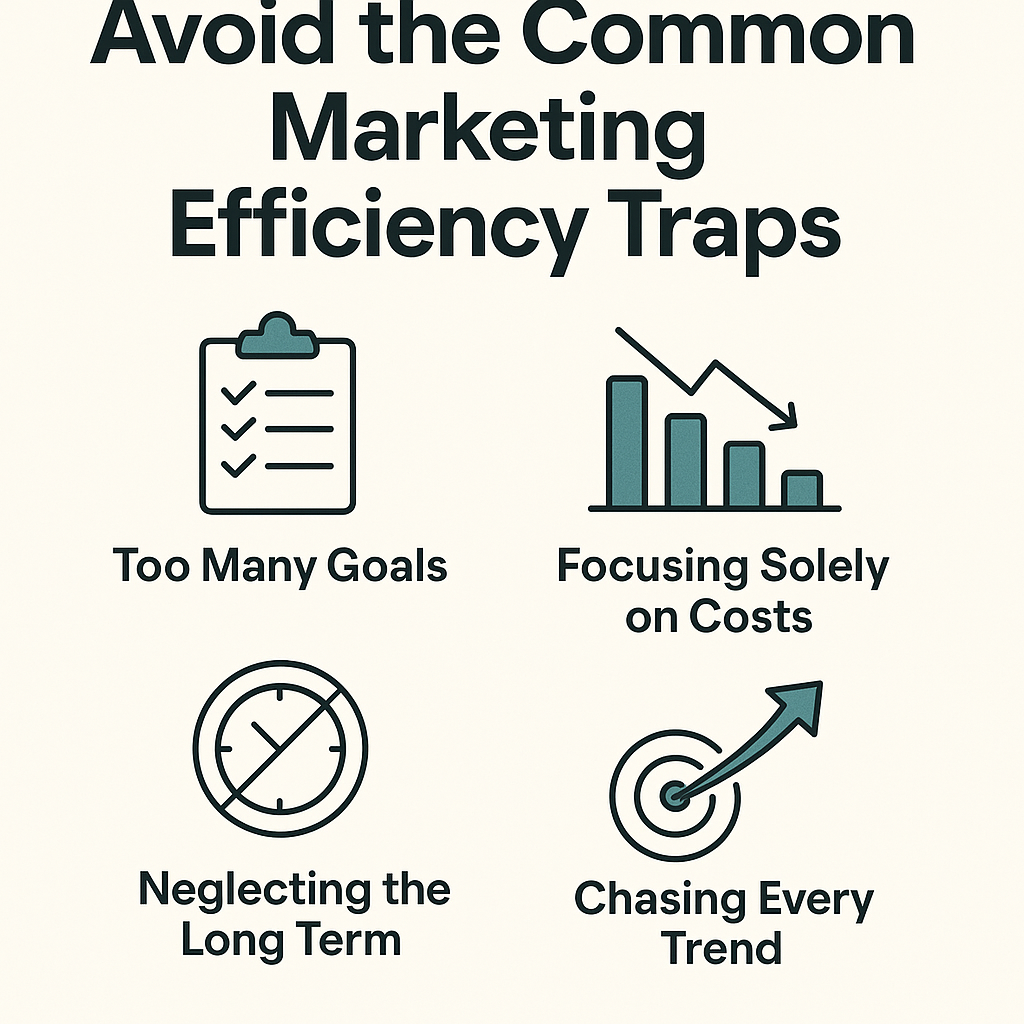
Even the most well-structured marketing strategy can lose momentum if efficiency becomes the only focus. When teams rush to streamline operations or automate everything, they sometimes sacrifice creativity, brand voice, and authenticity. Understanding these common pitfalls helps ensure your marketing stays both efficient and effective.
Over-Automation Reduces Human Connection
Automation is powerful, but too much of it can make your communication feel robotic. Audiences want to connect with brands that sound real and relatable. Automated emails, ads, and chat responses should always be reviewed to make sure they reflect your tone and message. Let automation handle repetitive work, but let humans guide the emotion and intent behind every campaign.
Ignoring Creativity for the Sake of Speed
Efficiency should never come at the cost of originality. Data may tell you what works, but creativity is what makes people care. Encourage brainstorming, storytelling, and experimentation within your marketing team. A campaign that feels authentic and emotionally engaging can often outperform one that is simply well optimized.
Chasing Vanity Metrics Instead of Real Results
It is easy to focus on numbers that look good on a report, like likes, clicks, or impressions, but these do not always reflect true success. Instead, prioritize meaningful outcomes like conversion rate, customer acquisition cost, and lifetime value. These metrics show whether your marketing efforts are genuinely generating revenue, not just attention.
Neglecting Brand Alignment and Asset Organization
Inconsistent branding can quietly drain your marketing efficiency. When team members use outdated logos, visuals, or copy, campaigns lose impact and trust. Keeping brand assets organized in a single, accessible space prevents confusion. Tools like Brandy make this effortless by storing all approved assets in one place, ensuring your marketing team always works with the right materials.
Treating Efficiency as a One-Time Task
Marketing efficiency is not a project you finish. It is a mindset you maintain. As technology, platforms, and customer behavior evolve, your processes must evolve too. Review your workflows regularly, adjust strategies, and keep learning from every campaign. Consistency and adaptation together sustain efficiency over time.
Final Thoughts: Make Efficiency a Culture, Not a Checklist
Marketing efficiency is not a quick fix or a one-time goal. It is an ongoing commitment to improvement. When efficiency becomes part of your marketing culture, every campaign, strategy, and decision naturally aligns with smarter growth.
Building this culture begins with awareness. Every member of your marketing team should understand how their work contributes to overall performance. From creative design to campaign analytics, every action plays a part in maximizing resources and improving outcomes.
Efficiency also thrives on collaboration. When departments share data, insights, and brand assets freely, marketing performance improves across the board. Tools like Brandy make this easier by giving teams a shared space for organized, approved, and up-to-date brand materials. This ensures that every project reflects the same voice and vision, saving both time and effort.
The most efficient marketing teams are those that stay curious. They experiment, measure results, and adapt quickly. They focus less on doing more and more on doing what truly matters. When efficiency becomes a daily practice, success follows naturally and marketing evolves from a cost center into a growth engine.