
Most enterprise teams do not have a tool problem. They have a connection problem. The average large organization runs dozens of platforms, yet content still gets lost, assets go off-brand, and campaign timelines keep slipping.
The solution is not another platform. It is a strategy that makes every platform work together.
That strategy is your enterprise digital ecosystem. And when it is built well, it transforms how your teams create, manage, distribute, and optimize content at scale.
This guide walks you through exactly how to build one, what to avoid, and why it matters more now than ever.
What Most Enterprises Get Wrong About Their Digital Ecosystem?
Here is a common scenario. A team needs to move faster, so they add a new tool. Another team has a different need, so they add another. Before long, the organization is running fifteen platforms that barely speak to each other.
That is not a digital ecosystem. That is a digital pile-up.
The mistake is treating individual tools as the ecosystem, rather than building the ecosystem around how those tools connect. A collection of software is not a strategy. Connections, data flows, and governance are.
The Hidden Cost of a Fragmented Content Environment
Fragmentation does not just slow teams down. It costs money, erodes brand trust, and creates real compliance risk.
When content is scattered across shared drives, inboxes, and disconnected platforms, teams spend hours hunting for assets that already exist. They rebuild campaigns from scratch and publish outdated logos. They also miss deadlines because approvals stay buried in someone’s inbox.
These are not minor inconveniences. They are compounding inefficiencies that quietly drain enterprise productivity every single day.
- 41% of organizations are actively scaling AI within their DAM systems
- 145+ pre-built integrations available in modern enterprise DAM platforms
- 1 connected ecosystem eliminates duplicated effort across teams and regions
What a High-Performing Enterprise Digital Ecosystem Actually Looks Like?
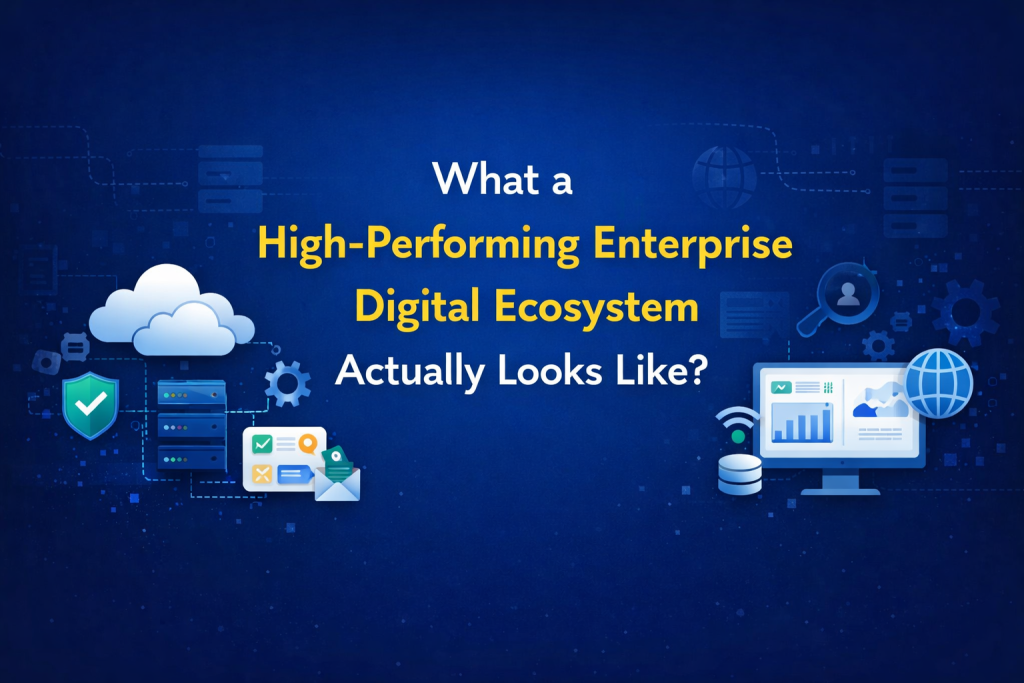
A digital ecosystem is the connected network of tools, workflows, and data flows that support your entire content lifecycle. From the moment an asset is created to the moment it reaches a customer, every step should flow through a structured, governed environment.
This is fundamentally different from a traditional tech stack. A tech stack is a list of tools. An ecosystem is the intelligence between them.
When built correctly, your ecosystem ensures that content stays accurate, teams stay aligned, and performance data flows back to inform what gets made next.
The Core Systems That Belong in Every Enterprise Ecosystem
While every organization is different, most high-performing enterprise digital ecosystems share a consistent set of layers.
Your Digital Asset Management (DAM) platform sits at the center as the system of record for all content. PIM handles product data and ensures accuracy across catalogs. Your CMS or ecommerce platform handles publishing. CRM and marketing automation tools power activation and personalization. Analytics platforms close the loop on performance.
Layered across all of this are AI-powered creative tools that accelerate production and surface insights at a scale no human team could match alone.
The goal is not to have all of these tools. The goal is to have them working in sync.
Why Your DAM is the Foundation, Not Just a File Library?
Many enterprise teams still treat their DAM as a storage solution. A better hard drive. A place to dump finished assets and move on.
That mental model is limiting everything downstream.
A modern, AI-powered DAM is not a passive archive. It is the engine that governs, enriches, and distributes content to every connected system in your ecosystem. It is where content becomes structured, searchable, approved, and ready for activation across every channel.
When your DAM is properly positioned at the center of your ecosystem, every downstream tool, from your CMS to your marketing automation platform, receives consistent, on-brand, up-to-date assets. Always.
How Governance Built into Your DAM Eliminates Content Risk at Scale?
Governance built into your DAM changes team behavior at a fundamental level.
When permissions, approval workflows, and metadata structures are embedded into the system itself, compliance stops being a manual process and becomes automatic. Teams stop second-guessing whether an asset is approved. They stop downloading outdated files. They stop creating one-off workarounds.
Instead, they work with confidence because the system keeps them on track.
Key Insight: Centralizing content in a single governed environment is the single highest-leverage action an enterprise can take to reduce content chaos and accelerate campaign execution.
Four Steps to Build Your Enterprise Digital Ecosystem the Right Way
Building a connected ecosystem does not happen overnight. But it does follow a clear progression. Here is how to approach it with intention.
Audit What You Have Before Adding Anything New
Start by mapping your current landscape. Where does content live? How does it move? Which tools create friction rather than remove it? Where are teams duplicating effort without realizing it?
This audit almost always reveals something uncomfortable: most enterprises discover that their DAM is acting as passive storage rather than an active system of record. That is the first thing to fix.
Resist the urge to add new tools during this phase. Understand what you already have before layering in anything else.
Establish Ownership, Governance, and Taxonomy First
Before connecting a single system, define who owns what. Which teams are responsible for which asset categories? What does your metadata structure look like? How are naming conventions enforced? What do approval workflows require?
Skipping this step is one of the most common enterprise mistakes. Teams rush to integrate systems and then discover that the data flowing between them is inconsistent, incomplete, or ungoverned.
Strong governance at the foundation prevents compounding problems at scale. Build it first.
Prioritize Integrations That Deliver Immediate Value
You do not need to connect every system at once. Start with the integrations between your DAM and your highest-traffic downstream platforms, typically your CMS, PIM, and marketing automation stack.
Pre-built integrations dramatically reduce technical complexity and accelerate time to value. Once those high-impact connections are stable and delivering results, layer in additional integrations progressively.
Think of it as building a network, starting with the most-used roads before paving the side streets.
Measure, Optimize, and Evolve Continuously
A digital ecosystem is not a one-time project. It is a living infrastructure that should evolve alongside your content operations.
Use analytics to identify which assets drive the most engagement, which workflows create bottlenecks, and where automation can eliminate repetitive manual tasks. Build a regular review cadence that treats the ecosystem as a product, not a setup.
Teams that treat optimization as ongoing rather than optional are the ones that pull ahead competitively over time.
The Three Business Benefits Enterprise Teams Unlock With an Integrated Ecosystem
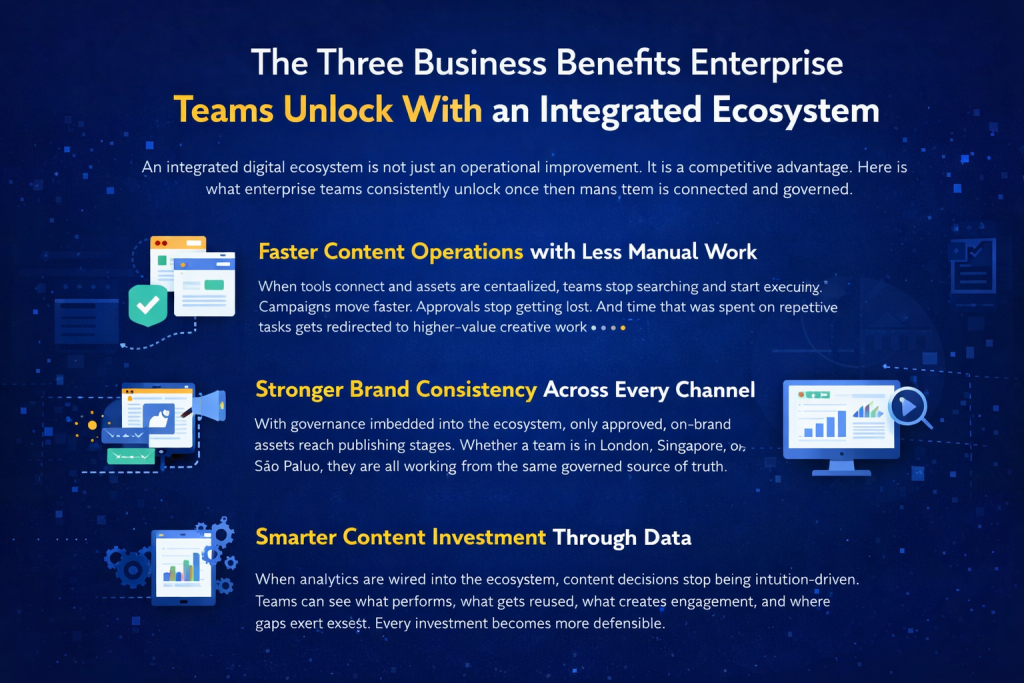
An integrated digital ecosystem is not just an operational improvement. It is a competitive advantage. Here is what enterprise teams consistently unlock once their ecosystem is connected and governed.
Faster Content Operations with Less Manual Work
When tools connect and assets are centralized, teams stop searching and start executing. Campaigns move faster. Approvals stop getting lost. And time that was spent on repetitive tasks gets redirected to higher-value creative work.
Stronger Brand Consistency Across Every Channel
With governance embedded into the ecosystem, only approved, on-brand assets reach publishing stages. Whether a team is in London, Singapore, or São Paulo, they are all working from the same governed source of truth.
Smarter Content Investment Through Data
When analytics are wired into the ecosystem, content decisions stop being intuition-driven. Teams can see what performs, what gets reused, what creates engagement, and where gaps exist. Every investment becomes more defensible.
How AI is Redefining Enterprise Digital Ecosystems?
AI is no longer a future consideration for enterprise content operations. It is already embedded in how leading organizations manage their ecosystems today.
According to recent research, 41% of organizations have either fully integrated AI or are actively scaling it within their DAM systems. That number is accelerating quickly.
In practice, AI inside a digital ecosystem handles tasks that used to consume hours of manual effort. Metadata generation, duplicate detection, asset tagging, quality checks, and content gap analysis all happen automatically, at scale, without human intervention.
The more advanced application is AI agents. These are configurable, autonomous systems that operate within the ecosystem continuously, running governance checks, recommending optimizations, and scanning for off-brand asset usage across the web.
Think of them less as tools and more as digital co-workers who never go offline.
As AI becomes more deeply embedded across enterprise ecosystems, the environment itself starts to self-optimize. It anticipates content needs, flags issues before they become problems, and simplifies workflows that used to require layers of manual coordination.
The enterprises investing in this infrastructure now will have a meaningful head start over those who treat AI as a feature to consider later.
Common Pitfalls That Stall Enterprise Ecosystem Growth
Even well-resourced enterprise teams can undermine their own ecosystems without realizing it. These three patterns are the most common culprits.
Choosing speed over governance. When teams rush to ship campaigns, they skip approval workflows and publish unvetted assets. It feels faster in the moment and creates compounding brand and compliance problems over time. Governance needs to be designed to move at the speed of the business, not against it.
Confusing tools for the ecosystem. The tools are components. The ecosystem is the logic connecting them. Organizations that evaluate their digital health by counting platforms rather than measuring connected workflow performance will keep hitting the same walls.
Ignoring analytics until something breaks. Data from a connected ecosystem is one of its most powerful outputs. Teams that check performance reports only when campaigns underperform miss months of optimization opportunity. Build a rhythm of regular analytics review from day one.
Building for Scale Means Building for Connection
The enterprises winning on content today are not the ones with the most tools. They are the ones who have built an ecosystem where every tool reinforces every other.
That means a DAM that governs and enriches content before it reaches any downstream system. Integrations that eliminate manual handoffs. Governance that protects brand consistency without slowing teams down. Analytics that inform what gets built next. And AI that operates continuously across the entire environment.
When all of that is connected, something shifts. Teams move faster, not because they are working harder, but because the system they work within is designed to accelerate rather than obstruct.
That is what a high-performing enterprise digital ecosystem delivers. Not just operational efficiency, but compounding competitive advantage over time.
Ready to Build an Ecosystem That Works at Enterprise Scale? Brandy helps enterprise teams centralize, govern, and activate their brand assets across every channel. See how a connected digital ecosystem could transform your content operations.