
Digital Asset Management is often evaluated through numbers. Storage capacity. Feature depth. File support. Integration lists. These details look impressive in demos and RFPs, but they rarely reflect how a DAM performs in real life.
Most teams do not struggle because assets are missing. They struggle because assets are difficult to use. Files exist, but people hesitate to open the system. They are unsure what is current, what is approved, or what applies to their situation.
Real DAM value shows up in everyday work. It appears when a marketer needs campaign visuals, when sales needs a presentation, or when a regional team needs the right logo quickly. In these moments, speed and clarity matter far more than capacity.
A DAM that makes assets easy to find, helps users understand how to use them, and removes uncertainty becomes part of daily workflows. That is what serving assets on a silver platter really means. Not excess. Effortless access.
The Real Question Every DAM Buyer Should Ask
Most DAM buying processes start with a checklist. File formats. Metadata fields. Permission levels. Workflow controls. These are important, but they focus almost entirely on system capabilities.
What often gets overlooked is daily usability.
RFPs are typically written for administrators and librarians, not for the people who use the DAM under pressure. Marketers, sales teams, partners, and local teams access assets infrequently and usually when time is limited. They do not want to remember rules or learn structures.
When ease of use is not prioritized, teams find shortcuts. They reuse old files. Save assets locally. Share links from email threads. The DAM remains technically correct but practically ignored.
The most important question is not what the system can do. It is whether people want to use it. That is the core problem modern DAMs must solve.
Why Single Source of Truth Is Not Enough
A single source of truth is a common DAM promise. Assets live in one place. Versions are controlled. Permissions are clear. From a governance perspective, the box is checked.
But intent does not guarantee adoption.
When accessing the DAM feels slow or confusing, teams often look for shortcuts. Files get downloaded once and reused repeatedly, copies end up on desktops, and assets are pulled from websites or presentations simply because it feels faster.
This behavior is not driven by carelessness. It is driven by friction.
A DAM can enforce structure, but it cannot force usage. Adoption happens when the system removes effort instead of adding it. When the DAM becomes the fastest path to the right asset, people naturally trust and use it.
Without that experience, a single source of truth exists only in theory.
Backend DAM vs Front End DAM
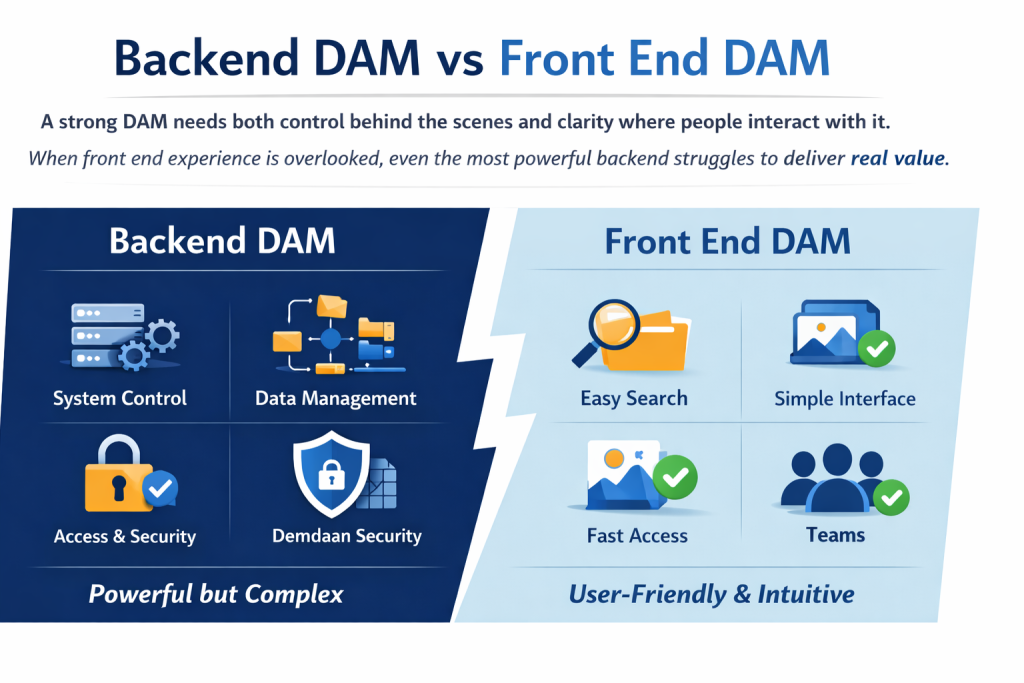
A strong DAM needs both control behind the scenes and clarity where people interact with it.
When front end experience is overlooked, even the most powerful backend struggles to deliver real value.
What Backend DAMs Do Well
Backend DAM functionality is strong across most platforms. Asset ingestion, metadata management, permission structures, and lifecycle control are well supported. Editors and librarians can upload, organize, approve, archive, and govern content efficiently.
These capabilities are essential. Without them, assets cannot be managed responsibly at scale.
Where End Users Struggle
End users experience the DAM very differently. They log in occasionally, usually under pressure and with a specific goal in mind. Taxonomy is unfamiliar, folder logic is easy to forget, and endless searching is the last thing they want to deal with.
Time pressure and uncertainty lead to frustration. When users cannot quickly recognize what they need, they abandon the system.
Why Front End Experience Drives Real ROI
Front end experience determines whether assets are reused correctly. When access is clear and intuitive, teams stop improvising. Brand consistency improves. Asset value increases. Usability is what turns governance into return on investment.
Designing a DAM for the People Who Actually Use It
Most brand assets are used by people who are not brand system experts. Sales teams. Regional marketers. Partners. Agencies. Local operators. Leadership.
These users do not want to explore. They want answers.
Which logo is current. Which visuals are approved. And,which presentation should be used. What is safe to share externally.
Navigation clarity matters more than advanced filtering. Guided access matters more than flexible configuration. A DAM designed for real users surfaces what is relevant instead of asking people to search for it.
When the system removes hesitation, people act with confidence. That confidence is what protects brand consistency at scale.
Delivering Brand Assets on a Silver Platter
Brand assets should be presented with clarity, context, and confidence, not buried behind search and structure. When the right materials are obvious and easy to use, teams make the right brand choices without thinking.
What That Really Means in Practice
Serving assets on a silver platter means removing guesswork. It means the system anticipates user needs and presents assets clearly and confidently.
Make the Right Assets Impossible to Miss
Key assets should stand out immediately. Visual hierarchy, curated collections, and clear grouping ensure users recognize what matters without searching.
Show How Assets Should Be Used
Context matters. Usage guidance, do and do not rules, and clear explanations prevent misuse. Assets should teach correct behavior as they are accessed.
Adapt Views to Different Teams
Marketing, sales, partners, and regions need different perspectives. A single generic interface forces compromise. Tailored views ensure relevance without complexity.
Assets Should Never Be More Than Two or Three Clicks Away
Every extra click adds friction and hesitation, especially when teams are working under time pressure. When assets are quick to reach, people stop improvising and start using the right materials by default.
Reducing Friction In Real Workflows
Every extra click introduces doubt. When access feels heavy, users disengage.
Campaign Pages Instead of Endless Searches
Campaign assets work best when delivered together. One page. One link. All assets and context in one place. This replaces searching with recognition.
Sharing Links Instead of Instructions
Instead of explaining what to use, teams share links. One click delivers clarity. Fewer emails. Fewer mistakes.
Editors Should Not Need Technical Help
DAM editors should build these experiences without coding or consultants. Speed matters. Daily work should not depend on external support.
DAM as a Brand Portal Not Just a Library
A DAM should feel like the home of your brand, not a storage system people visit only when forced.
When it becomes a familiar and useful destination, teams return to it naturally and use assets with confidence.
Creating a Place Teams Remember
A DAM should be a destination, not a tool people forget. When teams know exactly where to go for trusted brand assets, usage becomes habitual rather than forced.
Why Naming and Positioning Matter
A brand hub mindset creates ownership. Tools are forgotten. Hubs are visited. Clear naming and positioning make the portal easy to recall, especially for infrequent users who need fast answers.
Making the Portal Useful on Day One
First time users should immediately find value. No training required. No exploration needed. When relevance is obvious from the first visit, confidence replaces hesitation and adoption starts naturally.
Brand Education Built Into Asset Access
Every interaction reinforces brand understanding. The DAM becomes a teacher, not just storage.
By adding context and guidance alongside assets, teams learn correct usage while they work.
What To Demand From a Front End DAM
Buyers should evaluate DAMs beyond feature lists. Ask how easily interfaces can be customized without breaking structure. How simple it is to maintain content over time. How well the system communicates context around assets.
Assess search and filtering from a user perspective, not an admin view. Most importantly, evaluate whether the system scales without constant consultant involvement.
A strong front end DAM reduces effort, not adds to it. That is the difference between a system that stores assets and one that truly delivers them.
Bringing Assets Into the Tools Teams Already Use

Brand assets should appear where work is already happening, not require teams to switch systems to find them. When DAM access is built into everyday tools, adoption increases and brand consistency becomes effortless.
DAM Integrations That Drive Adoption
A DAM cannot succeed if it requires people to leave their daily tools to access brand assets. Adoption increases when assets are available exactly where work already happens.
For most teams, the DAM is not a destination they visit intentionally. It is a resource they need in the middle of doing something else. Writing a document. Building a presentation. Designing a campaign. Updating a website.
When DAM access is embedded into everyday tools, friction disappears. Users stop thinking about where assets live and focus instead on how to use them correctly. This shift turns the DAM from a system into an invisible layer of support.
The strongest DAM strategies do not rely on training people to remember where to go. They bring the assets directly into existing workflows so brand consistency happens naturally.
Office and Google Workspace Integrations
Most brand assets are used inside documents and presentations. Office tools and Google Workspace are where marketing plans, sales decks, and internal communications are created.
When DAM access is available directly inside these tools, teams can search, preview, and insert approved assets without switching systems. This removes guesswork and prevents outdated files from being reused simply because they were easier to access.
Creative Tools and Agency Workflows
Design teams and agencies need linked assets that stay connected to the source. Creative tools should pull directly from the DAM so updates flow automatically.
This ensures designers always work with approved visuals while maintaining flexibility. It also prevents broken links, duplicate uploads, and version confusion across projects.
CMS and Web Team Access
Web teams need direct DAM access inside content management systems. When assets update in the DAM, websites should reflect those changes without manual intervention.
This keeps digital channels aligned with brand updates and reduces the risk of outdated visuals remaining live.
API Access and System Level Distribution
A modern DAM should function as infrastructure, not just a place people visit manually.
Through APIs, DAMs connect to PIM systems, ecommerce platforms, websites, and internal tools. Assets flow automatically to every touchpoint where the brand appears.
This approach ensures consistency at scale. Product images update across stores. Campaign visuals refresh across channels. Brand changes propagate without manual effort.
When DAMs operate as living systems, assets remain current everywhere they are used. The DAM stops being a library and becomes the backbone of brand delivery.
Making Brand Identity Visible To Everyone
Brand identity should not live only with marketing teams. Sales, operations, partners, and leadership all rely on brand assets in different ways.
When assets are easy to access, brand presence expands internally. Teams feel confident representing the brand because the right materials are always available.
When assets are hidden in silos, brand equity weakens. People improvise. Inconsistencies grow quietly. Over time, trust erodes.
Easy delivery ensures brand identity is visible, usable, and respected across the organization.
How Brandy Serves Brand Assets the Right Way

Brandy is built around how teams actually work with brand assets, not how systems prefer to store them. It prioritizes clarity, confidence, and ease of access so the right assets are always ready to use.
Designed for Front End Clarity and Control
Brandy approaches DAM from the perspective of the people who actually use brand assets.
Guided Brand Access Not Just Storage
Brandy focuses on guided access rather than raw storage. Assets are presented with context so users know what to use and when. This removes hesitation and reduces misuse.
Flexible Views for Growing Teams
As teams grow, needs change. Brandy supports flexible views that adapt to roles, regions, and use cases. Each team sees what matters most to them without complexity.
Governance Without Slowing Teams Down
Governance should protect the brand without blocking progress. Brandy enables control through clarity, not restriction. Teams move faster because they trust what they see.
Conclusion
Brand assets represent significant investment. Design. Strategy. Time. But their value only exists when they are used correctly and consistently.
A DAM succeeds when it removes friction, builds confidence, and fits naturally into daily work. Storage alone does not achieve this. Delivery does.
Serving brand assets on a silver platter means making the right choice obvious, easy, and immediate. When access is effortless, adoption follows. When adoption follows, brand consistency becomes automatic.
That is the difference between owning assets and enabling them.