
Choosing a Digital Asset Management platform is not just a software decision. It is a decision about how your brand operates, scales, and stays consistent over time. As content volumes grow and teams become more distributed, the way assets are created, approved, stored, and reused starts to directly affect speed, compliance, and brand trust.
This is where a well written DAM RFP becomes essential. A Request for Proposal is not paperwork for procurement. It is a strategic tool that forces clarity. It helps you define what your organization truly needs before vendors define it for you. Without that clarity, teams often end up selecting platforms that look powerful on paper but fail to fit real workflows.
A strong DAM RFP connects business goals with practical requirements. It aligns marketing, creative, legal, and operations teams around shared outcomes. It also creates a fair framework to evaluate vendors based on relevance, not marketing language.
In this guide, we will walk through DAM RFP best practices that help you choose a scalable DAM solution with confidence. The focus is on outcomes, usability, governance, and long term growth so your DAM investment supports your brand today and as it evolves.
Start With Business Reality Before Writing DAM Requirements
Before listing features or technical specifications, it is critical to ground your DAM RFP in business reality. Many RFPs fail because they jump straight into tools and functionality without first addressing why a DAM is needed in the first place. When requirements are written without context, vendors respond with generic feature lists that look impressive but do not solve real problems.
A strong DAM RFP starts by clearly defining the challenges your organization is facing and the outcomes you expect from a new system. This ensures the DAM you choose supports how your teams actually work, not how software brochures describe ideal workflows.
Identify the Problems You Are Actually Solving
Every organization reaches the DAM decision point for a reason. Assets may be scattered across drives and tools, version control may be unreliable, or teams may be unsure which files are approved for use. Compliance risks often emerge when outdated or unlicensed assets continue to circulate. Creative teams may also be spending more time searching for files than producing new work.
Documenting these issues helps your RFP focus on impact. Instead of asking for generic storage or search features, you can ask vendors to explain how their solution reduces friction, prevents misuse, and supports faster execution. This shifts the conversation from what the software does to how it improves daily operations.
Define Who Uses the DAM and How Often
A DAM is rarely used by a single team. Marketing, design, product, sales, agencies, and regional offices often interact with assets in very different ways. Some users upload and manage content daily, while others only need to find and download approved materials occasionally.
Your RFP should reflect this range of usage. Clearly outlining user groups and access patterns helps vendors propose interfaces, permissions, and workflows that support adoption across the organization. A system that only works well for power users will struggle to deliver value at scale.
Define What Success Looks Like After Implementation
Success should be defined before the DAM is selected. Faster approvals, fewer duplicate assets, improved brand consistency, or reduced compliance risk are all measurable outcomes. When these goals are written into the RFP, vendors can map their capabilities directly to your expectations.
This approach also gives your internal stakeholders a shared definition of success. It becomes easier to evaluate vendor responses and, later, to measure whether the DAM is delivering on its promise.
How to Structure a Digital Asset Management RFP That Vendors Can Respond To Clearly
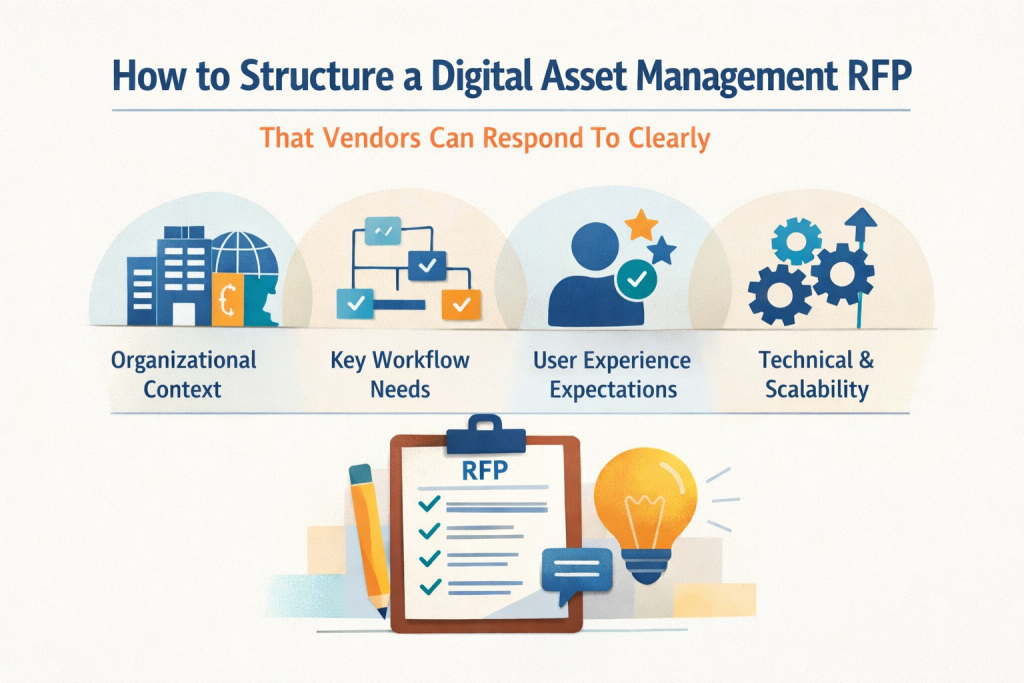
Once your business context is clear, the next step is turning that understanding into a DAM RFP that vendors can respond to meaningfully. Structure matters more than volume. A well structured RFP gives vendors enough information to tailor their responses while avoiding rigid checklists that limit insight and innovation.
The goal is to help vendors explain how their DAM supports your workflows, users, and growth plans rather than forcing them to simply confirm whether a feature exists.
Organizational Context and Brand Environment
Start by explaining who you are as an organization. This includes your industry, size, geographic footprint, and brand complexity. If you manage multiple brands, regions, or product lines, that context is essential. Vendors need to understand whether they are supporting a single centralized brand team or a distributed ecosystem with varying levels of autonomy.
This section sets the stage for every response that follows. It allows vendors to position their platform appropriately and avoids assumptions that can lead to misalignment later in the process.
Functional and Workflow Requirements That Matter
This is where many DAM RFPs become overly technical. Instead of listing every possible capability, focus on the workflows that are critical to your teams. Metadata management, permissions, approvals, version control, and search should be described in terms of how they support real use cases.
It is helpful to separate requirements into must have and important but flexible categories. This gives vendors room to explain tradeoffs and alternatives while still meeting your core needs. Clear priorities also make evaluation easier once responses come in.
User Experience Expectations Across Teams
A DAM only delivers value if people actually use it. Use this section to describe expectations around simplicity, onboarding, and daily usability. Consider how non technical users will interact with the system and how external partners will gain access without creating friction.
Vendors should be encouraged to explain how their interface supports adoption across different roles and skill levels. This insight is often more valuable than a long list of interface features.
Technical Ecosystem and Scalability Expectations
Your DAM will not exist in isolation. Outline the systems it needs to connect with such as CMS platforms, design tools, CRM systems, or PIM solutions. You should also describe how you expect your content operations to grow over time.
Rather than asking for a fixed list of integrations, focus on flexibility and scalability. Vendors should be able to explain how their platform evolves as your organization expands.
Implementation, Support, and Change Management
Finally, clarify expectations around implementation, migration, training, and ongoing support. A smooth rollout often determines whether a DAM succeeds or stalls.
Ask vendors to describe their onboarding approach, support structure, and experience guiding teams through change. This helps you evaluate not just the software, but the quality of partnership you can expect after the contract is signed.
Build a DAM Evaluation Checklist That Enables Fair Vendor Comparison

Once vendor responses begin to arrive, decision making can quickly become difficult. Each DAM vendor uses different terminology, emphasizes different strengths, and presents their platform in the best possible light. Without a structured evaluation framework, teams often rely on gut feeling or internal bias rather than clear evidence.
A DAM evaluation checklist creates consistency. It allows stakeholders to assess every vendor against the same criteria and keeps the conversation focused on what matters most for long term success.
Usability and Adoption Across Roles
Ease of use should be one of the first criteria in your checklist. A DAM that requires extensive training or constant support will struggle to gain adoption, especially among occasional users. Evaluate how intuitive the interface is for marketers, designers, and non technical teams.
Ask vendors to demonstrate common tasks such as uploading assets, finding approved files, and sharing content externally. If these actions feel complex during a demo, they will feel even more difficult in daily use. Strong usability reduces resistance and accelerates value.
Governance, Permissions, and Compliance Controls
Governance is where DAM systems deliver long term value. Your checklist should assess how clearly permissions are defined, how approvals are enforced, and how version control prevents outdated assets from being reused.
This is especially important for regulated industries or global brands. Look for systems that make compliance part of everyday workflows rather than an extra layer of manual review. When governance is built into the platform, brand risk is reduced without slowing teams down.
Brand Presentation and Asset Context
A DAM should do more than store files. It should help users understand how assets are meant to be used. Evaluate whether the platform provides visual context, brand guidance, and clear indicators of approved usage.
Systems that surface assets within brand frameworks help reinforce consistency and reduce misuse. This is a critical but often overlooked area when comparing vendors.
Automation and Intelligence Capabilities
Automation can significantly reduce operational overhead. Use your checklist to evaluate features such as automated tagging, intelligent search, approval routing, and localization support.
Rather than scoring automation based on buzzwords, focus on practical impact. Ask how these capabilities reduce manual work and improve speed for real teams.
Scalability, Roadmap, and Vendor Stability
Finally, consider how well each vendor supports growth. A scalable DAM should handle increasing asset volumes, new user groups, and evolving workflows without major reconfiguration.
Review the vendor’s product roadmap, customer base, and long term vision. Stability and direction matter as much as current features. The right DAM partner will continue to invest in the platform as your organization grows.
Why the Right DAM Vendor Is a Long Term Partner Not Just a Platform
A Digital Asset Management implementation does not end when the contract is signed. In reality, that is when the relationship begins. The DAM you choose will shape how your brand operates every day, which makes the vendor behind the platform just as important as the technology itself.
Focusing only on features can lead to short term satisfaction and long term frustration. A strong DAM partner understands that your workflows, brand structure, and governance needs will evolve over time.
Experience With Complex Brand Environments
Not every DAM vendor is built to support growing or multi brand organizations. As part of your evaluation, look closely at the types of customers the vendor typically serves. Experience with enterprise teams, global brands, or distributed stakeholders often indicates a deeper understanding of scale, permissions, and governance.
Ask vendors to share examples of organizations similar to yours. Their ability to speak confidently about complex brand environments is a strong indicator of future alignment.
Onboarding, Enablement, and Ongoing Guidance
Successful DAM adoption depends heavily on how the system is introduced to your teams. A thoughtful onboarding process helps users understand not just how to use the platform, but why it matters.
Evaluate how vendors approach training, documentation, and change management. Ongoing guidance, regular check ins, and access to knowledgeable support teams can make the difference between a DAM that becomes embedded in daily work and one that is slowly abandoned.
Alignment With Brand Governance and Content Workflows
The best DAM partners understand that asset management is deeply connected to brand governance. They help teams establish clear rules for creation, approval, and distribution while keeping workflows flexible.
Vendors that can align DAM functionality with templated content creation, brand guidelines, and approval logic are better positioned to support consistency at scale. This alignment ensures your DAM remains relevant as your brand grows and adapts.
How Brandy Simplifies the DAM RFP Process for Growing Brands

As DAM RFPs grow more detailed, many teams struggle with alignment before vendor evaluation even begins. Different stakeholders often have different priorities, language, and expectations. Without a shared foundation, RFPs become fragmented documents that reflect compromise rather than clarity.
Brandy helps solve this problem by giving teams a structured way to define and visualize their brand system before selecting a DAM. Instead of starting with software features, teams begin by aligning on brand architecture, governance rules, and content workflows. This clarity makes it easier to articulate requirements that actually matter.
By centralizing brand logic, approved assets, and usage rules, Brandy helps organizations understand what they need from a DAM and why. This leads to RFPs that are outcome focused and easier for vendors to respond to accurately. Stakeholders can see how assets should be organized, shared, and governed long before technical discussions begin.
Brandy also supports ongoing brand consistency alongside a DAM. While a DAM manages storage, distribution, and permissions, Brandy acts as a living reference for how the brand should be expressed. Together, they reduce ambiguity, improve adoption, and ensure that DAM investments support long term brand clarity rather than just operational efficiency.
Final Thoughts: From DAM Evaluation to Confident Decision Making
A strong DAM RFP creates alignment before a single vendor is evaluated. By starting with business reality, structuring requirements around real workflows, and using a clear evaluation checklist, teams move from uncertainty to informed decision making. The process becomes less about comparing features and more about selecting a system that supports how the brand actually works.
Choosing a scalable DAM solution requires looking beyond today’s needs. Governance, usability, and partnership quality determine whether the platform will continue to deliver value as content volumes grow and teams expand. When these factors are considered early, implementation becomes smoother and adoption more natural.
The most effective DAM RFPs connect technology to brand intent. They create space for the right vendors to stand out and give internal teams confidence in the final decision. With the right structure and tools in place, your DAM investment becomes a foundation for speed, consistency, and long term brand integrity.