Display advertising is everywhere. From websites people browse during work breaks to the apps they scroll through at night, digital display ads shape how people discover and remember products. With most of the global population now online, display ads are not disappearing anytime soon.
What has changed is the pressure on marketing teams. Campaigns move faster. Channels multiply. Audiences expect relevance instead of repetition. At the same time, brand teams are responsible for maintaining consistency across every visual touchpoint.
This creates a real tension. How do you produce large volumes of display ads quickly without sacrificing quality or brand integrity?
Many teams struggle with this balance. Ads take too long to create. Designs vary from region to region. Approval cycles slow everything down. And by the time assets are ready, the opportunity may already be gone.
This guide breaks down why creating display ads at speed and scale is so difficult today, what actually makes display ads work, and why traditional production models are no longer enough.
Why Creating Display Ads at Scale Is So Difficult Today
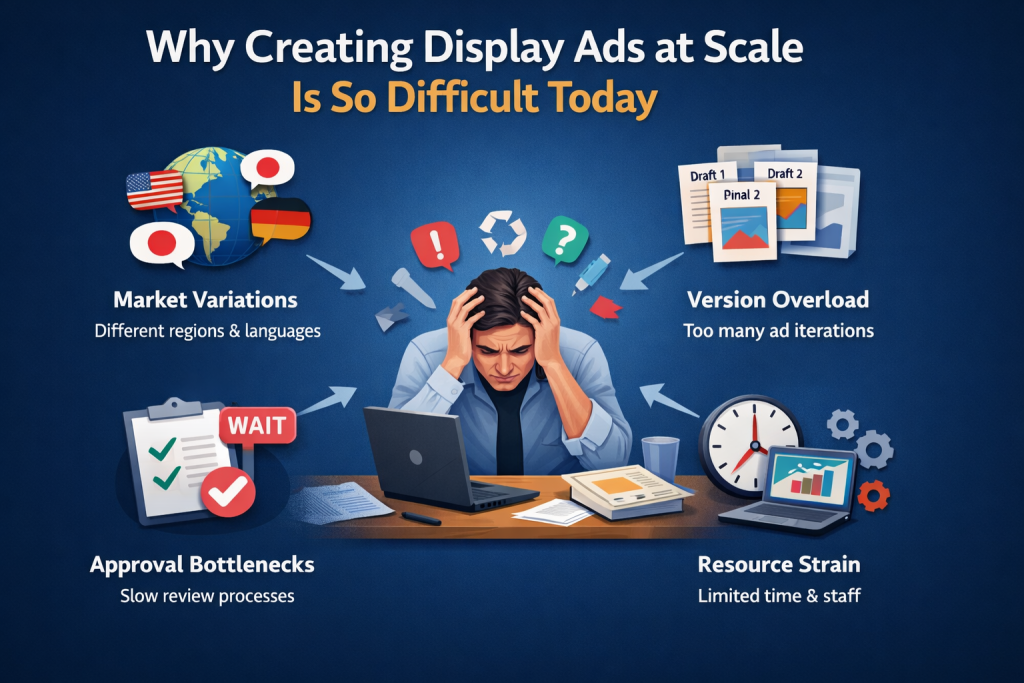
Producing one strong display ad is manageable. Producing dozens or hundreds across platforms, formats, and markets is where complexity appears.
Volume Pressure Is Constantly Increasing
Modern campaigns rarely rely on a single banner or size. A single promotion can require multiple variations for different platforms, screen sizes, languages, and audiences.
What once meant designing a few static banners now involves responsive ads, retargeting variations, regional adaptations, and ongoing optimization. The volume is not a one time spike. It is continuous.
As demand grows, teams are forced to choose between speed and precision. Without a scalable system, quality often suffers first.
Speed Expectations Leave No Room for Bottlenecks
Campaign timelines have shortened dramatically. Marketing teams are expected to respond to trends, launches, and performance data in near real time.
Traditional workflows rely heavily on designers, handoffs, and approval layers. Each step adds friction. A small change to copy or imagery can trigger a full redesign and another review cycle.
When speed becomes critical, these bottlenecks turn into missed opportunities.
Brand Consistency Breaks Under Scale
As more people become involved in content creation, the risk of inconsistency grows.
Logos get resized incorrectly. Fonts are swapped. Colors drift. Messaging tone shifts subtly from one ad to another. None of these issues are intentional, but together they dilute brand recognition.
Brand guidelines alone are rarely enough to prevent this. When teams are under pressure, they improvise. At scale, improvisation becomes a liability.
What Makes Display Ads Actually Work in a Crowded Digital Space
Before solving production challenges, it helps to understand what separates effective display ads from the ones people ignore.
Relevance Matters More Than Reach
Audiences are exposed to hundreds of ads every day. Most are filtered out instantly.
The ads that perform well are the ones that feel timely and relevant. They reflect the viewer’s context, interests, or intent. This requires flexibility in messaging and visuals without starting from scratch each time.
Speed and relevance are closely linked. The faster a team can adapt creatives, the more relevant those ads can be.
Design Quality Signals Trust
Even when ads are small, design quality matters.
Clean layouts, consistent branding, and thoughtful hierarchy communicate professionalism. Poorly designed ads create friction and reduce trust before the message is even read.
Inconsistent visuals across campaigns can confuse audiences and weaken brand memory. Strong design systems help maintain trust at scale.
Clear Messaging Beats Clever Messaging
Display ads have limited space and limited time to make an impact.
The most effective ads prioritize clarity. A single message. A clear benefit. A visible call to action. Overloading ads with information or trying to be too clever often backfires.
Intentional frameworks make it easier to maintain clear structure and hierarchy than improvised designs.
Why Traditional Display Ad Production Models Do Not Scale
Many teams still rely on production models that were never designed for today’s pace or volume.
Heavy Reliance on Designers and Agencies
Designers play a critical role in brand expression, but involving them in every minor variation is inefficient.
When every size change, copy update, or regional tweak requires designer time, production slows and costs rise. Agencies add another layer of coordination and delay.
This model works for flagship campaigns, but not for always on display advertising.
Fragmented Tools and Asset Storage
Assets often live across shared drives, email threads, cloud folders, and local desktops.
Finding the right logo, image, or approved version becomes a task in itself. Teams duplicate work simply because they cannot locate what already exists.
Fragmentation increases the risk of outdated or incorrect assets being used in live ads.
Manual Brand Policing Does Not Work
Many organizations rely on guidelines and reviews to enforce brand consistency.
In practice, this means catching mistakes after they happen. Reviews become reactive rather than preventative. As volume increases, reviewers miss things or approvals get rushed.
True consistency requires systems that guide creation, not just documents that explain rules.
How Templated Content Creation Changes Display Advertising
Templated content creation introduces structure into what is often a chaotic process.
Instead of starting every display ad from a blank canvas, teams work from pre approved templates designed around brand standards. Core elements such as logos, fonts, colors, and layout structure are defined upfront.
What changes is the content, including headlines, images, offers, and local messaging, while the underlying structure stays consistent and on brand.
This approach shifts creative work earlier in the process. Designers focus on building flexible, high quality templates. Marketers and local teams use those templates to produce variations quickly and safely.
Templates do not limit creativity. They remove friction. By reducing decision fatigue and eliminating common mistakes, they allow teams to focus on relevance and performance.
Most importantly, templates turn brand consistency from a guideline into a built in rule.
Creating Display Ads Faster Using Smart Templates
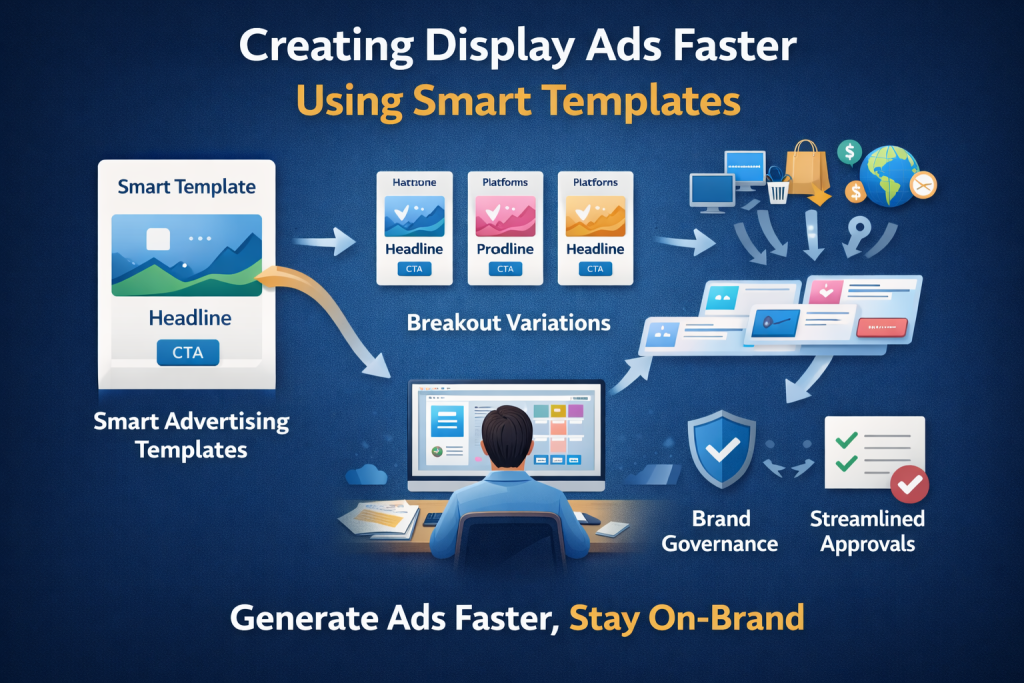
Speed comes from removing unnecessary steps, not from cutting corners.
Pre Approved Layouts Remove Guesswork
Templates eliminate the need to decide where elements should go every time.
Spacing, hierarchy, and alignment are already defined. Teams simply add content where it belongs. This dramatically reduces production time while maintaining design quality.
Responsive Formats Without Rebuilding Everything
Smart templates are designed to adapt across formats and sizes.
Instead of recreating ads for each placement, teams can generate multiple versions from a single template. This supports consistent execution across devices and platforms without repetitive work.
Local Teams Create Ads Without Waiting
Templates empower teams closer to the market.
Local marketers can update messaging, offers, or language without waiting for central teams or designers. Guardrails ensure brand safety while autonomy improves speed.
This balance between control and flexibility is what makes scaling display ads sustainable.
Producing Display Ads at Scale Without Losing Control
Speed alone is not enough. When display ads are produced at scale without the right guardrails, brand erosion happens quietly and quickly.
This is where many teams struggle. They decentralize creation to move faster, but consistency starts slipping. Centralize everything to maintain control, and production slows to a crawl.
The solution is not choosing one over the other. It is designing systems that allow both to coexist.
Brand Rules Built Into the System
The most effective way to maintain consistency is to remove the possibility of mistakes.
When brand elements are locked directly into templates, teams do not have to remember rules. Logos cannot be resized incorrectly. Fonts cannot be swapped. Colors stay aligned with brand standards.
This shifts brand governance from review based enforcement to system based prevention.
Centralized Assets Reduce Errors
Scale introduces complexity, and complexity increases the chance of error.
A centralized library of approved assets ensures everyone works from the same source of truth. There is no confusion about which logo to use or which image is cleared for a specific campaign.
When assets are easy to find and clearly approved, teams move faster and make fewer mistakes.
Faster Approvals and Fewer Revisions
When ads are built within predefined frameworks, review cycles become simpler.
Approvals focus on messaging and relevance instead of technical brand issues. Reviewers spend less time fixing basic mistakes and more time improving performance.
This leads to faster launches and more confident execution.
The Role of Digital Asset Management in Display Advertising
Templated creation solves structure, but scale also depends on how assets are stored, governed, and distributed.
Digital Asset Management plays a critical role in this process.
DAM systems centralize brand assets and make them easy to search, filter, and reuse. Teams can quickly find images, videos, logos, and creative files that are approved and up to date.
Beyond storage, DAM adds essential context such as usage rights, version history, and access control. This reduces risk and ensures assets are used appropriately across markets and channels.
When DAM and templated creation work together, display advertising becomes significantly more efficient. Templates define how ads are built. DAM ensures teams always have the right ingredients to build them.
How Brandy Helps Teams Create Display Ads at Speed and Scale

Brandy brings structure to one of the most fragmented parts of marketing operations.
By centralizing brand assets, templates, and brand rules in one platform, Brandy enables teams to create display ads quickly without compromising consistency.
Marketing teams gain autonomy. They can produce and adapt ads without waiting for design support. Brand teams gain confidence. Every asset created stays aligned with approved guidelines.
Instead of acting as a gatekeeper, the brand system becomes an enabler. Creation accelerates while governance stays intact.
This approach is especially valuable for organizations running multiple campaigns across regions, teams, or partners. Brandy supports scale without adding complexity.
Common Mistakes to Avoid When Scaling Display Ads
Even with the right intent, teams often repeat the same missteps.
Relying on brand guidelines alone is one of the most common. Documents explain rules, but they do not enforce them.
Another mistake is letting every team create ads from scratch. This leads to inconsistent layouts, duplicated work, and unnecessary revisions.
Many organizations also focus heavily on media spend optimization while ignoring production efficiency. Faster ad creation directly impacts campaign performance and should be treated as a strategic priority.
Finally, governance is often introduced only after problems appear. The most successful teams build structure early and scale confidently from there.
Conclusion
Creating display ads at speed and scale is no longer optional. It is a requirement for modern marketing teams operating in competitive digital environments.
The challenge is not choosing between speed and control. It is building systems that support both. When structure is embedded into the creation process, teams move faster, stay consistent, and produce better results.
Templates, centralized assets, and thoughtful governance transform display advertising from a bottleneck into a growth engine.
The teams that succeed are the ones that treat content creation as a system, not a series of one off tasks.
Frequently Asked Questions
Creating display ads at scale requires balancing speed, quality, and consistency. Without the right systems, teams rely on manual processes that slow production and introduce errors. As volume increases, these issues compound.
Templates provide predefined layouts with locked brand elements. This allows non designers to safely create professional ads by focusing only on content updates such as messaging and imagery.
Effective display ads are visually clear, contextually relevant, and professionally designed. They communicate a single message, align with brand standards, and include a clear call to action.
A banner ad creator with built in templates ensures every ad follows approved layouts and brand rules. This reduces mistakes and maintains consistency across all campaigns.
Yes, when the right guardrails are in place. Templated creation and centralized asset management allow teams to work independently while staying on brand.