Pharmaceutical marketing operates in one of the most demanding environments of any industry. Regulation, public trust, and patient safety shape every message, visual, and document. At the same time, marketing teams must scale content across regions, channels, and audiences while maintaining absolute consistency.
This pressure creates a difficult balancing act. Pharma marketers must move fast without making mistakes. They must empower local teams without losing control. And they must build strong brands while navigating some of the strictest compliance rules in the world.
Digital Asset Management has quietly become the foundation that makes this balance possible. For modern pharmaceutical teams, DAM is no longer optional software. It is the system that protects reputation, enables scale, and keeps marketing operations functioning under pressure.
The Reality of Modern Pharmaceutical Marketing
Pharma marketing looks nothing like traditional brand marketing. The stakes are higher, the rules are stricter, and the margin for error is minimal.
Regulatory Pressure Shapes Every Marketing Decision
Every pharmaceutical asset exists within a framework of legal and ethical requirements. Messaging must be accurate. Claims must be substantiated. Visuals must align with approved indications. Disclaimers must be present and correct.
What makes this challenging is not just the regulation itself, but how frequently standards evolve. Guidelines change. Regional rules differ. Internal approvals add additional layers of review. As a result, even a small lapse such as using an outdated presentation or an incorrect visual can carry serious consequences.
Marketing teams are not simply creating content. They are managing risk with every asset they distribute.
Global Reach Increases Brand and Compliance Risk
Most pharmaceutical companies operate across multiple markets. Each region brings its own regulations, languages, cultural expectations, and distribution channels.
What works in one country may be prohibited in another. A visual approved for one audience may be unsuitable for a different group. Without structured systems in place, this complexity becomes unmanageable.
As content spreads across regions, the risk of misalignment grows. Without clear control, brands face exposure not only to regulatory penalties but also to reputational damage that can be difficult to reverse.
The Core Challenges Pharma Marketing Leaders Face Today
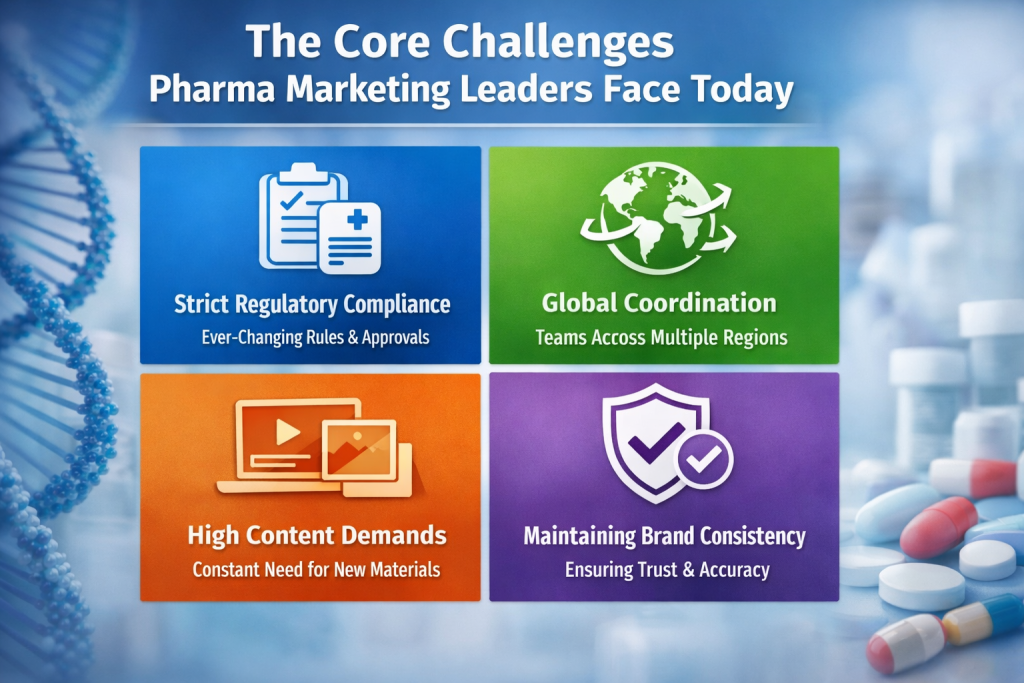
Pharma marketing leaders are under pressure from every direction. Their challenges are operational, strategic, and reputational all at once.
Compliance Risk Across Multiple Channels
Marketing content today lives everywhere. Websites. Sales decks. Recruitment campaigns. Social platforms. Partner portals. Each channel introduces another opportunity for error.
When teams rely on shared drives, email attachments, or informal file sharing, it becomes difficult to guarantee that only approved materials are being used. Over time, outdated or unapproved assets resurface quietly, often without malicious intent.
In a regulated industry, these small gaps can turn into serious compliance breaches.
Time and Budget Constraints Under Growing Content Demand
Pharma brands are expected to produce more content every year. Product launches, clinical updates, educational materials, employer branding, and localized campaigns all compete for attention and resources.
At the same time, budgets remain under scrutiny and teams are expected to do more with less. Efficiency becomes essential, but not at the expense of accuracy or governance.
Without the right systems, marketing teams lose time searching for assets, duplicating work, and managing approvals manually.
Brand Consistency Across Regions and Partners
Trust is central to pharmaceutical brands. Consistency plays a critical role in maintaining that trust.
Yet as brands grow, consistency becomes harder to enforce. Local teams adapt content. Agencies create variations. Partners reuse materials in unexpected ways. Over time, the brand identity begins to fragment.
This erosion rarely happens all at once. It happens gradually, asset by asset, until leadership realizes the brand no longer looks or sounds unified.
Asset Chaos and Collaboration Breakdown
As asset libraries grow into the thousands, chaos becomes inevitable without structure. Files are duplicated. Naming conventions vary. Ownership becomes unclear.
Collaboration suffers as teams struggle to find what they need or question whether an asset is safe to use. Instead of empowering teams, content becomes a source of friction.
This environment slows campaigns, frustrates creatives, and increases risk across the organization.
What Digital Asset Management Really Means for Pharma Teams
Digital Asset Management is often misunderstood as a storage solution. In reality, for pharmaceutical teams, it is an operational framework.
A Single Source of Truth for Regulated Content
At its core, DAM provides a centralized environment where every approved asset lives. This includes marketing materials, sales collateral, videos, templates, and brand guidelines.
By centralizing assets, DAM eliminates ambiguity. Teams no longer wonder which file is correct or whether a version is approved. The system itself becomes the authority.
This clarity is essential in an industry where using the wrong asset can have serious consequences.
Structuring Assets for Speed and Accountability
Effective DAM systems do more than store files. They structure content using metadata, permissions, and governance rules.
Assets can be tagged by region, product, audience, or approval status. Access can be controlled based on role or geography. Ownership and version history are clearly defined.
This structure allows teams to move faster without sacrificing control.
DAM as Operational Infrastructure Not Just Software
For pharma marketers, DAM is not a tool that sits on the side of existing workflows. It becomes the backbone of content operations.
It supports compliance, enables collaboration, and scales with the organization. Over time, it reduces dependency on manual processes and individual knowledge.
DAM shifts marketing from reactive asset management to proactive brand governance.
How DAM Strengthens Compliance Without Slowing Marketing
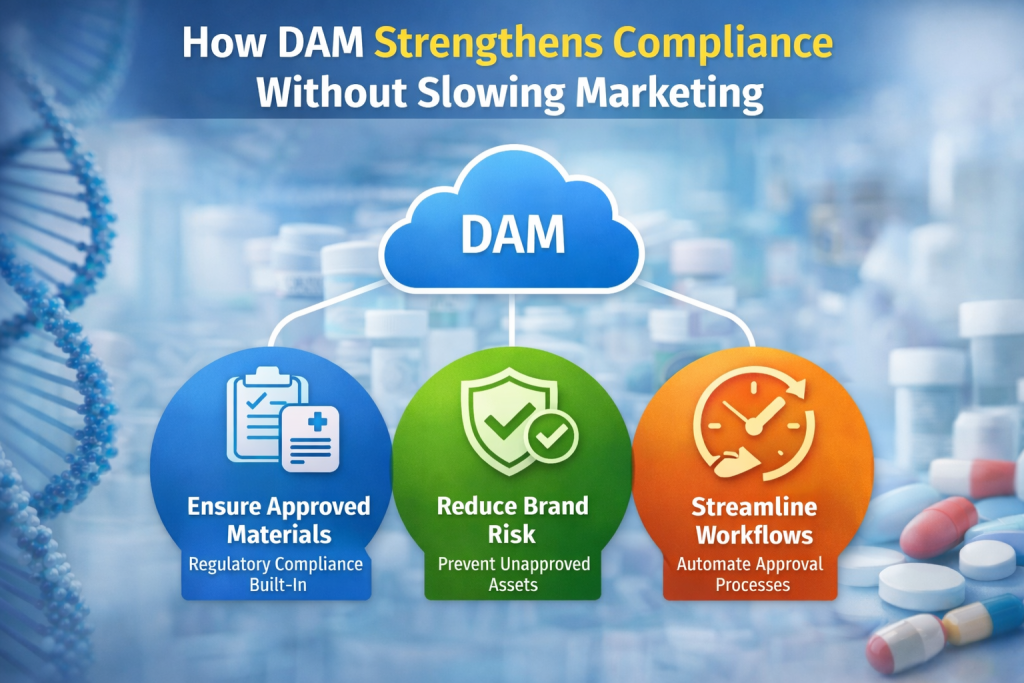
One of the biggest misconceptions about compliance is that it slows creativity. In reality, the right systems make compliant marketing faster and safer.
Version Control Prevents Risky Mistakes
Without DAM, outdated assets tend to resurface. A slide saved locally. A brochure reused from an old campaign. A visual pulled from an email archive.
Version control eliminates this risk. Teams only access the most current approved version of an asset. Older versions are archived or restricted automatically.
This removes the need for constant manual checks and reduces the chance of accidental misuse.
Controlled Access Protects Sensitive Materials
Not every asset should be available to everyone. Some materials are intended for healthcare professionals. Others are for internal use or specific regions.
DAM allows marketers to control access precisely. Teams see only what is relevant and approved for them.
This level of control protects both the brand and the audience while simplifying compliance enforcement.
Audit Readiness Without Manual Scrambling
Regulatory reviews and audits are part of life in the pharmaceutical industry. When assets are scattered across systems, responding to requests becomes stressful and time consuming.
With DAM, assets are already organized, searchable, and traceable. Teams can quickly retrieve what is needed without disrupting ongoing work.
Compliance becomes part of everyday operations rather than an emergency response.
Why DAM Is Essential for Pharma Marketing Efficiency

Efficiency in pharma marketing is not about cutting corners. It is about removing unnecessary friction so teams can focus on high value work.
Faster Asset Discovery Across Teams
Studies consistently show that marketing teams lose significant time searching for files. DAM reduces this dramatically by making assets easy to find through search and filters.
When teams can locate what they need instantly, productivity improves across the organization.
Removing Bottlenecks Between Global and Local Teams
DAM enables structured sharing between central and regional teams. Brand portals allow headquarters to distribute approved materials while empowering local teams to execute confidently.
This reduces delays, minimizes back and forth communication, and speeds up campaign launches.
Enabling Teams to Focus on Strategy Not File Hunting
When systems handle asset management instead of people, marketers regain time and mental space. They can reinvest that time in strategy, creativity, and building stronger relationships with audiences.
Delivering Brand Consistency in a Highly Regulated Industry
In pharmaceutical marketing, consistency is not just about aesthetics. It is about credibility. Healthcare professionals, patients, and potential employees all form judgments based on how reliable and coherent a brand appears across touchpoints.
When messages vary, visuals feel disconnected, or tone shifts unexpectedly, trust erodes. In an industry where trust is everything, this erosion can have lasting consequences.
Consistency Builds Trust With HCPs and Patients
Healthcare professionals rely on pharmaceutical brands for accurate, dependable information. Consistent branding reinforces the perception that a company is professional, stable, and committed to quality.
When materials look and feel aligned across channels, it signals control and responsibility. DAM ensures teams use only approved visuals, messaging frameworks, and materials, regardless of where or by whom they distribute the content.
Brand Guidelines That Are Actually Used
Many pharma companies invest heavily in brand guidelines, yet struggle to enforce them. PDFs get outdated. Local teams interpret rules differently. Agencies work from old references.
DAM changes this dynamic. Brand guidelines live alongside assets, templates, and examples in a central environment. Teams do not need to search for rules. They work within them by default.
This makes consistency achievable without constant policing.
Aligning Employer Brand With Corporate Brand
Pharmaceutical companies compete fiercely for top talent. Recruitment materials are often created quickly and locally, which increases the risk of off brand messaging.
DAM helps ensure that employer branding aligns with the corporate identity. Recruitment teams access the same approved visuals, tone guidance, and templates as marketing teams.
This alignment strengthens credibility with candidates and supports long term employer brand equity.
Managing Rebrands and Mergers Without Brand Leakage
Rebrands and mergers are common in the pharmaceutical sector. They are also moments of heightened risk.
Without structured systems, teams continue to circulate old assets long after launching a new identity. This confuses audiences and weakens the impact of the change.
Preventing Old Assets From Reappearing
DAM provides clear lifecycle control. When a rebrand occurs, teams archive, restrict, or remove outdated assets from circulation entirely.
Teams no longer rely on memory or manual cleanup. The system enforces the transition automatically.
This prevents legacy materials from resurfacing and undermining the new brand.
Supporting Regional Rollouts With Precision
Rebrands rarely launch everywhere at once. Different regions often transition at different speeds due to regulatory approvals or operational constraints.
DAM allows marketers to manage access by region and timing. Teams only see what they are meant to use, when they are meant to use it.
This precision supports smoother rollouts and reduces confusion across markets.
Scaling Content Without Losing Control
Content demands continue to grow. Pharmaceutical brands must produce more educational materials, recruitment content, and localized campaigns every year.
Scaling content without systems leads to chaos.
Handling Growing Volumes of Regulated Content
DAM platforms are designed to handle large asset libraries. Bulk uploads, automated tagging, and structured organization allow teams to manage growth without friction.
As libraries expand, assets remain usable rather than becoming buried or forgotten.
Making Global Localization Faster and Safer
Localization is essential for pharmaceutical marketing, but it introduces risk if not managed carefully.
DAM supports localization by allowing teams to adapt approved core assets rather than starting from scratch. This preserves compliance while enabling relevance.
Local teams move faster while staying within guardrails.
Collaboration Across Borders Without Compliance Compromise
Global collaboration is unavoidable for pharmaceutical brands. The challenge is ensuring collaboration does not lead to inconsistency or risk.
Shared Visibility Across Teams and Partners
DAM creates transparency. Everyone works from the same environment, with clear visibility into what is approved and current.
This shared understanding reduces miscommunication and aligns teams across regions and functions.
Confidence That Every Team Uses Approved Content
Leadership gains confidence knowing that teams are not improvising or relying on outdated files.
DAM replaces uncertainty with clarity. Teams trust the system, and leadership trusts the output.
Why Modern Pharma Teams Choose Brand Platforms Like Brandy

As DAM evolves, many pharmaceutical teams are moving beyond basic asset storage toward full brand platforms.
Centralized Brand Access Built for Regulated Industries
Brand platforms like Brandy combine DAM with brand governance. Assets, guidelines, templates, and approvals live in one structured environment.
This unified approach supports compliance while making brand access simple for every team.
Governed Collaboration Without Slowing Teams
Brandy enables collaboration without sacrificing control. Permissions, versioning, and structured access ensure that teams can move quickly while staying compliant.
Governance becomes built in rather than enforced after the fact.
Preparing Pharma Brands for Long Term Scale
Pharmaceutical marketing will only become more complex. More channels. More regions. And, more scrutiny.
Brand platforms provide the foundation needed to scale confidently without losing control or clarity.
Digital Asset Management is a Requirement Not a Nice to Have
Pharmaceutical marketers face a unique set of challenges. Strict regulation. Global scale. High expectations for trust and accuracy.
Digital Asset Management has emerged as a foundational system that supports all of these demands. It strengthens compliance, enables efficiency, protects brand consistency, and fosters collaboration across borders.
For modern pharma teams, DAM is no longer a productivity tool or a future consideration. It is a requirement for operating responsibly and competitively in today’s environment.
Brands that invest in structured asset management are not just protecting themselves from risk. They are building the operational confidence needed to grow, adapt, and lead in a highly regulated world.