You can invest years building a strong brand identity. Clear positioning. A recognizable visual language. A tone of voice that customers connect with. On paper, everything looks right. But brand health is not defined by how well your brand is designed. It is defined by how consistently it is delivered.
Across regions, teams, agencies, and platforms, execution is where brand equity is either strengthened or quietly eroded. A single off brand campaign will not destroy trust. But hundreds of small inconsistencies over time will. That erosion rarely shows up immediately. It surfaces later as declining engagement, weaker recall, and flat growth that is hard to explain.
Brand health tracking exists to highlight these risks. But tracking alone does not protect a brand. Action does.
This is where many organizations struggle. They can see the signals, but they cannot always connect those signals back to daily brand execution. The result is insight without impact.
What Brand Health Really Measures Beyond Awareness and Sentiment
Brand health is often reduced to dashboards and percentages. Awareness levels. Sentiment scores. Share of voice. While these metrics are useful, they only tell part of the story. True brand health reflects how well a brand delivers on its promise, consistently and at scale.
It is not just about whether people recognize your brand. It is about whether every interaction reinforces what your brand stands for.
Brand Health as a Promise Kept Repeatedly
Healthy brands feel reliable. Customers know what to expect before they engage. The visuals feel familiar. The messaging sounds consistent. The experience feels intentional.
This reliability is built through repetition. Every campaign, every social post, every localized asset either reinforces or weakens that promise. Brand health improves when execution aligns with intent, again and again, across all touchpoints.
The Link Between Brand Health and Brand Equity
Brand equity grows when customers trust what a brand represents. That trust is emotional, but it is reinforced operationally. When brand delivery feels inconsistent, equity does not disappear overnight. It thins gradually.
Inconsistent visuals. Mixed messaging. Unclear tone of voice. These gaps may feel minor in isolation, but together they weaken differentiation and make it harder for a brand to command loyalty or premium positioning.
Why Brand Health Trackers Reveal Problems But Rarely Fix Them
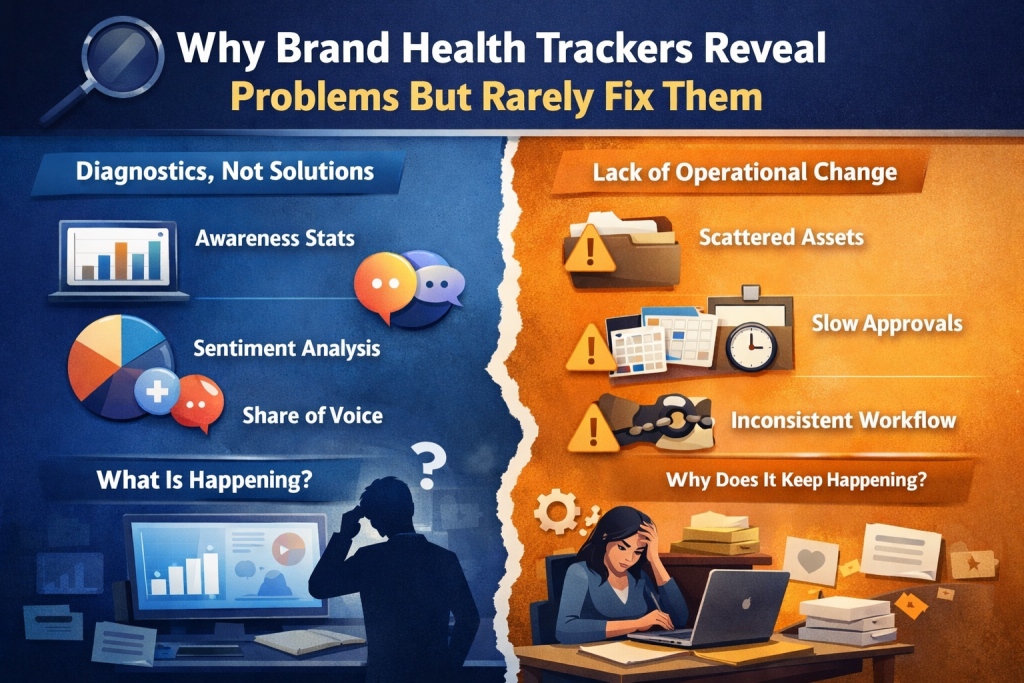
Brand health trackers are valuable. They surface changes in perception and awareness that teams might otherwise miss. They help identify where a brand is gaining or losing ground.
However, most brand health tools are diagnostic by nature. They show what is happening, not why it keeps happening.
What Brand Health Tools Measure Well
Brand health trackers excel at listening. They monitor how audiences talk about a brand, how often it appears in conversations, and how sentiment shifts over time. These insights help brand leaders understand external perception at scale.
They are especially useful for spotting trends early, before they turn into larger reputation issues.
Where Most Brand Health Programs Break Down
The challenge begins after the data is collected. Teams often know there is a problem, but struggle to trace it back to execution. Which assets are being used incorrectly. Which teams are creating off brand content. Where approvals are breaking down.
Without operational systems to support consistent delivery, insights remain abstract. Teams discuss results, but the same issues resurface quarter after quarter.
The Silent Brand Killers Hidden in Daily Content Execution
Brand health rarely collapses because of one major failure. It declines through small, repeated breakdowns in everyday workflows.
Inconsistent Assets Across Markets
When teams store assets locally or rely on outdated files, inconsistencies spread quickly. Logos vary slightly. Colors drift. Messaging evolves without alignment. Over time, the brand begins to feel fragmented.
Slow or Missing Approval Workflows
When approvals take too long or are skipped entirely, teams work around the system. Content goes live without review. Speed is prioritized over alignment. The brand pays the price later.
Brand Guidelines That Exist But Are Not Used
Many organizations have brand guidelines. Fewer have guidelines that are actively used. If guidelines are difficult to access or hard to interpret, teams rely on guesswork. Consistency becomes optional instead of automatic.
It Is Not a Visibility Problem It Is a Governance Problem
Most brand leaders do not lack visibility. They know execution is inconsistent. They see the symptoms in brand health data. The real issue is governance.
Governance does not mean control for the sake of control. It means creating systems that make the right behavior easy and the wrong behavior difficult. Without this structure, even the best brand strategy will struggle to scale.
True brand health improves when teams are enabled to deliver on brand standards by default, not when they are corrected after the fact.
From Brand Health Signals to Brand Action
Brand health tracking tells you where attention is needed. Action determines whether brand equity improves.
The gap between insight and execution is where most brands lose momentum. Closing that gap requires more than awareness. It requires operational clarity. Clear access to assets. Simple content creation workflows. Measurable usage insights.
The next step is not another report. It is building the systems that allow teams to act consistently, every day, across every market.
How to Fix Brand Health Through Smarter Content and Brand Operations
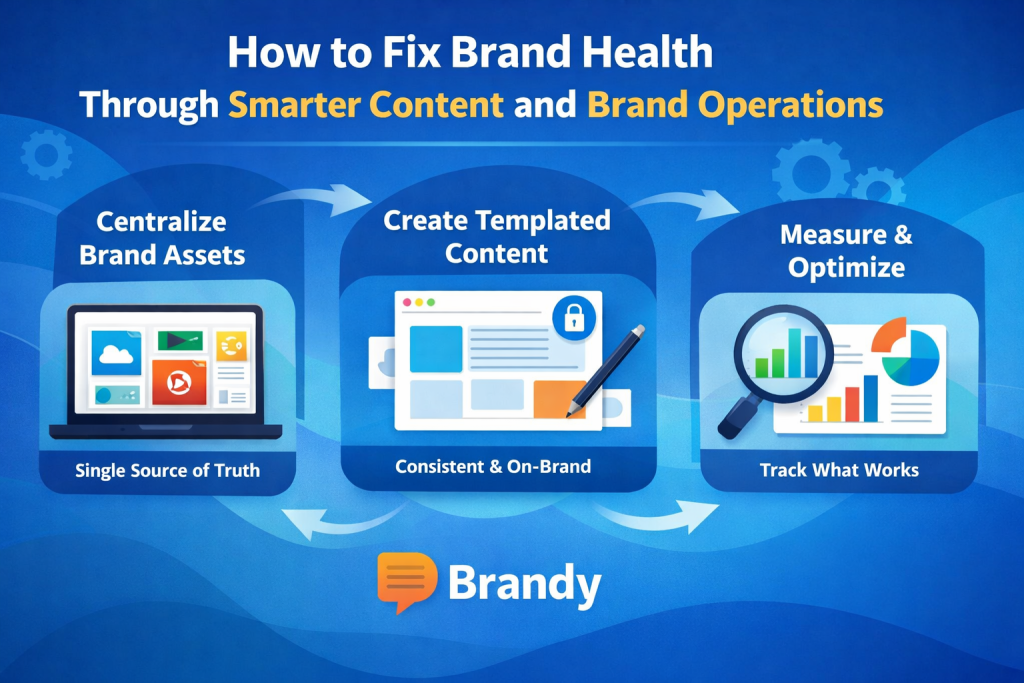
Brand health does not improve because teams try harder. It improves when systems make consistent execution the easiest path forward. When brand health trackers highlight declining engagement or inconsistent perception, the root cause is rarely creativity or intent. It is almost always operational friction. Assets are hard to find. Approvals are slow. Guidelines are disconnected from daily work.
Fixing brand health means fixing how content is created, accessed, and reused across the organization. The following three steps show how brands move from insight to action by building better brand operations instead of relying on manual enforcement.
Step 1 Centralize Your Brand Assets Into a Single Source of Truth
Scattered assets quietly undermine brand consistency. When files live across shared drives, personal folders, email threads, and outdated tools, teams make decisions based on convenience rather than accuracy. The result is duplicated work, inconsistent visuals, and slow execution that erodes trust internally and externally.
Centralizing brand assets changes this dynamic. A single source of truth ensures every team works from the same approved materials. Logos, templates, imagery, messaging frameworks, and campaign assets are easy to find and clearly labeled. Teams no longer guess which version is correct. They know.
This clarity improves speed as much as consistency. When marketers do not waste time searching for files or recreating assets, campaigns move faster without sacrificing alignment. Local teams can work independently while staying connected to the core brand.
Brandy supports this foundation by acting as a centralized digital asset management platform built for brand teams. Through structured brand portals, teams gain controlled access to approved assets based on role, region, or use case. Global standards remain protected while local execution becomes easier, not harder.
Step 2 Enable Templated Content Creation Without Losing Brand Control
Brand guidelines often fail at scale because they rely on memory and interpretation. Templates solve this by embedding brand rules directly into the creation process. Instead of telling teams how to stay on brand, templates show them.
Templated content creation allows teams to personalize content safely. Campaign headlines, images, and local messaging can adapt to market needs while core brand elements remain locked. Logos stay in place. Colors remain consistent. Tone stays aligned.
This approach reframes brand control as enablement. Teams gain speed and autonomy without creating risk. Approvals become lighter because guardrails are already built in. Content moves from draft to live faster, with fewer corrections and less friction.
Brandy supports templated content creation by allowing brand teams to define what can and cannot be changed. Locked templates protect key brand elements while still giving teams the flexibility they need to create relevant content. The result is faster execution that stays on brand by default, not by exception.
Step 3 Measure What Gets Used and Repeated Not Just What Gets Created
Many brands track output. Fewer track adoption. Creating content does not improve brand health if the right assets are not being used consistently across regions and channels.
Measuring asset usage reveals where brand equity is actually being built. Which visuals are reused most often. Which templates drive consistent execution. And, which materials are ignored or misused. These insights show where brand systems are working and where they need refinement.
Usage data also helps teams invest smarter. Instead of producing more assets, they can strengthen the ones that already perform well. This focus reinforces consistency and improves efficiency across the organization.
Brandy analytics make this visibility practical. Teams can see how assets are accessed, shared, and reused across markets. These insights turn brand health signals into clear actions, helping teams improve execution continuously rather than reacting after problems appear.
Together, these three steps transform brand health from a reporting exercise into an operational advantage. When systems support consistency, brand equity grows naturally through every piece of content created and shared.
How Strong Brand Systems Turn Consistency Into Customer Trust
Customers rarely analyze brand execution. They feel it. When every interaction looks familiar, sounds aligned, and meets expectations, trust builds naturally over time. This trust is not created through messaging alone. It is created through consistency that holds up across channels, markets, and moments.
Strong brand systems make this consistency invisible but reliable. Customers experience the same tone, quality, and visual language whether they engage with a global campaign or a local social post. Even small signals, such as layout choices or wording patterns, reinforce familiarity. That familiarity reduces friction and strengthens emotional connection.
When brand systems work, loyalty grows without conscious effort. Customers return because the brand feels dependable. Advocacy follows because the experience is predictable in the best way. Consistency becomes a competitive advantage that compounds with every interaction.
Building Brand Awareness Beyond the Health Check
Brand health tracking highlights where attention is needed, but it is only the starting point. Awareness does not improve brand equity unless execution improves alongside it. Periodic audits may reveal issues, but they do not prevent them from reappearing.
Sustainable brand awareness is built through continuous systems that support daily work. Teams need access to the right assets, clear creation workflows, and simple governance that scales. When these systems are in place, brand alignment becomes routine instead of reactive.
Brands that move beyond the health check focus less on measuring perception and more on shaping behavior. Over time, this shift turns brand awareness into brand preference through consistent delivery, not occasional correction.
How Brandy Helps Teams Turn Brand Health Insights Into Action

Brandy is designed to close the gap between brand insight and brand execution. Instead of adding another layer of reporting, it focuses on helping teams act consistently across every touchpoint.
Centralized Brand Access for Every Team
Brandy provides a single place where teams can find approved brand assets without friction. Structured brand portals ensure that the right materials are accessible based on role or region, reducing confusion and preventing misuse.
Governed Content Creation at Scale
With templated content creation, Brandy enables teams to move fast while staying aligned. Critical brand elements remain protected, while local teams personalize content safely and efficiently.
Visibility Into What Strengthens or Weakens Brand Equity
Brandy analytics show how assets are actually used across markets. This visibility helps teams understand what reinforces brand consistency and where improvements are needed, turning insights into informed action.
Conclusion: Healthy Brands Are Built Through Systems Not Spot Checks
Brand health is not maintained through occasional reviews or strict enforcement. It is sustained through systems that guide daily decisions. When teams have the right tools, clarity, and structure, consistency becomes the default.
Tracking brand health reveals signals. Strong brand systems determine outcomes. By focusing on execution over enforcement, brands protect equity, strengthen trust, and create experiences that customers return to again and again.