
At first glance, a billboard covered in Lorem Ipsum looks like a mistake. Placeholder text belongs in drafts, wireframes, and unfinished mockups, not in public space. For anyone responsible for brand quality, seeing it displayed boldly and without apology triggers an immediate reaction. That reaction is exactly why the idea works.
The campaign was never about shock value or cleverness for its own sake. It was a deliberate interruption designed to expose a growing problem in modern branding. Too much work today looks correct, polished, and technically on brand, yet fails to communicate anything meaningful. The billboard was not unfinished branding. It was a mirror.
This article explores why being on brand is no longer enough to create impact. It looks at how mistakes can become creative tools, why predictability has become a brand risk, and why the future of brand building depends on flexibility, relevance, and human judgment rather than flawless repetition.
When Looking On Brand Stops Meaning Anything
Brand consistency still plays an important role in recognition and trust. However, consistency on its own no longer guarantees relevance or memorability. Many brands execute their guidelines perfectly and still struggle to create work that resonates or performs.
The difference between alignment and impact
Alignment ensures that assets look like they belong together. Impact determines whether they are noticed, remembered, or felt. A campaign can align perfectly with brand guidelines while failing to move anyone emotionally or intellectually. When teams focus exclusively on alignment, they often lose sight of why the brand exists in the first place.
Impact requires intention. It asks whether a piece of communication contributes something new to the brand narrative or simply repeats what has already been said. Without that intent, branding becomes maintenance rather than meaning.
How surface consistency replaced substance
Design systems, templates, and shared libraries made it easier than ever to scale branding across teams and channels. While this improved efficiency, it also created a subtle shift in priorities. Execution quality became easier to achieve, which made repetition safer than exploration.
Over time, many brands stopped questioning whether their output was still relevant. As long as it looked right, it was approved. This is how branding becomes empty. Not through bad design, but through unexamined repetition.
The Rise of Empty Branding in the Age of Speed
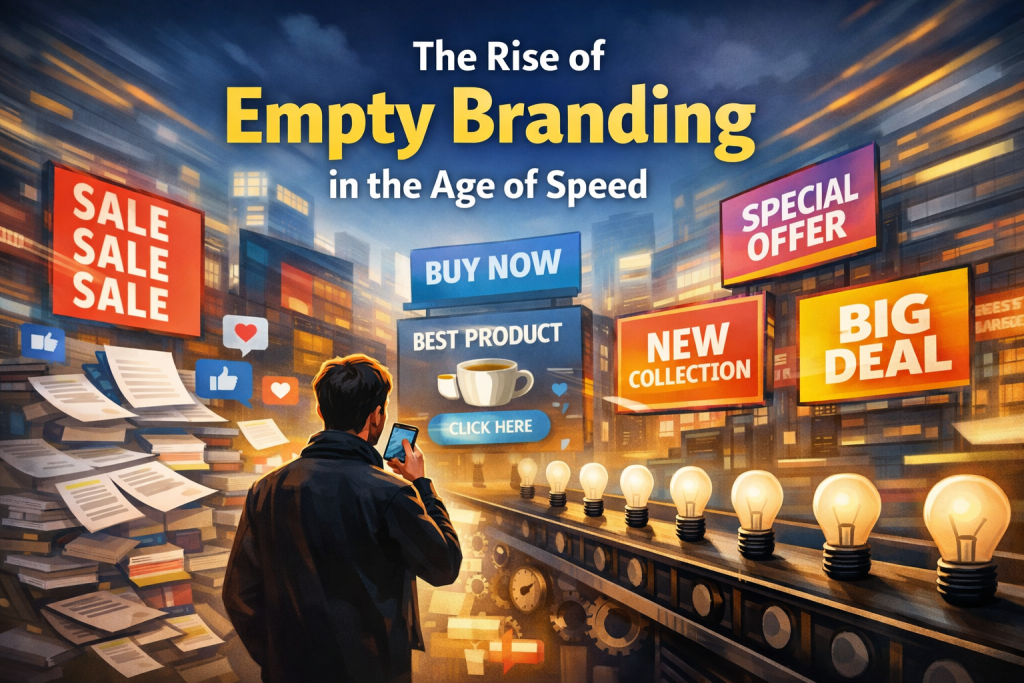
Modern branding operates in an environment defined by speed, volume, and constant visibility. Content is expected to appear everywhere, all the time, and that pressure reshapes how brands make decisions.
Why Volume Rewards Sameness
When teams are required to produce at high frequency, they naturally gravitate toward what already exists. Familiar formats reduce risk and speed up approval. Over time, this creates a feedback loop where the safest option becomes the default option.
As a result, brands begin to echo themselves. Campaigns differ in timing and placement, but not in substance. What looks like consistency is often just inertia.
When Branding Imitates Itself
Empty branding does not feel broken. It feels bland. Assets are clean, correctly formatted, and unmistakably branded, yet they leave no lasting impression. They do not challenge expectations or reflect the moment they exist in.
In this state, branding becomes decorative rather than communicative. It fills space without advancing the brand’s point of view or emotional connection with its audience.
Why On Brand Is Now the Bare Minimum
Consistency used to be a competitive advantage. Today, it is an expectation. Meeting that expectation no longer differentiates strong brands from forgettable ones.
How Quality Signals Changed
In earlier eras, consistent branding required significant effort and expertise. It signaled care, investment, and attention to detail. That signal helped brands stand out in crowded markets.
Today, the same level of execution is widely accessible. Tools and platforms allow almost any organization to produce content that looks polished and professional. What once indicated excellence now indicates competence.
The Impact of Automation and AI
Automation and AI have accelerated this shift. Visual styles, tone, and layout can be replicated instantly. Consistency at scale is no longer rare. It is assumed.
As a result, differentiation moves away from how a brand looks and toward how it behaves. Relevance, timing, and originality now carry more weight than technical perfection.
The Hidden Power of Intentional Mistakes
Mistakes attract attention because they disrupt patterns. In an environment optimized for uniformity, disruption feels human and intentional, even when it appears accidental.
Why Imperfection Feels Real
Audiences are highly attuned to signals of authenticity. A perceived mistake suggests that a human made a decision rather than a system following rules. That signal creates curiosity and emotional engagement.
Imperfection implies presence. It suggests that someone is actively responding to the world rather than repeating a formula.
Mistakes Vs Carelessness
Not all mistakes are valuable. Careless errors undermine trust and credibility. Intentional mistakes, by contrast, serve a purpose. They highlight an idea, provoke a reaction, or invite interpretation.
The distinction lies in intent. When disruption reinforces meaning, it strengthens the brand. When it distracts from meaning, it weakens it.
Predictability Is the Real Brand Risk
Perfect consistency produces familiarity. Familiarity, when overused, produces invisibility. Predictable branding blends into its surroundings instead of standing out.
Why Surprise Creates Recall
Surprise interrupts automatic consumption. It forces people to pause and reassess what they are seeing. That pause is where attention lives.
Surprise does not require shock or controversy. It can come from subtle shifts in tone, unexpected timing, or deliberate restraint where noise is expected.
How Rigid Rules Limit Response
Brands governed by inflexible rules struggle to respond to culture and conversation. Approval cycles slow reaction time. Fear of deviation discourages experimentation.
In fast moving environments, this rigidity creates distance between brands and the people they want to reach.
Branding as a Living Conversation Not a Fixed System
Branding no longer exists in a controlled broadcast environment. It unfolds in public, shaped by feedback, interpretation, and participation.
Why Feedback Reshapes Brand Meaning
Every piece of communication invites response. Comments, shares, criticism, and remixing all contribute to how a brand is understood.
Modern branding is iterative by nature. Meaning evolves through interaction rather than enforcement.
From Broadcast to Dialogue
Traditional branding focused on sending a clear message outward. Modern branding requires listening and adapting as much as speaking.
Brands that acknowledge this shift remain relevant because they stay connected to their audience rather than insulated from it.
Why the Future of Branding Sounds Like Jazz
The traditional model of branding was built for stability. It assumed that environments changed slowly, audiences were passive, and messages could be carefully controlled. That model rewarded precision and repetition, much like classical music rewards faithful performance of a fixed composition.
That world no longer exists.
Classical Branding and Fixed Execution
Classical branding treats deviation as failure. The goal is to reproduce the same experience everywhere, every time, regardless of context. This approach creates clarity, but it also assumes that the audience and environment remain static.
In practice, this leads to branding that feels disconnected from reality. When culture shifts or conversations change, fixed execution struggles to keep up. The brand remains correct, but no longer current.
Jazz as a Branding Model
Jazz operates on a different principle. Musicians share a structure, an understanding of rhythm, tone, and progression. Within that structure, they listen, react, and improvise. No two performances are identical, yet the identity remains unmistakable.
Modern branding works best the same way. Teams need shared understanding rather than rigid scripts. When brand foundations are strong, variation does not weaken identity. It reinforces it.
How Brands Can Stay Recognizable Without Staying Rigid

Flexibility often gets mistaken for inconsistency. In reality, rigidity is what weakens brands over time. The challenge is not choosing between consistency and creativity, but learning how to support both at once.
Shifting from Rules to Principles
Rules tell teams what not to do. Principles explain why something matters. When teams understand purpose, they make better decisions without needing constant approval.
Principle driven branding scales more effectively because it empowers judgment. It allows teams to adapt execution while staying aligned with intent.
Consistency of Character Over Appearance
Visual systems will evolve. Platforms will change. Formats will disappear and reappear. What remains is character.
Brands that stay recognizable focus on how they speak, respond, and behave. This consistency of character creates familiarity even when surface elements shift.
Where Brand Systems Support Creativity Instead of Replacing It
Systems are essential in modern branding, but their role must be clearly defined. When systems focus solely on control, they limit creative response. When they focus on clarity, they enable it.
Systems as Shared Truth
The most effective brand systems act as a single source of understanding. They explain not just what the brand looks like, but what it stands for and how it behaves.
This shared truth allows teams to work independently without fragmenting the brand. Creativity becomes coordinated rather than chaotic, and alignment comes from understanding rather than enforcement.
Supporting Evolution at Scale
As brands grow, the number of people creating content multiplies. Without the ability to evolve systems alongside that growth, brands either become fragmented or overly restrictive.
Modern brand systems must allow for change. They should be easy to update, simple to interpret, and flexible enough to support new formats, markets, and cultural moments. When systems evolve with the brand, they protect coherence without suffocating creativity.
Final Thoughts: Building Brands That Feel Alive
Branding has reached a point where being on brand is no longer a mark of distinction. It is simply the minimum expected. When every brand can look polished and consistent, technical perfection stops creating meaning. What matters now is intention.
The real risk for brands today is predictability. Perfect repetition may feel safe, but it rarely earns attention or emotional response. Brands that feel alive allow room for surprise, context, and human judgment. They understand that relevance comes from responding to the world, not repeating themselves flawlessly.
Mistakes, when used with purpose, can reintroduce humanity into branding. They signal presence, risk, and authenticity in a landscape shaped by automation and sameness. This does not mean abandoning discipline. It means knowing when structure should support creativity rather than restrict it.
Branding is not a finished product. It is a practice. Like jazz, it evolves through interpretation, collaboration, and thoughtful improvisation.