Franchise marketing depends on one fragile promise. No matter where a customer interacts with your brand, the experience should feel familiar, intentional, and trustworthy. The logo should look right. The offer should be accurate. The message should sound like it came from the same brand everywhere.
Yet behind the scenes, many franchise networks are quietly losing control of this promise.
Not because teams do not care. Not because guidelines do not exist. But because unofficial tools are filling the gaps left by rigid or slow corporate systems.
These shadow tools often appear harmless. A quick flyer made in a design tool. A menu update shared through a messaging app. A local promotion created in a document that never passed through review. Individually, they seem efficient. At scale, they quietly unravel brand consistency, compliance, and visibility.
This is not a technology problem alone. It is a system design problem. And in franchise models like retail and hospitality, the cost compounds fast.
Why Franchise Content Creation Is More Fragile Than It Looks
Franchise content creation operates under constant pressure. Brands must move quickly while staying consistent. They must empower local teams without sacrificing control. They must scale campaigns across locations while adapting to regional needs.
This balance is far harder than it appears.
Every Location Is a Brand Publisher
In a franchise model, every location actively publishes the brand. Store signage, in store posters, menus, local ads, social posts, and promotional materials all act as live brand touchpoints.
Unlike centralized marketing teams, franchise locations produce content continuously. A seasonal offer changes. A local event needs promotion. A menu item is updated. Each action requires content creation, often under tight timelines.
When official systems do not support this reality, local teams do what they need to do to keep moving.
Scale Turns Small Inconsistencies Into Brand Risk
One off brand flyer is easy to ignore. One outdated disclaimer feels manageable. But when those inconsistencies repeat across dozens or hundreds of locations, they stop being minor issues.
They become brand dilution.
Customers notice when visuals change from store to store. They question credibility when offers differ. They lose trust when messaging feels fragmented. At scale, inconsistency does not just confuse customers. It weakens the brand itself.
What Shadow Tools Really Are in Franchise Marketing
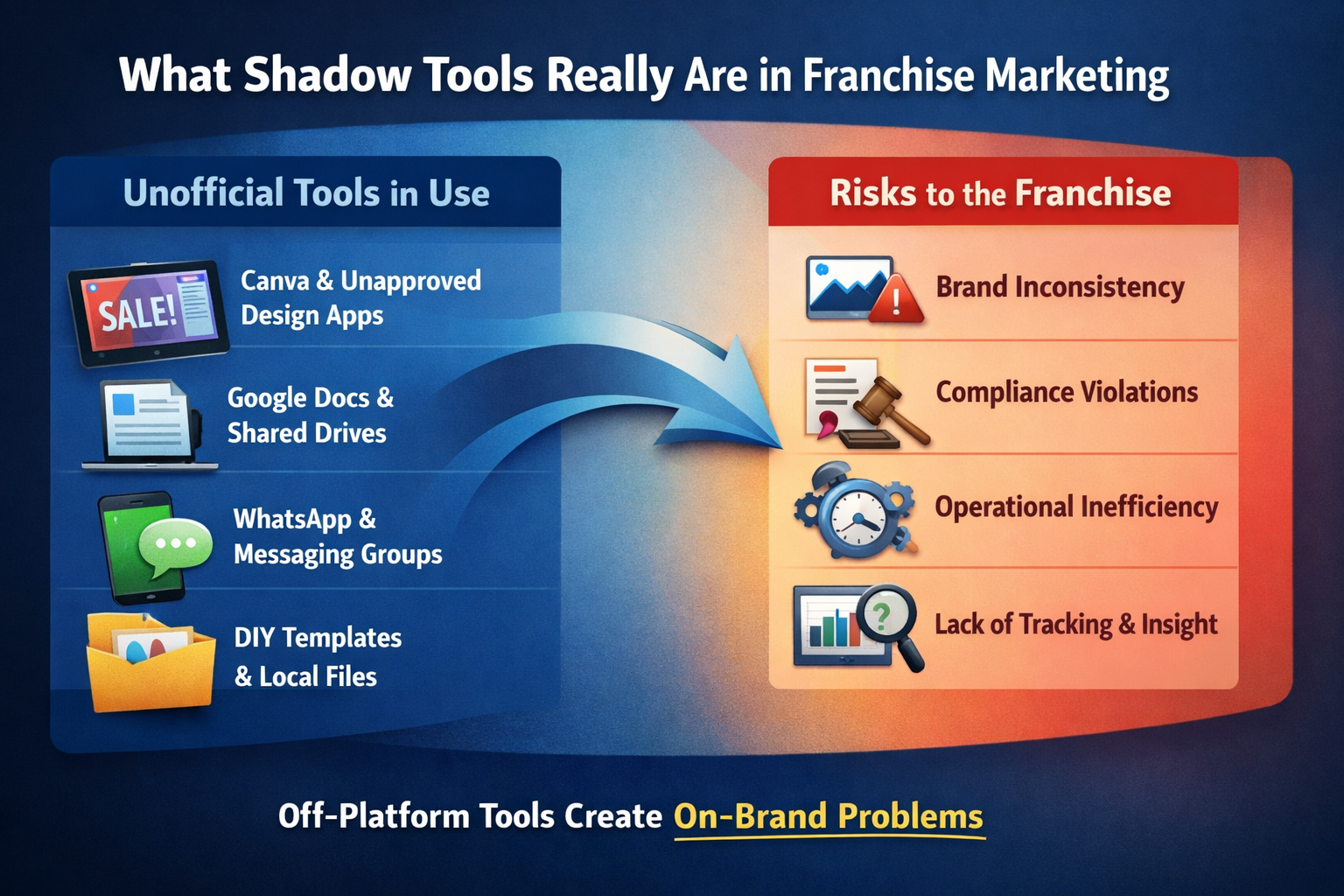
Shadow tools are not inherently malicious. They are simply tools and workflows that exist outside approved systems. They often emerge quietly and become normalized over time.
In franchise marketing, they fill gaps between what teams need to do and what systems allow them to do.
Common Shadow Tools Used by Franchise Teams
Most franchise leaders recognize these patterns instantly.
Local teams create promotional materials in consumer design tools using old logos or outdated colors. Menus are edited in shared documents without version control. Campaign details are discussed in messaging apps where files are easily lost or altered. Assets are pulled from personal drives instead of brand libraries.
None of these actions start with bad intent. They start with urgency.
Shadow Tools Are a Symptom, Not Rebellion
It is tempting to view shadow tools as a discipline problem. But in reality, they signal friction.
When official systems are slow, restrictive, or unclear, teams seek alternatives. Shadow tools appear because they feel faster, easier, or more flexible. They succeed not because teams want to break rules, but because they allow work to continue.
Understanding this distinction is critical. You cannot eliminate shadow tools by tightening rules. You eliminate them by fixing the systems that make them attractive.
Why Franchise Teams Turn to Shadow Tools
Shadow tools do not appear randomly. They follow predictable patterns. When you look closely, the same triggers surface again and again across franchise networks.
When Corporate Systems Feel Slow or Rigid
Franchise teams operate in real time. Promotions cannot wait weeks for approval. Menu updates cannot stall during review cycles. Local events require fast turnaround.
When corporate systems introduce delays, teams feel stuck. The pressure to deliver outweighs the risk of going off platform. Shadow tools become the path of least resistance.
When Local Teams Lack Safe Autonomy
Most franchise teams want to stay on brand. What they need is room to adapt content responsibly. When systems lock everything down, teams either stop creating or create outside the system entirely.
Controlled flexibility matters. Without it, shadow tools fill the gap between rigid governance and local reality.
When Training and Enablement Are Missing
Even the best tools fail without proper enablement. If franchisees do not understand how to access approved assets, customize templates, or move content through approvals, they will default to what they already know.
Shadow tools often thrive where onboarding is light and documentation is unclear. Teams do not go rogue because they want to. They go rogue because no one showed them a better way.
The Hidden Damage Shadow Tools Cause at Scale
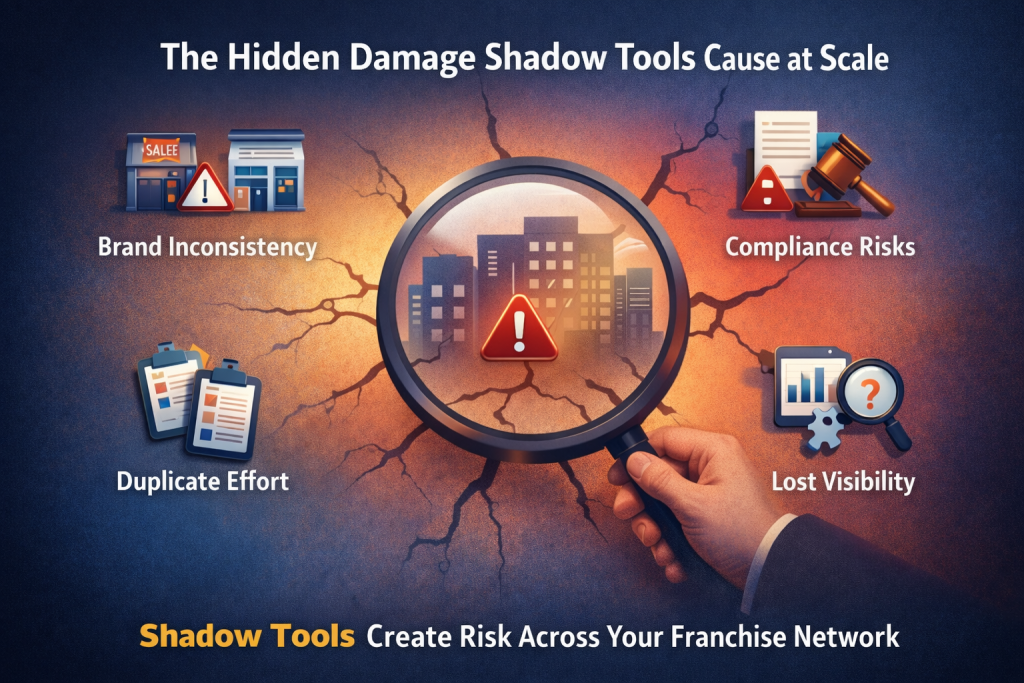
The true impact of shadow tools rarely appears immediately. Damage builds quietly over time. By the time leaders notice, the effects are already widespread.
Brand Inconsistency That Customers Notice
Inconsistent visuals and messaging erode brand recognition. Customers may not articulate the problem, but they feel it. Trust weakens when the brand feels different from one location to another.
Consistency is not about control for its own sake. It is about building familiarity. Shadow tools chip away at that foundation.
Compliance and Legal Exposure
Outdated promotions, incorrect disclaimers, and unauthorized claims introduce real risk. In regulated industries or highly competitive markets, even small errors can lead to penalties, disputes, or reputational damage.
When content bypasses governance, compliance becomes guesswork.
Operational Waste and Duplicate Effort
Shadow tools create invisible inefficiencies. Teams recreate assets that already exist. Campaigns are delayed due to rework. Corporate teams spend time correcting content instead of scaling strategy.
The cost is not just financial. It is time, momentum, and morale.
Loss of Visibility and Performance Insight
Perhaps the most damaging effect is what leaders cannot see. Content created outside approved systems is not tracked. Usage is invisible. Performance data disappears.
Without visibility, optimization becomes impossible. Decisions are made without insight. The organization loses the ability to learn from its own marketing.
What Franchise Marketing Leaders Are Experiencing Today
Across franchise networks, the same frustrations surface again and again. They appear in different industries and regions, but the pattern is remarkably consistent.
Central teams feel overwhelmed. Local teams feel constrained. And content sits in the middle, stuck between speed and control.
Central Teams Stuck Policing Instead of Scaling
Corporate marketing teams are not short on strategy. They are short on time.
Instead of focusing on campaign performance, brand evolution, or market expansion, many teams spend their days correcting local content. They chase down outdated logos. They flag off brand visuals. They request revisions that could have been avoided entirely.
This reactive workload grows with every new location. The more the brand scales, the harder it becomes to enforce consistency manually. Policing replaces progress.
Franchisees Frustrated by Unclear or Inflexible Rules
On the other side, franchisees often feel blocked rather than supported.
They want to promote local offers. They want to move quickly. They want to follow brand guidelines but not at the expense of missed opportunities.
When rules feel unclear or systems feel rigid, frustration builds. Shadow tools do not feel like rebellion. They feel like survival.
This tension is not about trust. It is about alignment. And without the right systems, alignment breaks down.
How to Replace Shadow Tools Without Breaking Trust
Eliminating shadow tools is not about cracking down. It is about redesigning the experience of creating content.
Successful franchise marketers focus on removing friction, not adding restrictions.
Audit the Shadow Stack Without Blame
The first step is visibility. Leaders must understand where shadow tools exist and why they are being used.
This means talking to franchise teams. Observing workflows. Identifying patterns. Are approvals too slow. Are templates missing. Is mobile access limited.
The goal is not to punish behavior. It is to uncover unmet needs.
Build Flexibility Into Brand Safe Templates
The most effective way to replace shadow tools is to offer something better.
Smart templates lock brand critical elements like logos, fonts, colors, and legal language. At the same time, they allow local teams to personalize content where it makes sense.
Dates, locations, offers, and imagery can be customized without risking brand integrity. When flexibility lives inside governance, shadow tools lose their appeal.
Remove Approval Bottlenecks Intelligently
Not all content carries the same level of risk. Treating every asset as high risk slows everything down.
High performing franchise teams define approval tiers. Low risk content moves quickly or is pre approved. Higher risk content flows through structured workflows with clear ownership.
Automation plays a critical role here. When approvals are predictable and fast, teams stay on platform.
Enable Teams Through Training and Support
Systems only work when people know how to use them.
Ongoing enablement matters. Clear documentation. Short training sessions. Office hours. Simple guides. These investments reduce confusion and build confidence.
When teams feel supported, they stop looking for shortcuts.
Measuring Success in a Governed Franchise Content Model
Replacing shadow tools is not just about compliance. It is about performance.
Governed systems unlock insight that was previously invisible.
Tracking Content Usage Across Locations
When content creation happens inside approved systems, leaders gain visibility into what is being used and where.
Which templates perform best. Which campaigns scale smoothly. Which locations engage most actively. This data creates accountability without micromanagement.
Showing the ROI of Staying On Brand
Consistency drives results. Faster launches. Fewer revisions. Better brand recognition.
When teams see how staying on brand improves outcomes, governance stops feeling like a burden. It becomes a competitive advantage.
Supporting Every Franchise With On Brand Content at Scale
Modern franchise networks need more than simple asset storage. They need content systems designed for decentralized execution.
That means governed access instead of open folders. Smart templates instead of static files. Permission based workflows instead of email approvals. Visibility instead of guesswork.
When brand assets, templates, permissions, and workflows live in one place, every location gains confidence. Local teams move faster because they know what they can use. Central teams regain focus because they are no longer correcting preventable mistakes. Leadership gains visibility because content creation finally happens inside the system.
This is how leading retail and hospitality brands scale content creation without losing control.
Not by fighting shadow tools, but by making them unnecessary.
How Brandy Helps Franchise Teams Replace Shadow Tools With Confidence

Brandy is built for brands that operate at scale but need to move fast locally.
Instead of forcing franchise teams into rigid systems, Brandy creates a controlled environment where speed and governance coexist. Brand assets, templates, permissions, and workflows live in one connected space that reflects how franchises actually work.
Local teams access only what is approved for them. They can create content using brand safe templates that lock critical elements while allowing meaningful localization. Corporate teams maintain oversight without micromanaging execution.
What changes is not just where content lives, but how it moves.
Approvals become structured instead of reactive. Version control becomes automatic instead of manual. Usage becomes visible instead of fragmented. Every asset created stays connected to the brand system rather than drifting into personal folders or unofficial tools.
Most importantly, Brandy removes the need for shadow tools by removing the friction that causes them. When the official system is faster, clearer, and easier to use, teams naturally stay inside it.
That is how governance scales without resistance.
Final Thoughts: From Chaos to Consistency in Franchise Content Creation
Shadow tools thrive when official systems fall short. They disappear when systems meet real needs.
Franchise marketing does not fail because teams want freedom. It fails when freedom exists without structure or when structure exists without flexibility. When local teams are forced to choose between speed and compliance, speed usually wins.
The solution is not stricter enforcement or more rules. It is smarter system design.
When content creation is fast, intuitive, and brand safe, teams do not feel the need to work around the system. They stay within it because it helps them do their jobs better. Trust improves because expectations are clear. Campaigns scale because workflows are predictable. The brand strengthens because every location speaks with the same voice.
Consistency at scale is not about control. It is about alignment.
Frequently Asked Questions
Shadow tools are unofficial apps, templates, or communication channels that franchise teams use outside approved systems. They usually emerge when official tools feel slow, restrictive, or difficult to use.
Retail and hospitality rely on consistency across many locations. Shadow tools introduce off brand content, outdated offers, and compliance risks that scale quickly across the network.
Brands can identify shadow tools through internal audits, franchise surveys, and content reviews. Repeated inconsistencies or unapproved assets often signal off platform workflows.
The key is offering better systems. Brand safe templates, faster approvals, and clear enablement make it easier to stay compliant than to work around the system.
Yes. With governed templates, permission based workflows, and centralized visibility, franchises can scale content quickly while protecting brand integrity.