Marketing in 2025 is no longer about who can create the most content. It is about who can move the fastest without losing control. Creative teams are producing more assets than ever before, across more platforms, for more audiences, and under tighter timelines. At the same time, brand expectations are higher. Every asset must feel consistent, intentional, and trustworthy.
AI tools are everywhere, but not all of them deliver real value. New design tools have turned almost everyone into a content creator, yet brand teams are struggling to maintain consistency. Campaigns are running faster, but workflows often remain fragmented and reactive.
This creates a new kind of pressure for marketers and creative leaders. Speed matters. Quality matters. Control matters. And cost alone is no longer the deciding factor.
This guide breaks down the marketing and creative production trends that will actually shape 2025. Not hype. Not predictions for the distant future. These are shifts already happening inside high performing teams. You will learn where AI delivers the most value today, how to empower non designers without weakening your brand, and why smarter systems matter more than higher output.
What You Will Learn From This Guide
This blog focuses on the real operational shifts shaping modern marketing teams. You will learn why post production AI is delivering more measurable impact than generative AI, especially when it comes to scaling content efficiently.
You will also understand why brand consistency has become harder and more important as more people across teams create content. Creating more assets is no longer the goal. Managing, tracking, and optimizing what you create is where competitive advantage lives.
We will explore how modular campaigns allow faster testing and personalization, and why centralizing creative workflows is becoming essential for teams that want visibility and control. Most importantly, you will see why speed and quality are replacing cost as the primary drivers of production decisions in 2025.
Why Generative AI Alone Is No Longer Enough for Marketing Teams

Generative AI has quickly become part of everyday marketing workflows. It helps teams brainstorm ideas, draft copy, and explore creative directions faster than ever before. For early stage ideation, generative tools play a useful role in getting ideas off the ground.
However, when it comes to real production work, many teams are realizing that generative AI alone does not solve their biggest challenges. It often creates new ones.
Limitations of Generative AI in Real World Production
Generative AI still depends heavily on human input. Prompts need refinement. Outputs need review. Brand tone, visual consistency, and accuracy often require multiple revisions. This slows teams down rather than speeding them up.
Generated assets can also vary widely in quality. Without strict controls, teams risk publishing content that feels inconsistent or off brand. In regulated or brand sensitive industries, this risk is even higher.
Instead of reducing workload, generative AI can add layers of checking and approval, especially when outputs cannot be trusted without manual oversight.
Where Creative Teams Still Need Human Judgment
Creative decisions are not just about speed. They involve context, storytelling, positioning, and emotional resonance. These are areas where human judgment remains essential.
Brand strategy, campaign direction, and narrative coherence cannot be automated. AI can assist, but it cannot replace the thinking that shapes how a brand shows up in the world. This is why the most effective teams use generative AI selectively rather than relying on it for end to end production.
Post Production AI Is Where Real Efficiency Is Being Gained
While generative AI focuses on creating something new, post production AI focuses on scaling what already works. This shift is where many marketing teams are seeing immediate operational gains.
Post production AI automates repetitive and time consuming tasks that slow creative teams down. Instead of spending hours resizing assets, swapping images, or adapting formats, teams can focus on strategy and quality.
How Post Production AI Supports Creative Teams
Post production AI handles tasks like resizing assets for different platforms, adapting layouts for new formats, and generating variations from approved designs. These tasks are necessary but rarely creative.
By automating this work, teams reduce bottlenecks and production fatigue. One strong asset can be adapted across channels quickly without starting over. This improves turnaround times and keeps campaigns moving.
Why Post Production AI Scales Better Than Generative AI
The real value of post production AI lies in scale. Generative AI helps move from idea to first draft. Post production AI helps move from one approved asset to dozens of variations.
This approach protects brand consistency while increasing output. Instead of creating new content from scratch, teams multiply the impact of what already performs well. That is where efficiency and quality meet.
When Everyone Creates Content Brand Consistency Becomes the New Challenge
Design tools have become more accessible than ever. Marketers, sales teams, partners, and even external collaborators can now create content without design training. This shift helps teams move faster, but it also introduces risk.
When everyone can create, brand consistency becomes harder to maintain. Without clear boundaries, brands can quickly fragment across channels.
Freedom Within Clear Brand Boundaries
The solution is not to restrict creation. It is to guide it. Brands that succeed enable freedom within boundaries.
Flexible templates allow teams to move quickly while locking essential elements like logos, colors, and typography. This ensures that content feels on brand even when created by non designers.
Role Based Access to Creative Assets
Not every team needs the same level of creative freedom. Marketing teams may require flexibility to test and iterate. Sales teams often need ready to use assets with minimal customization.
By tailoring access and options based on roles, brands empower teams without sacrificing control. This balance will be critical as content creation continues to decentralize.
Why Creating More Content Is No Longer a Competitive Advantage
High content volume is now expected. Social platforms, ad networks, and customer touchpoints all demand constant output. Simply producing more assets no longer sets brands apart.
The challenge is managing that volume effectively.
Where Traditional Content Workflows Break Down
Many teams rely on disconnected tools for storage, review, publishing, and reporting. Assets move between platforms through downloads and uploads. Context gets lost. Performance data is hard to trace.
Without a clear view of where assets are used or how they perform, teams struggle to make informed decisions. This creates inefficiency and risk at scale.
The Shift From Content Creation to Content Oversight
Leading teams are shifting focus from output to oversight. They want visibility into what exists, where it is used, and what works.
Control does not slow creativity. It enables it. When teams understand asset performance and usage, they create smarter content with clearer intent.
Centralized Content Systems Are Becoming Essential
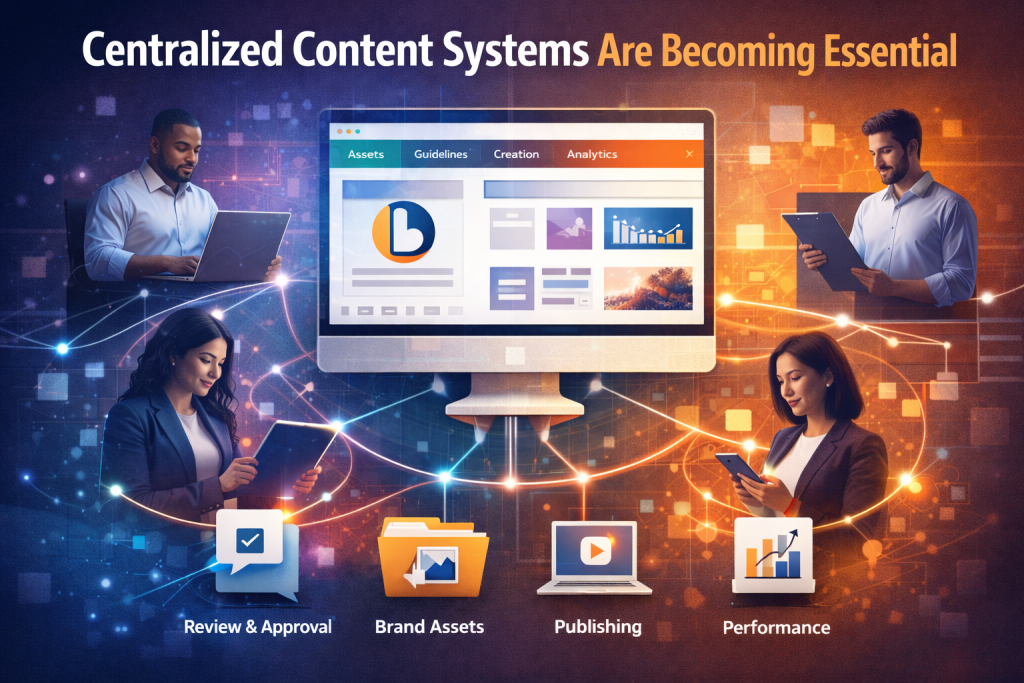
As content volume grows, so does complexity. Managing assets across folders, tools, and teams becomes unsustainable.
Centralized systems bring structure to creative operations. Instead of moving files manually, teams work from a shared source of truth.
End to End Visibility Across the Content Lifecycle
Centralized platforms allow teams to track assets from creation through distribution. This visibility reduces duplication, prevents misuse, and supports compliance.
Teams know what exists, who owns it, and where it is live.
Using Performance Insights to Guide Creative Decisions
When performance data connects directly to assets, creative decisions improve. Teams can see which visuals resonate, which formats convert, and where to invest next.
This closes the loop between creativity and results, turning content into a measurable growth driver.
Modular Campaigns Are Replacing One Size Fits All Marketing
Attention spans are shrinking, and audiences expect relevance from the first second. A single static campaign can no longer serve every channel, region, or audience segment effectively. This is why modular campaigns are becoming the preferred approach for modern marketing teams.
Instead of building one complete campaign and pushing it everywhere, teams are breaking campaigns into smaller reusable components. These components can be mixed, tested, and optimized without rebuilding everything from scratch.
How Modular Campaigns Actually Work
Modular campaigns are built from interchangeable parts such as headlines, visuals, video intros, body copy, and calls to action. Each element is designed to work independently while still fitting within a unified brand system.
This allows teams to test variations quickly. A new headline can be swapped without changing visuals. A different image can be tested without rewriting copy. Teams can tailor campaigns by market, platform, or audience while keeping the core message intact.
Why Modular Content Improves Speed and Results
Modularity removes friction from experimentation. Instead of launching one version and waiting for results, teams can test multiple variations in parallel.
This approach saves time and resources. It also improves performance because decisions are based on real data rather than assumptions. When teams know which elements work best, they can scale winning combinations faster and with more confidence.
Adapting Content for Every Platform Without Slowing Down
Each platform comes with its own formats, dimensions, and best practices. Vertical video, square posts, banners, stories, and long form placements all require different treatments. Manually adapting content for every channel creates bottlenecks and delays.
Automation is becoming essential to keep pace.
Automated Adaptation for Format and Channel Requirements
Creative automation tools allow teams to resize, reformat, and adapt assets automatically. Instead of rebuilding designs for every platform, teams generate variations from approved templates.
This speeds up campaign launches and reduces manual effort. It also ensures that assets remain visually consistent across channels, regardless of format.
How Automation Protects Brand Trust Across Channels
Consistency builds trust. When audiences see coherent messaging and visuals across platforms, brands feel reliable and intentional.
Automation ensures that brand standards are applied everywhere. Even at scale, content remains aligned. This consistency reinforces recognition and confidence, especially in crowded digital environments.
Why Speed and Control Are Replacing Cost Based Production Models
For years, offshoring creative production was seen as the most cost effective solution. In 2025, that logic is shifting. Speed, quality, and control now matter more than lowest cost.
Markets move faster. Campaigns change quickly. Delays reduce impact.
The Hidden Costs of Slow Production Cycles
Long production timelines create missed opportunities. Feedback loops stretch out. Market moments pass before assets are ready.
Even when offshoring reduces upfront costs, the lack of agility can hurt performance. In fast moving environments, slow execution becomes expensive.
Automation Driven Production as a Competitive Advantage
Automation driven production offers speed without sacrificing quality. Teams maintain visibility, oversight, and consistency while scaling output.
Although automation may require higher initial investment, it delivers stronger returns through faster launches, fewer errors, and better outcomes. For competitive teams, control and reliability outweigh cost savings.
How Marketing Teams Can Stay Competitive in 2025

Staying competitive in 2025 is less about chasing every new tool and more about building a marketing operation that can adapt without breaking. Creative demands are growing, timelines are shrinking, and audiences expect relevance across every channel. Teams that succeed are not the loudest or busiest. They are the most intentional.
The strongest marketing teams understand that creativity thrives within structure. They do not produce content for the sake of volume. Instead, they focus on delivering the right message, in the right format, at the right moment. This requires clarity around brand standards, faster decision making, and systems that support execution rather than slow it down.
AI plays an important role, but only when applied with purpose. High performing teams use AI to remove friction from production, not to replace strategic thinking. Automation supports scale. Human judgment drives direction. This balance allows teams to move quickly without sacrificing quality or brand trust.
Another defining factor is connection. When content creation, review, distribution, and performance insights live in separate places, teams lose momentum and visibility. Competitive teams close these gaps by connecting workflows and treating content as a living system rather than isolated assets.
Ultimately, success in 2025 comes down to speed with confidence. Teams that combine creative freedom with operational discipline are better equipped to respond to market changes, test ideas faster, and scale what works. Structure does not limit creativity. It enables it.
Key Takeaways for Creative and Marketing Leaders
- Post production AI delivers real operational gains by removing repetitive manual work from creative workflows.
- Brand consistency becomes more difficult and more valuable as content creation expands beyond design teams.
- Visibility and control across the content lifecycle matter more than producing higher volumes of assets.
- Modular campaign structures allow teams to test ideas quickly and adapt content without starting over.
- Automation driven production helps teams prioritize speed, quality, and reliability instead of focusing only on cost reduction.
How Brandy Supports Smarter Creative Operations

As marketing teams scale content across platforms, regions, and teams, managing brand integrity becomes increasingly complex. Brandy exists to bring clarity to that complexity.
Rather than acting as simple storage, Brandy helps teams organize brand assets with purpose. It provides a structured environment where logos, templates, visuals, and guidelines are easy to find, easy to use, and always up to date. This reduces guesswork and eliminates the risk of outdated or incorrect assets being used.
Brandy also supports smarter collaboration by defining how assets should be used and who should use them. Teams gain access to what they need without overexposure or unnecessary flexibility. This balance allows marketing, sales, and partner teams to move quickly while staying aligned with brand standards.
By centralizing brand materials and usage rules, Brandy helps organizations scale content creation without losing control. Creative operations become easier to govern, faster to execute, and more resilient as teams grow. The result is consistency at speed, supported by clarity instead of restrictions.
Final Thoughts
Marketing success in 2025 is shaped by intention, not intensity. Having more tools or producing more content does not guarantee results. What matters is how well teams execute with clarity and confidence.
The brands that stand out are those that invest in systems, workflows, and boundaries that support creative work rather than constrain it. When teams know where assets live, how they should be used, and what success looks like, they move faster with fewer mistakes.
Structure does not limit creativity. It protects it. Teams that build strong foundations today will be better positioned to adapt, scale, and stay relevant as expectations continue to rise.
FAQs
Post production AI removes repetitive tasks that slow creative teams down. It automates resizing, formatting, and asset variations so teams can focus on strategy and quality. This reduces production time and improves consistency across channels.
More people across organizations now create content. Without clear systems and templates, this leads to fragmented visuals and messaging. Brand consistency requires boundaries that support speed rather than restrict it.
Centralized platforms that connect assets, guidelines, and access rules help teams stay organized. When creation, distribution, and insight live together, teams gain visibility and control at scale.